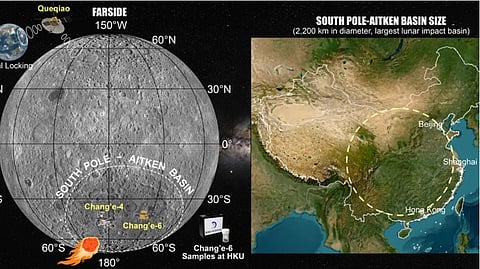

The far side of the Moon is home to a massive scar stretching roughly 2,200 km across and plunging more than 10 km deep. Known as the South Pole–Aitken basin, it is the Moon’s largest, oldest and deepest impact structure, formed when a massive object slammed into the lunar surface billions of years ago. Geologists from the University of Hong Kong (HKU) have now traced its geological evolution and subsequent impact history, estimating that it formed around 4.34 billion years ago.
The study, published in Science Advances, draws on lunar samples returned by China’s Chang’e-6 mission, along with surface measurements from Chang’e-4 and satellite observations. The research was led by Professor Guochun Zhao, Mok Sau-King Professor, with Dr Yuqi Qian as first author, from HKU’s Department of Earth and Planetary Sciences. The findings shed light on how the giant impact and later collisions reshaped the lunar basin.
By examining the samples, the researchers identified two types of magnesium-rich rocks with distinct geological origins. Moderately magnesium-rich norites formed when the initial impact melted vast quantities of lunar rock. The molten material subsequently cooled and differentiated, producing rocks that were later exposed at crater central peaks. Some were excavated by the Finsen impact and deposited at the Chang’e-4 landing site.
The second group, comprising highly magnesium-rich rocks, originated from a separate magmatic process triggered by the same giant impact. These rocks were later thrown up by the Chaffee S impact and carried to the Chang’e-6 landing site.
Combining sample analysis, remote sensing and numerical simulations, the team dated subsequent major impacts, placing the Apollo basin’s formation at around 4.2 billion years ago and the Orientale basin at approximately 3.87 billion years ago.
“The South Pole–Aitken basin is so deep that it excavates materials from the Moon’s deeper layers, giving us a window into processes we wouldn't otherwise be able to study,” Dr Qian said.
