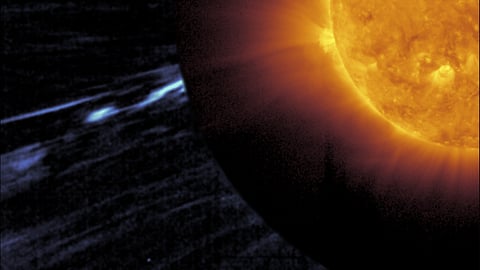

Scientists using the European Space Agency’s Solar Orbiter have traced mysterious magnetic switchbacks in the solar wind directly back to the Sun, providing new insight into how the star releases particles into space.
Switchbacks are sudden, S-shaped bends in the solar wind’s magnetic field. Although Solar Orbiter captured their full structure in 2022, their exact origin remained uncertain. A recent passage through a particularly large switchback has now provided crucial evidence.
The spacecraft’s Solar Wind Analyser (SWA) detected a distinctive combination of particles inside the structure. Researchers found that these particles could only have formed within hot magnetic loops at the Sun’s surface, pointing to a process called interchange reconnection.
During this process, regions with different magnetic properties interact. Open magnetic field lines extending into space meet closed lines that loop back to the Sun. The lines can reconnect, allowing plasma that was previously trapped in a loop to escape to space.
Researchers also found evidence of waves and turbulence, but believe these processes become important after a switchback moves away from the Sun.
Data from NASA’s Solar Dynamics Observatory helped identify the switchback’s solar source. The findings could improve understanding of how the Sun heats its atmosphere and accelerates the solar wind, while helping scientists better assess the severity of space-weather events that can affect satellites and other infrastructure.
“As humans on Earth – and in space – our lives are entangled with what’s happening on our star. The solar wind ties the Earth to the Sun, and our understanding of its dynamics has key implications for how we keep our planet safe from extreme space weather events,” said Daniel Müller, ESA Project Scientist for Solar Orbiter. “The more we know, the better we can prepare for solar storms to protect our space-based infrastructure and technology.”
