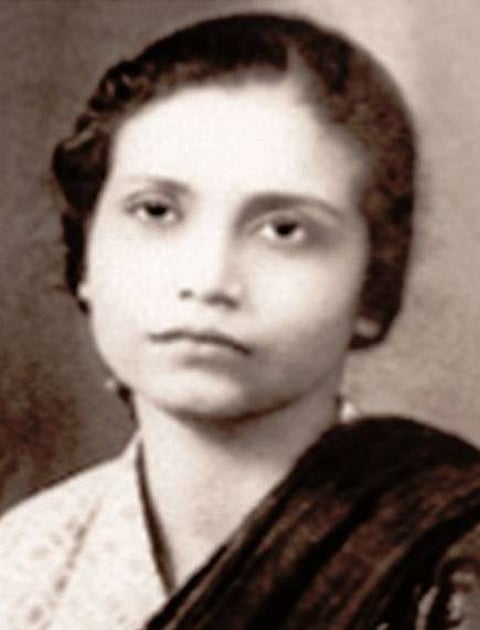

“Women are terrified of Physics—that is the trouble. It is a tragedy that we have so few women physicists today.” — Bibha Chowdhuri to the Manchester Herald in 1948.
The remark reflected much of Bibha’s own experience. At a time when women in India were rarely encouraged to pursue higher education, she entered one of the most demanding fields of science and quietly carved out a place for herself. Long before women scientists in India became familiar figures in laboratories, universities, and space missions, Chowdhuri was conducting pioneering research in particle physics and cosmic rays. Her work earned international recognition, yet for much of her life she remained largely unknown outside specialist scientific circles. Today, she is remembered as one of the earliest Indian women to make a significant contribution to particle physics.
A childhood shaped by science and reform
Bibha Chowdhuri was born in Kolkata in 1913 into an educated and socially progressive Bengali family. Her father, Banku Behari Chowdhuri, was a doctor, while her mother, Urmila Devi, came from a family associated with the Brahmo Samaj, a reformist movement that strongly supported education, including education for women. Growing up in such an environment gave Bibha and her siblings opportunities that were unusual for girls in colonial India.
Her interest in science began early. When she was about nine years old, her father told her about the pioneering experiments of Indian scientist Jagadish Chandra Bose. The story left a lasting impression. Bibha later recalled that she had wanted to become a scientist from a very young age. The possibility that an Indian could conduct original scientific research appears to have made a particularly strong impact on her.
She attended Bethune School before studying physics at Scottish Church College, where she earned her B.Sc. She went on to complete M.Sc. in physics at the University of Calcutta in 1936, reportedly the only woman in her batch. For a woman pursuing experimental physics in the 1930s, this was no small achievement.
Chasing particles from the Himalayas to Manchester
After completing her master's degree, Bibha sought research work under physicist Debendra Mohan Bose. Her entry into experimental research was not straightforward. Bose initially hesitated to accept her, reportedly believing that there was no suitable laboratory work for a woman. However, Bibha persisted, and eventually became part of his research group.
Her work took her into the emerging field of cosmic-ray physics. Before modern particle accelerators became available, cosmic rays provided scientists with a natural source of extremely high-energy particles. Researchers could study these particles by capturing their paths on photographic nuclear-emulsion plates.
Bose and Bibha took their experiments to high-altitude locations in the Himalayas, including Darjeeling and Sandakphu. Their photographic plates were exposed for long periods and later examined under microscopes. The work demanded extraordinary patience and precision: scientists had to interpret the minute tracks left behind by subatomic particles.
In the late 1930s and early 1940s, Bose and Bibha published important papers in Nature on mesotron showers and techniques for estimating the mass of the mesotron, a particle now associated with the muon. Their research contributed to the growing understanding of mesons. But the work was soon disrupted by the Second World War, when obtaining sufficiently sensitive photographic plates became increasingly difficult.
In 1945, Bibha travelled to the University of Manchester to work in the cosmic-ray laboratory of physicist Patrick M S Blackett, who went to receive the Nobel Prize in Physics in 1948.
There, she pursued doctoral research on extensive air showers produced when cosmic rays interact with Earth's atmosphere. The experience placed her within one of the world's leading centres for cosmic-ray research and helped establish her credentials on the international scientific stage.
Making a place in science
Despite her growing scientific reputation, Bibha Chowdhuri's professional journey was far from easy. She was building a career during a period marked by war, limited scientific resources, and very few opportunities for women in research. She chose a life centred largely on education and scientific work and never married. In an era when women were often expected to prioritise marriage and family, her decision to pursue an independent scientific life was itself unusual.
In 1949, after returning to India, Chowdhuri joined the newly established Tata Institute of Fundamental Research (TIFR). She was selected by Homi J Bhabha and became the institute's first woman faculty member. Her appointment was significant not only for her own career but also for the place of women in India's emerging scientific institutions.
Despite holding a senior position at TIFR, Bibha left the institute in 1953 and moved to Paris, where she joined the laboratory of cosmic-ray physicist L Leprince-Ringuet at the Centre National de la Recherche Scientifique. Working there, she identified several new K mesons in cloud chambers on the Alps. She published her findings in Il Nuovo Cimento in 1957. Bibha also collaborated with American physicist Wayne Hazen, who invited her to teach at the University of Michigan.
Bibha later returned to India and, in 1957, joined the Physical Research Laboratory (PRL) in Ahmedabad, where she worked under Vikram Sarabhai. Around this time, after reconnecting with a former colleague, she began investigating high-energy muon interactions using the TIFR large shower array at Kolar Gold Fields (KGF) in Karnataka. With the help of a muon detector and plastic scintillators, she recorded and classified numerous events and was able to measure the probability of their occurrence. The experiment spanned several years and was completed in 1976, following which Bibha retired from the PRL.
Achievements without awards
One of the most striking aspects of Bibha's life is the contrast between the importance of her research and the recognition she received during her lifetime.
Her early work with DM Bose formed part of the foundation for later research on mesons. Cecil F Powell subsequently made major advances in the field using similar photographic-emulsion techniques and received the Nobel Prize in Physics in 1950. Powell acknowledged the pioneering contribution of Bose and Bibha.
Bibha’s work had also attracted the attention of some of the leading physicists of her time. In 1950, Bibha was nominated for the Nobel Prize in Physics by Erwin Schrödinger, one of the most celebrated physicists of the twentieth century. More strikingly, she received no major national scientific award during her lifetime, nor was she not elected as fellow of India's major scientific academies.
Her commitment to science did not depend on awards. Her final research paper was published in 1990, just one year before her death. Bibha Chowdhuri died in Kolkata on 2 June 1991, at the age of 77. By then, despite a long and distinguished scientific career, she remained largely unknown outside specialist scientific circles.
The recognition she never lived to see
It was only after her death that broader recognition of Bibha Chowdhuri's contribution began to emerge. In 2019, the International Astronomical Union named the star HD 86081 “Bibha.” The name means “beam of light,” making it a particularly fitting tribute to a scientist whose achievements had remained largely out of the public spotlight.
A year later, in 2020, the Government of India announced a chair professorship in her name. Bibha’s personal life was closely intertwined with her commitment to education and research. She never married and dedicated much of her life to teaching and scientific research.
