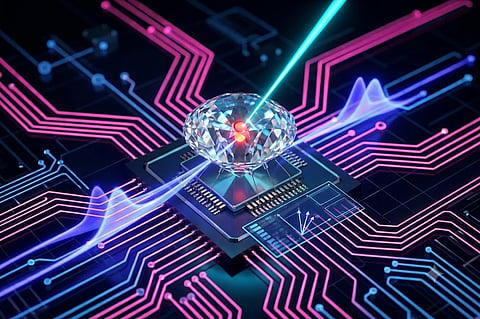

Diamonds are supposed to be flawless. But when it comes to quantum computing, a little imperfection can actually be a good thing. As Galileo once said, “the universe is a grand book open before us”. And sometimes, there is more to a beautiful crystal than meets the eye — a tiny defect can be turned into a tool for processing quantum information.
Quantum computing uses qubits, unlike conventional computers, which use bits that are either on or off. Qubits can exist in superpositions, allowing quantum systems to process information in ways classical computers cannot.
Several physical systems are being studied for building qubits, including superconducting circuits, trapped ions, semiconductor devices and defects in diamond. One particularly interesting approach uses nitrogen-vacancy (NV) centres.
Diamond is made entirely of carbon atoms, each bonded to four neighbours in a tetrahedral structure. An NV centre is a tiny defect created when one carbon atom is replaced by nitrogen and an adjacent position is left empty. This vacancy, together with the nitrogen atom, forms the nitrogen-vacancy centre. The negatively charged NV-minus form is particularly useful for quantum technologies.
Its most important feature is its electron spin, a fundamental quantum property that can store information. Although an NV centre has several possible spin states, two can be selected to represent the two states of a qubit. Thus, the spin of a single defect in diamond can act as a quantum bit.
The spin can be controlled using lasers and microwaves. A laser prepares the NV centre in a well-defined state, while microwave pulses manipulate its spin and create quantum superpositions, enabling quantum logic operations.
The state can also be detected optically. When laser light is directed at the centre, it emits fluorescence whose intensity depends on its spin state. Detecting this light therefore provides a way to read out the qubit.
This optical initialisation and readout, along with diamond’s relatively stable environment, makes NV centres attractive for quantum technologies. Their spins can retain quantum information for comparatively long periods, a property known as quantum coherence.
NV centres can also operate at or near room temperature, unlike superconducting Josephson junctions, which require extremely low temperatures. This makes diamond-based quantum technology attractive for ambient applications and reduces the need for expensive cooling systems.
The electron spin can interact with nearby carbon and nitrogen nuclear spins, which could serve as additional qubits or quantum memories. NV centres can also interact with photons, offering possibilities for connecting separate centres over larger distances and developing quantum networks and distributed quantum computers.
Everything comes with a price. Challenges include creating diamonds with precisely controlled defects, reliably manipulating multiple qubits, improving optical readout and protecting quantum information from decoherence. Scaling from a single NV centre to a fault-tolerant quantum computer remains a major challenge.
In toto, NV-centre diamond represents an aesthetic combination of quantum physics, optics, spin physics and chemistry. A tiny defect can function as a quantum bit, while lasers and microwaves provide ways to prepare, control and measure it.
Its ability to operate under practical conditions and connect spins with photons makes NV centres a promising platform for future quantum computers and communication systems.
So let us wait!!
(This piece is written by Dr MS Ramkarthik, a theoretical physicist at VNIT Nagpur whose work has focused on quantum computing for over a decade)
