
Fact: nobody makes an RPG like Bioware. The Canadian developers, founded by medical doctors Ray Muzyka and Greg Zeschuk have been in the business of developing great games since 1995, and even greater RPGs since 1998, starting with the epic Baldur’s Gate. Baldur’s Gate’s sequel, Shadows of Amn is widely regarded as the greatest RPG ever made, and the game is one of the highest rated PC games of all time on aggregating site, Metacritic. It was clear to the world after the release of BG-2 what Bioware were truly capable of — creating a game that was tactical, deep and complex, with a narrative style that gave the player an unparalleled sense of immersion.
If you have played a Bioware game in the past, you will be familiar with the “just-one-more-quest” phenomenon, which almost definitely will double the length of a play session.
After having experimented with several RPG universes ranging from the fantasy settings of Baldur’s Gate and Neverwinter Nights, space and science fiction with Mass Effect and Knights of the Old Republic, and the martial arts/kung-fu world of Jade
Empire, Bioware have returned with Dragon Age: Origins. It has often been described by the creators and fans of Bioware as the spiritual successor to Baldur’s Gate even though the universe is completely original, and not based on Dungeons & Dragons.
Let’s get one thing out of the way. The PC version of Dragon Age: Origins is superior in every conceivable way to the console versions. It’s good to see some developers making an effort to give something back to the platform that made them rich and famous in the first place (I’m talking Infinity Ward).
With sharper graphics, better interface (offering quicker access to spells, abilities and items), a zoomed-out camera angle (the most useful of the lot) and as IW would put it, “mouse and keyboard control”, the PC version is the definitive version of the game.
The X360 and PS3 versions aren’t bad, mind you (you would have to search hard to find a better console-based RPG), but if you’ve got a PC that’s capable of playing Dragon Age, then just get the PC version; it’s really as simple as that.
Dragon Age: Origins sports a unique, nifty new feature: the ‘origins’ story. A similar feature made an appearance in Mass Effect, where customising your character’s back-story prompted certain NPCs to react in a certain way. This was purely a cosmetic feature that had little or no impact on the gameplay experience. On the other hand, in Dragon Age: Origins, you get to play out a unique origins story (there are six in total), which will occupy you for the first two-or-so hours in-game. Each of the origins stories are completely unique from the other, so you’ll definitely want to play through a few of them before you’re done with the game. The game’s class system might initially appear to lack depth (there are only three classes in total: Warrior, Mage and Rogue), but the sheer amount of skills, abilities and specialisations will overwhelm you once you’ve got a party of four. Of course, any RPG-nut will only be more than willing to drown him/herself in said micro-management of bejesus-esque proportions. Dragon Age scores full points in the ‘RPG fundamentals’ category.
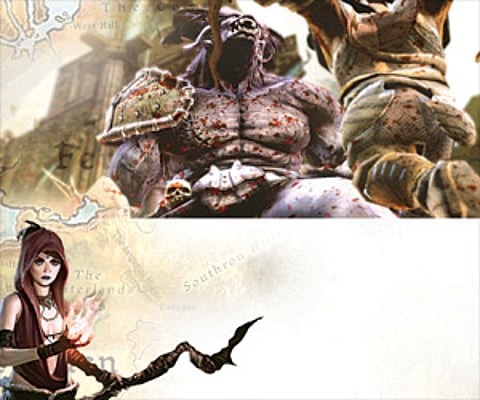
Violence is an integral part of RPGs. You’ll have to slay monsters, undead, mercenaries and the occasional innocent civilian for XP, loot or quest-completion. Dragon Age: Origins takes said killing to a whole new level. Your characters will bathe in the blood of their slain foes — literally. There’s an unbelievable amount of blood in Dragon Age. In fact, once your party is done with the killing, they don’t bother to wash the junk off. So you’ll see them drenched in blood-spatter, walking around small villages, interacting with storekeepers, chantry-members and kids! Huzzah! Needless to say, this is all a bit unrealistic, but it will evoke a giggle or two occasionally. Fortunately, the storytelling is relatively less-bizarre when compared to the bloodbaths. The plot in an overall sense is pretty linear, but there are multiple ways to play through it. The game lets you choose the order in which you wish to proceed — a formula which has become a standard fixture of Bioware’s RPGs. There’s a lot of melodramatic dialogue that all sounds inherently epic, but isn’t so over-the-top that it’s funny. And this is thanks to the voice acting which is top-notch (even if some of the facial animations are a bit dodgy), and every single line in the game has been voice-acted.
The combat system is deep and complex, with a lot of the math (dice-rolls and whatnot) going on in the background. The game encourages you to find the right mix of characters for your party as you will need to rely on abilities specific to each class to essentially ‘out-math’ your enemies. The combat in the retail release was abnormally difficult, but fortunately, Bioware fixed this within a week of the game’s launch with a patch. There are still a few lingering issues with the game’s combat system, including random target-switching by the enemy AI that prompts your character to give chase, and the occasional poor friendly AI that fails to execute ‘stacked’ commands. There are also a lot of situations when enemies will overwhelm you with sheer numbers, making fighting them in cramped spaces very difficult — the level-design is to blame for this. These problems can be quite annoying at times, and are more than capable of occasionally ruining your mood.
Verdict
Dragon Age: Origins is sure to please fans of RPGs. A well crafted universe, deep-as-hell RPG mechanics and tens of thousands of voice-acted dialogue driving an epic story are just some of the things this game has to offer. There are quite a few annoyances, however, particularly in terms of AI, difficulty and balancing, but none of them eat into the overall gameplay experience.
— videep@gmail.com