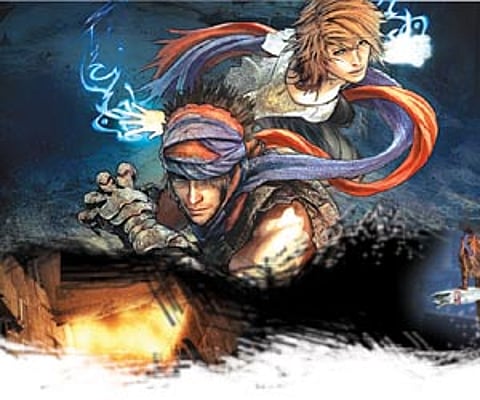

There’s something very strange and uniquely appealing about the new Prince of Persia title. No, I’m not talking about the game’s incredible aesthetic appeal, visual style, solid (non-linear) platforming mechanics or even the preposterously hot Elika (the Prince’s new companion in the game). The strangeness and creepiness has more to do with the double-deja vu factor. You see, the Prince of Persia series had already been ‘reinvented’ once with a trilogy of games in the form of Sands of Time, Warrior Within and The Two Thrones. They were fantastic games, but the developers intended to keep it a trilogy, and there was
no way to continue the story-arc. So what do
they decide to do — reinvent it again?
You betcha!
Tree of Life
I think with a title like ‘Prince of Persia’, there’s not much experimentation you can do with the setting or with the characters (the protagonist, at least). So, predictably enough, the game is set in a land rooted in ancient Persian mythology, where the Prince of Persia finds himself caught in an epic battle between the forces of good and evil. To be precise, he’s caught in the middle of a conflict between the god of light, Ormazd, and his evil brother, Ahriman, the god of darkness. Our protagonist makes his first appearance in the game just in time to witness the destruction of the magical Tree of Life, which essentially plunges the world in darkness, putting it on the brink of destruction. At this point in the game, we are also introduced to Elika, daughter of the King of the land, and the King himself. We are also introduced to another ‘entity’, an evil and dark substance called the ‘corruption’ which physically contaminates the environment. So, it is the objective of Elika to cleanse the world of this corruption, and the Prince’s objective to get it on with Elika. Yes, that’s right.
Non-linear platforming
The gameplay and platforming mechanics draw a lot of inspiration from the SoT Trilogy, but everything in Prince of Persia has a next-gen twist to it. I mean, you still need to jump around a lot, solve the occasional ridiculous trial-and-error puzzle, fight enemies and collect glowing light orbs. But now, you not only get to do that in glorious hi-definition, but you get to do that and, well, not die. Yes, you read that right. In Prince of Persia, you simply cannot die. We'll get to that in a while, because the folks at Ubisoft Montreal have tried something else that's really ambitious. They’ve made the game open-ended, which means that you’re no longer required to complete one level after another in a linear fashion. You are free to explore the world, and finish the game in any manner you see fit. This works for the most part, but the lack of NPCs and enough stuff to do in the ‘open-world’ results in some seriously monotonous gameplay. And don’t even get me started on those darned light seed-collecting missions. Maybe some RPG-esque elements would’ve made it more interesting.
IDDQ-Elika
Now, let’s get back to talking about dying, or more particularly, the Prince’s inherent invulnerability to pretty much all attacks/weapons/environmental hazards and even situations. What essentially happens is Elika bails the Prince out of any and all precarious situations, either by grabbing his hand and pulling him out, or by using magic. So, you see, the developers wanted to do two main things with the new Prince of Persia: make it accessible to a much wider audience and make the game feel open-ended (they’ve clearly spent too much time playing GTA IV). It’s fair to say that they didn’t do a totally bad job with the open-ended part, although it could’ve been way better. As far as the 'no-dying' and accessibility goes, I think they’ve got it spot-on. All these people whining about how this ‘reduces the game's challenge’ are missing the point entirely. I mean, sure, the ‘problem’ could’ve been fixed by letting gamers choose from a list of difficult settings, but I think ‘not dying’ makes for a much more cinematic experience, and doesn’t interrupt play with yet another‘you’re dead/game over’ screen. There are enough games out there which display ‘game over’ quite often — play Bionic Commando: Rearmed if you’re feeling particularly masochistic.
Cutscene Combat
The combat system has been watered down considerably. It's no longer complex and beautiful. It's just beautiful. I mean, the combos are there, but you always get enough time to string them together, and you’ll find yourself almost always using one combo repeatedly. The Prince has four attacks at his disposal: a sword attack, an aerial attack, a claw attack and Elika’s magic attack. You’ll get to fight only one foe at a time, and these battles are almost always bossfights. The combat always pans out like a cutscene in the sense that you push buttons infrequently, but with some skill required in terms of timing and then you lose complete control over what’s happening on screen — up and until you’re asked to push some buttons again. The combos are moderately challenging to pull off initially, but it comes a breeze after a point. Enemies also ‘change state’, becoming unaffected by all but one of the Prince's attacks. The counter-attack system is a bit weak, and the scripted press-this-button-repeatedly-to-dodge events are a bit lame. Overall, the combat is not very satisfying.
Visual Splendour
Prince of Persia, by far, has the best visual style of any game I’ve played to date. The cell shaded graphics combine with the 3D environments to create something really special. The lighting effects are brilliant as well, and are showcased when a ‘corrupted’ land is healed. In fact, the brilliant technology behind the graphics is showcased during this single event. Words won’t do it justice. It simply has to be experienced. The game’s sound, on the other hand, is a mixed bag. The music/score is excellent, with some really haunting orchestral middle-eastern sounding melodies. The voice acting for the Prince and Elika is great, but isn’t so great for the other characters. The volume levels for the ‘Concubine’ character are totally imbalanced, and are so loud that they’re sure to put a few holes in a budget speaker set.
Final Verdict
The game is worth picking up for it’s visuals alone, but the platforming is solid enough to carry the game on it’s own. Just prepare yourself for some repetitive back-tracking and average combat. Price is also a bit of a mystery, I would’ve expected it to cost 999, and not 1,299.
