
2009 was the year of the RPG. While Dragon Age: Origins gave everyone their traditional D&D-style RPG fix, Demon’s Souls infused unforgiving Japanese hardcoreness into the genre, while Borderlands hybridised FPS loot-hunts with a solid RPG level-up system. RPGs have had an influencing effect not just on other genres of games, but video gaming itself. For instance, Xbox Live and Games of Windows Live achievements, Playstation Trophies and even the Call of Duty series, with classes and level-ups that allow you unlock weapons and perks. So not only have we had some quality stuff for core RPG fans, RPG-specific features are now ubiquitously present in the world of gaming. Of course, there was something missing in 2009: Diablo 3 – the quintessential dungeon crawling / loot-hunting RPG. Fortunately, there was something that seems to have done a pretty good job of filling-in for Blizzards ever-so-popular series.
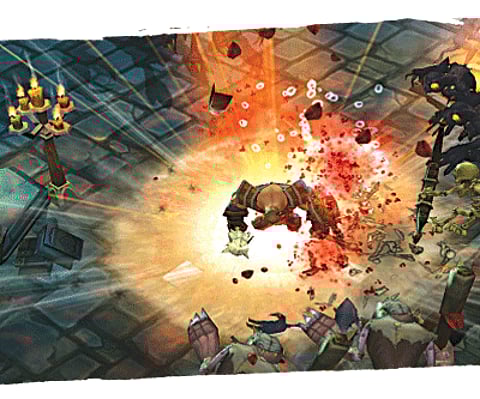
Enter Torchlight, a budget title from Runic Games, set in the fictional town of, well, Torchlight. I say ‘budget’ because it would cost you a mere $20 if bought a full-price, but if you’re going down the digital download route, content delivery providers like Steam and D2D have some very good deals for the game (I paid $4.99). Before dismissing it as ‘just another Diablo clone’, you might want to take a look at the people behind the game, which includes Travis Baldree, designer of Fate, and Max and Eric Shaefer, co-designers of Diablo and Diablo 2. While Torchlight is heavily influenced by Diablo, its visual treatment and innovative gameplay features do make it stand out.
The story is pretty interesting as well. There are several mines under the city of Torchlight, the fantasy-themed setting of the game, which is an interesting mix of old school fantasy settings, industrial age-esque mechanical contraptions, guns, muscats and alchemy. The mines contain Ember, a mysterious ore which has the power to give magical powers to items but with one downside, it ‘taints’ people exposed to it. Several adventurers who venture into the depths of the mines are often exposed to its corruptive influence. So when your character discovers that someone or something is responsible for the spreading corruption, he/she decides to venture into the mines to put a stop to it once and for all.
In Torchlight, you will be able to play as one of three classes, the Destroyer, the warrior class skilled in melee combat, the Alchemist, a spellcaster and the Vanquisher, who is skilled in ranged weapons. Unlike other RPGs, all three classes have the ability to learn and cast spells, but the Alchemist has access to a wider variety. The game’s levelling-up system is very refined, allowing you to customise your skills a great deal. Each individual skill can be levelled-up a maximum of ten times, so you can choose to focus on enhancing a single ability or access to several. The game employs a simple ‘hotkey’ system for attacks, skills or items. All can be activated at the push of one of the number keys on the keyboard (you can also pause the combat a la Dragon Age). Your main character in Torchlight also has a pet (a dog or cat, depending on your fancy). This is a nifty little feature, with your pet being useful both in combat as well as other ways. For starters, you can equip your pet with rings and a chain, the attributes of which will have an impact on your pet. You can also teach your pet spells, which it will automatically cast. But the best thing about your pet is that you can load it up with items that you want to sell and send it back to town, saving you the trip. There’s also a pretty cool fishing mini-game, and if you manage to catch something, you can feed it to your pet causing it to shapeshift into a creature/monster.
While Torchlight is the quintessential loot-hunter of 2009, there’s a serious problem with the game’s narrative and story. Before each act, there’s an excerpt that’s read from the Alric (that’s the bad guy) journal, and there are a few sections where plot points are explained via small-ish non-interactive gaming segments. But then again, it’s a budget title which, apart from the lack of deep storytelling, sports very high production values. Another problem is that it’s an entirely single player experience – a co-op feature would have been nice. But thanks to the randomised dungeons and three character classes, there’s at least some 30-odd hours of time that you can spend with Torchlight.
Verdict
Runic Games can pat themselves on the back for the most successful implementation of the Diablo formula yet. The lack of any form of multiplayer and iffy story are drawbacks for sure, but thanks to random levels, items and unique character classes, Torchlight offers tremendous replay value at such a low cost.
—Videep@gmail.com