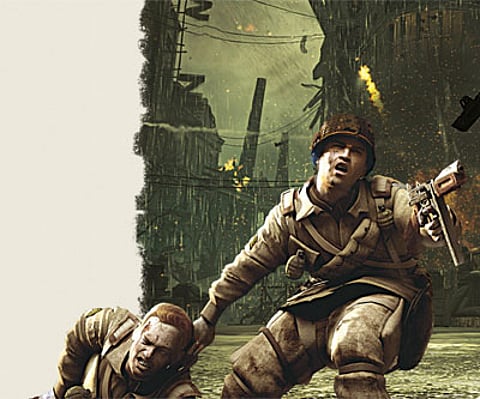

HBO has produced some of the finest mini-series in the history of television. First with Band of Brothers in 2001, a series based on the writings of biographer Stephen Ambrose about the soldiers of ‘Easy’ Company, a group of paratroopers who were an integral part of America’s European campaign, and more recently with The Pacific, which focuses on the exploits of the United States Marine Corps in the Pacific Theatre of Operations. It was watching The Pacific that renewed my interest in World War II shooters, so I decided to rummage through my games collection, and to my surprise, found a copy of Treyarch and Activision’s 2008 shooter, Call of Duty: World at War (a game I don’t remember buying). I had played CoD WaW’s campaign mode in the past, but only in co-operative mode with some other friends. We used to pick random missions and give them a go in no particular order, with the sole intention of having fun rather than be immersed in its mayhem-filled atmosphere and intense, brutal combat. This play-through was going to be different. I was going to pay attention to everything — the story, voice-acting, characters, historical significance of each of the battles, weapons, historical accuracy... everything. Basically, I was (impractically) going to apply everything I had learned from watching The Pacific into practice — a feat easily achieved in my head, but the exaggerated ‘realism’ of World at War proved to be a (rather large) roadblock. Fortunately, I was willing to make that compromise, and this compromise was made easier by the game, which seemed to be a lot more immersive. Simply put, it was better than I remembered.
World at War’s multiplayer is highly competent, with classes, perks and huge arsenal of weapons and game types — but that’s as much as I will say about it. The game’s single player campaign and almost-seamless co-op implementation is in focus here. As mentioned previously, a chunk of World at War’s campaign mode takes place in the Pacific Theatre, focusing on skirmishes on Makin Island, Peleliu and Okinawa, while the rest of it takes place on the Eastern Front, first in the Battle of Stalingrad in Russia, ultimately fighting your way to the Reichstag in Berlin. The game is experienced in true Call of Duty-style through the eyes of three soldiers, Private Miller of the USMC and a Russian solider, Private Dimitri Petrenko and weapons operator Petty Officer Locke (on one mission). While the Petrenko missions are something you’ve seen before (in Call of Duty and CoD 2, which do a much better job with the setting), you’ve probably not played anything like the missions set in the Pacific Theater. Throughout the campaign, the soldiers are exposed to the brutal realities of war and the insignificant value of human life at the time of war. World at War is considerably more violent than previous (and subsequent) Call of Duty titles, with profanity-laden dialogue as well. The violence and potty-mouthed characters heavily add to the atmosphere, making it more believable as a theatre of war than other Call of Duty games. Hollywood actors such as Kiefer Sutherland, Gary Oldman and Aaron Standford lend their voice-acting talents to the game, with Sutherland’s vocal portrayal of Corporal Roeback being the standout performance.
The Pacific campaign in particular is very brutal — skirmishes are often fought in very difficult conditions with lots of close-quarter fighting. The Japanese ‘banzai’ soldiers in particular are a handful to deal with because they pop out of nowhere, rushing your position with their bayonets. A quick mini-game ensues, requiring the player to counter melee-attack, failing which he is killed in an instant. A fair amount of research ensures that the Japanese soldiers employ real-world tactics used at the time, including snipers who hide in trees, ambushes, booby traps and so on. Of course, this is still a Call of Duty game and not an ultra-realistic tactical shooter, so the game does take some liberties while keeping things interesting at the same time. Shooting is tight, and while I’m no weapons expert, the guns all shoot the way they probably do in real life. Of course, there probably has been a little bit of balancing for the multiplayer. The
addition of portable machine guns like the MG42 and M1919 Browning is interesting (since these weapons were used extensively during the war, and have been portrayed in video games as a mount-only weapons). Visually, it looks great even by today’s standards, with great explosion effects, character animation and textures. It scores highly in the audio department also, thanks to quality voice-acting, great atmospheric sound effects, massive explosions and convincing gunfire. All-in-all, it’s a solid World War II shooter that works just as well in co-op as it does in single player.
— videep@gmail.com