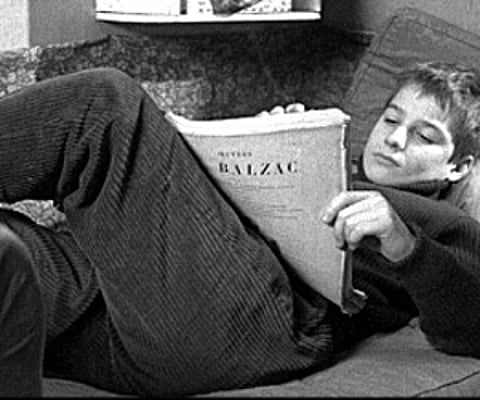

David A Cook called 1959 the annus mirabilis for the French New Wave. The film historian’s viewpoint has proved increasingly correct today what with the ongoing golden jubilee celebrations of the most influential iconoclastic movement in the history of cinema. In that year of wonders, three prominent filmmakers of the era came up with their most important works: Jean-Luc Godard (Breathless), Francois Truffaut (The 400 Blows) and Alain Resnais (Hiroshima, mon amour).
The New Wave (nouvelle vague) was not just an offshoot of the influential French film journal Cahiers du Cinema. The journal, established in the beginning of the ’50s by New Wave guru Andre Bazin, had a group of young film critics around it.
These writers, including Truffaut, Godard, Claude Chabrol, Jacques Rivette and Eric Rohmer, were trained theoretically in the art of filmmaking as they devoured works exhibited in Paris’ Cinematheque Francaise on a regular basis. The far-sighted Henri Langlois, one of the founders of Cinematheque, preserved classics of Griffith and other masters for the post-war generation of French film enthusiasts. Naturally, these cinephiles craved to try their hands on filmmaking; but the French film industry was too hefty for the youngsters to approach. This inaccessibility made them venture into amateur productions.
Unmindful of the conventional and dogmatic principles of filmmaking, pioneers of the nouvelle vague devoted themselves to self-expression. In an earnest effort to create a new language for the cinematic medium, they improvised or rather chanced upon novel ideas. The ‘jump cut’ introduced by Jean-Luc Godard in his first feature length film Breathless (1959) is an example. The film “was at one and the same time a gangster story and an essay about gangster films,” observes James Monaco. The protagonist of the film, Michael Poiccard (Jean-Paul Belmondo) is a great fan of Hollywood cinema. He goes on imitating his matinee idol Humphrey Bogart and lives in a fool’s paradise.
Godard pooh-poohs his generation’s craze for Hollywood as his anti-hero is cheated in the end of the movie by his American girlfriend, Patricia. “There was a clear political vision behind all these filmmakers. Their sole aim was to torpedo the conventional thoughts of the old school in filmmaking,” says senior Malayalam filmmaker K G George who is an alumnus of the FTII in Pune. “The New Wave was in fact a battle between the old and the new in cinema,” says George who believes that the slightly westernised mindset his generation of filmmakers possess owes much to the French New Wave.
Godard’s iconoclastic attitude went on to reflect in his later films, some of which were highly political in nature. His concept of political film was quite different from that of Soviet master Sergei Eisenstein. Godard does not believe in making political films. He believed in making films politically. Thus, he disagrees with Sergei Eisenstein’s belief that “the juxtaposition of opposing forces would create a metaphor for political action.”
Godard’s unconventional methods of movie making and utter disregard for the old had irritated his contemporaries including the late Ingmar Bergman. “I've never got anything out of (his) movies,” said the legendary director once. “They have felt constructed, faux intellectual and completely dead. Godard is a f***ing bore.” May be this statement is enough proof for how conventional Bergman was in narrating his movies. Godard, on the other hand, earnestly sticks on to his nouvelle vague slogan that “a story should have a beginning, a middle, and an end... but not necessarily in that order.”
Francois Truffaut, who inaugurated the New Wave theoretically in his 1954 Cahiers du Cinema article, A Certain Tendency in French Cinema, continued to remain a towering genius of the movement until his unexpected death in 1984 at the age of 52. The Cahiers du Cinema intellectuals argued against almost all the postulates of the existing schools of thought in filmmaking. They realised the importance of structuring and composition of the movie prior to the process of editing (mise-en-scene). Maybe that is the reason why many of the New Wave directors went for lengthy shots in their movies.
Remember the famous traffic jam sequence in Godard’s Week End (1967).
Truffaut in his Cahiers article argued that the director must be as independent as
possible. He should not depend much on the screenplay writer or the editor. He is the author of his film. The director is in fact writing a novel or a story using the movie camera. The auteur theory (director as auteur or author) propounded by Truffaut thus influenced filmmakers all over the world and defined cinema essentially as a medium of personal expression.
The annus mirabilis of New Wave saw the debut of Truffaut as a filmmaker, with his monumental The 400 Blows. Truffaut’s cinematic expression rose to its zenith when he made Day for Night (1973) a movie about the travails of a filmmaker (played by Truffaut himself) towards the end of which he asks the question: “Is the cinema more important than life?” The New Wave has not influenced the Indian cinema or Malayalam cinema in particular. We couldn’t venture beyond the limits of Socialist Realism and Neo Realism, observes C V Balakrishnan, novelist and scenarist.
The nouvelle vague was the result of the insatiable love for cinema of a generation of intellectuals who had to struggle against the bigwigs of mainstream cinema. Still they could succeed and become legends.
— The writer is a freelance journalist based in Thiruvananthapuram. venukarakkatt@gmail.com
(Part of the Picture will resume next week.)