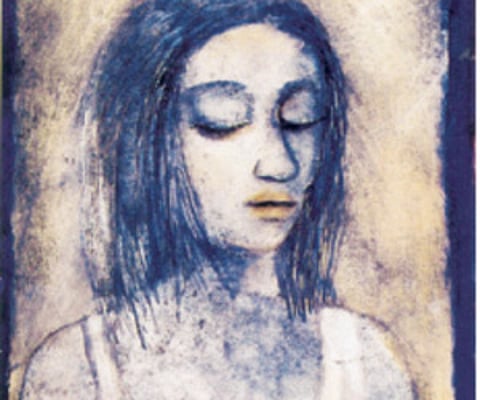

In her case, the inspiration hasn’t been the masters — old or new, of the West or East. Anjolie Ela Menon was inspired by a rather unusual person: Swami Ranganathan of the Ramakrishna Mission. She met him in her twenties. At his discourses, she was introduced to the tenets of the Gita. “I got to learn that you work without an eye on the fruits of your labour. As I practised that tenet in my life, I felt free…my art expanded, things began falling into place,” she notes. “I stopped running after galleries. The results of my work came on their own.”
Born in 1940, Anjolie was brought up in West Bengal’s Burnpur where her grandfather was chairman of Martin and Burn. She had her education in the Nilgiris’ Lovedale, where teacher Sushil Kumar Mukherjee introduced Anjolie to painting at age 13. Later, after studying English literature at Delhi University, she enrolled as a student of art at the J J School in Bombay and Ecole des Beaux-arts in Paris. She had her first exhibition — in Delhi — as an 18-year-old, when the renowned M F Husain helped her hang the painting on stands made of gunny and bamboo.
By the 1960s she had married Raja Menon, a sub-lieutenant in the navy, and moved out of India. This triggered a nomadic existence that lasted for two decades. Anjolie had two children and was tied down to many things, including her husband’s career. “You won’t believe,” she recalls, “I changed houses 30 times all over the world. One day we’re in
Vizag, next day in Vladivostok.”
When Russia invaded Czechoslovakia in 1967, Anjolie spent long days in queues for food, and borrowed paint from Viktor Fyodorov, who was doing portraits of late leader Vladimir Lenin. She painted in her spare time — and waited for her break to come.
She returned to India in the ’70s, and the next decade proved to be most productive. “ I was at the peak of my energy…and free. Opportunities were opening up, people were beginning to appreciate my work.”
Anjolie’s earlier work was a blend of objective reality and internal reverie. Goats, dogs, crows, crowded her paintings and diaphanously clad women (only half revealed) and apocalyptic male figures emerged. Later, there was a shift in her work from the nude to the windows, and from painted windows to real windows that served as a metaphor and visual device, hinting at unrealised dreams that beckoned through them. The windows persisted through the ’80s, but gave way to an engagement with subjects from Kerala — her husband’s home state.
The ’80s overlapped with the ’90s and from then on, says the artist, “working has been sheer fun, full of experimentation”. To begin with, Anjolie began with furniture and painted objects. She was obsessed with the idea of retrieval so much that it was part of our tradition like the kantha embroidery, calendar art, film posters, the rickshaw, circus images — in short, the people’s art. That was her first introduction to ‘kitsch’ and she had a large exhibition of her kitsch art in New York. She felt that whenever an Indian artist looked for indigenous sources, (s)he looked to miniatures. “The vibrant visual matrix of our times was ignored. My idea was to bring down two barriers — the one between high and low and the one between past and present. Now there is a wave of kitsch art in India: what I stared individually has become a movement.”
After this, she went through a stint of Buddhist abstraction that was influenced by her visit to Ladakh. She wanted to isolate certain elements of Buddhist iconography, and created 25 pieces of non-figurative art, sort of meditative paintings in which the continuous chanting of a mantra was transmuted into image, evoking metonymic reverberations.
There was a sudden change of track, and the artist started experimenting in computer-aided images for the first time in India. Her works were well received abroad but many in India expressed doubts about them. In these works, unexpected juxtapositions intrigued the viewer, while the complexity of the structure heightened the element of surprise.
Then it happened that a completely new medium challenged the artist’s creativity. Anjolie went to Murano in Italy and collaborated with Antonio da Ros one of the well-known artists of Muranese glass, to create glass objects. What emerged was a body of exquisite crystal sculptures of Shiva, Ganesha, Mother and Child, Madonna and baby Jesus and even Socrates. She titled these works “The Sacred Prism”.
Today, Anjolie intends to return to oil paintings on board as “belonging to a generation of that was mired in aesthetics” she would find it tough to abandon straight painting. She would not reveal her next subject. After all, she never pre-planned her work.
