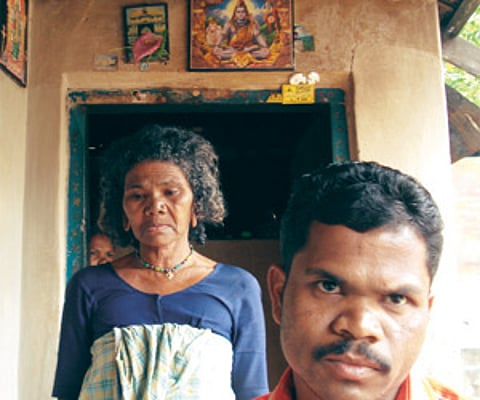

gopalan’s house in northeast Malabar, on the rugged terrain of Mulanchira colony, wears a deserted look. At the entrance, a torn jute bag and an old bamboo basket stand mute spectators to the agony. The door is open to silence. Fingertips of fear adorn the walls. A spider tries to web over the thick scar of smoke left by the kerosene lamp near the window. Surprisingly, there is no picture of a god.
This is where Gopalan hanged himself after the police tortured him for participating in the Muthanga land struggle in February 2003. He was arrested with 300 other adivasis in their struggle for land that took place when A K Antony was the chief minister of Kerala. The police tortured the 50-year-old man, and after he was released he started behaving strangely. He ran away from people. He was scared of everyone, including his family members. He did not die under police custody, but the fear of that prospect indirectly killed him.
Gopalan is not the only victim. There is Jogi, who died on the spot in police firing, and Njenan who collapsed and died on the way home while returning after completing a CBI inquiry in connection with the Muthanga incident. An old woman with a goitre throat and a swollen leg sits and starts talking talks suddenly from the house opposite Gopalan’s — in Noolpuzha panchayat off Sultan Battery. With scary eyes, she abuses everyone who walks close to her house. The fear of Muthanga still haunts the adivasis in Wayanad.
Nachi, Gopalan’s neighbour, vividly remembers the day. “We still live in fear. Thousands of teargas shells were fired in Muthanga. It was like a wild fire. Our children are still
suffering from eye related problems due to overexposure to gas. Police came to the houses in groups and picked up everyone including the children,” she says.
A look at the history of tribal agitation in Kerala would unveil a streak of irony playing hide-and-seek everywhere. When a section of adivasis, led by the redoubtable C K Janu, erected huts in front of the state secretariat in the capital Thiruvananthapuram in 2001 demanding land for the adivasis, the UDF supported it. A year later, at a function, Antony even danced (literally) to the tunes of the adivasis, wearing their traditional attire. But when the frustrated adivasis tried to reclaim their land in Muthanga in 2003, Antony changed his colour, and deployed the police to suppress the agitation.
“When we talk about tribal agitation in Muthanga,” says K K Surendran, a teacher with DIET in Sultan Battery, “we should first look into the incidents that led to it. The adivasis have every right to live in the forest. And they were happily doing it. But when people from outside encroached into their land, their life became
insecure.” Surendran was himself arrested in the stir, and tortured by the police for allegedly supporting the land struggle.
“Another reason,” adds Surendran, “is the non-implementation of Alienated Tribal Land (Restoration) Act of 1975. If implemented properly, the act could have helped the adivasis reclaim their land from the encroachers. But both the UDF and the LDF failed in this.”
When you talk about the Muthanga land struggle, three colonies in the Noolpuzha panchayat comes in the front row — Pulithooki, Koyalipura and Mulanchira.
Pulithooki is the place where the Muthanga agitation first took place in a traditional way. Recalls Balan, a daily wager, who actively participated in the agitation: “The mooppans (elders) lit the lamps. We sang songs and beat drums. To reclaim our land, we then moved to Muthanga and erected huts and stayed there. The police beat us. It has been six years since we fought, we haven’t got even a piece of land.” As he says this, Balan’s mother Kammatti listens to him — and chimes in, “We went to Muthanga for land. But the police took us to hell.”
At Koyalipura colony, Njarayan will show the exact spot where he was shot by a rubber bullet. “We all went to Muthanga because we wanted land. We didn’t expect a police attack there. I ran away after I was hit by a rubber bullet. The police couldn’t catch me. Since they used to come for rounds during the nights, I slept in the interior forest for so many days,” he says.
“This house is not ours,” says Malu, Njarayan’s wife. “It belongs to the Panchayat. We are actually landless. Though we were promised land after the Muthanga agitation, we didn’t get anything from the government. What we got was torture from the police. We can never forget our leader Janu’s swollen face after the police attack. We are still scared.” She says she is not able to do any work as she suffers from bone-related problems. “They beat me till I lost my consciousness. When I woke up, there was swelling and pain all over my body.” Malu’s is not an isolated case. There were many who were picked up from the agitation spot.”
Though the Muthanga agitation didn’t help the adivasis in Wayanad, it worked out well for the adivasis in neighbouring Kannur district. The state government bought the 7000-acre Aralam farm in Kannur from the Central government, using the funds allotted to the rehabilitation of tribals in 2004. The idea was to distribute half of the land to the landless adivasis, mainly those in Wayanad region as a settlement over the Muthanga issue.
“The result of Muthanga struggle is the Aralam farm in Kannur. About 2000 pattas were issued so far. Each one got one-acre of land,” says Chathutti, one of the patta holders in the farm. But the problem in Aralam is different. Many who got the land don’t use it. They come only for taking the yearly produces from the land. As a result, most of the plots remain vacant now.
“The adivasis expect the wage when the day’s work gets over. How do they get money if the work in their own property,” asks Janu, the tribal leader and chairperson of the Adivasi Gothramaha Sabha, who led the Muthanga land agitation. “The government has to give a fixed sum to each one for farming in their own lands. The money can be adjusted by selling the crops at the end of the year,” she adds.
But social activist and critic Civic Chandran has another idea. “The government should issue group patta rather than single patta,” notes the one-time Naxalite. “If you give single patta, I don’t think they will be able to use the land in a productive way. But it will work if the land is given to a group of people. Why can’t the government experiment green economy zones in places like Aralam and Sugandhagiri,” he asks.
Green economy zones may be a better idea. But Janu is worried about the fate of adivasis in Wayanad. “According to the agreement with the previous UDF government, a major portion of the farm land should be given to the adivasis in Wayanad. But when the LDF came to power after the subsequent polls in summer 2006, they breached this agreement and allotted the land to their ‘favourite’ people. This is an injustice to the adivasis in Wayanad who fought the Muthanga land agitation. If land is not given to them, we will be compelled to repeat Muthanga,” warns Janu.
Clearly, it’s time the government forgot the colour of their flag and take a decision in favour of the Wayanad adivasis. It will help achieve at least a feather in the featherless crown of the LDF government.
— mtsaju@yahoo.com
muthanga struggle
The adivasis who participated in the Muthanga land struggle are facing many criminal charges in courts in Sultan Battery and Ernakulam. Some of them are even facing CBI inquiries. Branding Adivasis as ‘criminals’ was but the age-old tradition of the British. The surrender drama of the forest looters was enacted in an organised manner after which they were set free from the cases.
1 & 2. Njarayan and his wife Malu of the Koyalipura colony; 3. Balan and
his mother, Kammatti of Pulithooki;
4. An old woman with a goitre throat and a swollen leg opposite Gopalan’s house in Mulanchira colony; 5. Cheeru of Koyalipura; 6. Chathutti, one of the adivasis who got one-acre land in
Aralam, Kannur; 7. Nachi of
Mulanchira colony; 8. The Aralam Farm; 9. A memorial for Jogi, who died in police firing in Muthanga.
