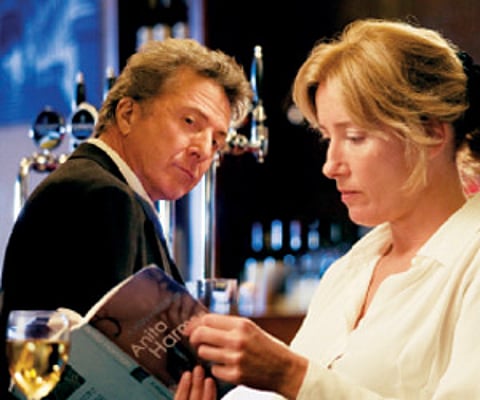

Dustin Hoffman is 72 years old, and has been famous for more than 40 of them. Hoffman was the accidental movie star, who, as he likes to describe it, ‘plummeted to stardom’ with The Graduate in 1967. Standing at just 5ft 6in, Hoffman’s presence fills the room. He commands it lightly, with charm. As on screen, in person he almost hums with energy.
What Hoffman really liked about Last Chance Harvey was that he was allowed to “be a part of the process. In other words you’re not just a colour on a palette, but you’re actually part of the creation of it, of the choices made in what it’s going to be.” And that, of course, is the key to understanding Hoffman.
Hoffman cites the sculptor Henry Moore by way of explaining his approach to work. “They say he was once asked, “How do you do that big elephant, it must be so difficult,” and he says, “No, it’s really not all that difficult, you just keep chipping away at what’s not the elephant.” And that’s all you do, you just keep trying to get rid of that stuff that feels like detritus, it’s dead skin. We don’t know what we’re going to wind up with, we just don’t want to wind up with crap.”
In 1965, aged 27, Hoffman was cast in an off-Broadway show, Ronald Ribman’s Harry Noon and Night.
His exuberant performance as a hunchbacked cross-dressing Nazi was a word-of-mouth hit, and he triumphed in Ribman’s next play, The Journey of the Fifth Horse, winning an Obie in 1966 for best actor off Broadway. He then starred in an English farce called Eh!, also a sell-out success, and after eight years of struggling, it looked as if Hoffman at last had the career he thought he wanted. And then came the call for The Graduate.
Hoffman was not alone in wondering why he was asked to audition for Benjamin Braddock, the high-achieving graduate adrift in Beverly Hills. “He looks about 3ft tall, so dead serious, so humourless,” his co-star Katharine Ross has said of her reaction to meeting him. “This is going to be a disaster.”
Hoffman had the humiliation of spending two hours in make-up, where they fussed over his hair, plucked his eyebrows and shaded his nose. His awkward, nervy screen test was a disaster as far as he was concerned and he flew back to New York, depressed, wishing he had never even gone. But when director Mike Nichols watched his test on film, he knew he had his man.
The Graduate went on to be the highest-grossing film of 1968, winning Nichols an Oscar for best director, and nominations for its lead actors, Hoffman, Ross and Anne Bancroft. Hoffman was caught unawares by its success (five months after filming, he was still signing on for unemployment benefit), and rather than enjoying it, he did what he had done before, retreat.
“I didn’t want it,” he says. “It’s in the court records. I didn’t want to be a star, I wanted to go back to the theatre.”
According to Hoffman, there was collective shock when he signed on for Midnight Cowboy, to play Ratso Rizzo, a fast-talking, hustling scrap of humanity, living low in New York. “Everybody tried to talk me out of it,” he says, “including Mike Nichols: ‘I made you a star, you’re a leading man and now you want to play this ugly guy who’s a supporting part to Jon Voight’.” But Hoffman gave dignity to Rizzo, and likeability, and he earned a second Oscar nomination.
The 1980s marked a shift in Hoffman’s career: the roles he took were showier exhibitions of his talent in more obviously commercial films. He had massive box office success with Tootsie, playing the underemployed actor who becomes the smash hit soap star Dorothy Michaels, and won a second Oscar for his performance as Raymond Babbitt, the autistic savant kidnapped by his brother (Tom Cruise) in Rain Man.
Audiences can be fickle and suddenly Hoffman was making films that were failing at the box office. With the exception of Barry Levinson’s Wag the Dog in 1997, a political satire that had Hoffman running around as the megalomaniac producer helping Robert De Niro’s fixer stage a phoney war to ensure the American President’s re-election, his choice of films was critically and commercially lacklustre.
After receiving a lifetime achievement award from the American Film Institute in 1998, Hoffman took himself into semi-exile from filmmaking. “Somehow it hit me in my bone marrow — they’re saying I’ve lived a lifetime, and I didn’t feel I had,” he says. “Not in the work, as much as in life, and I wanted to live life. I realised one thing will remain a constant and that is there is just not enough time.” After five years of self-imposed gardening leave, however, he was ready to return.
Director Joel Hopkins believes there is “a bit of the old-school entertainer in Dustin.” But it will always ultimately relate to him as a child, “being the short Jewish kid in school, whose way of getting along was to make people laugh, and there’s still that about him. However successful he is and however many Oscars he’s won, there is still this ingrained need to please in a way, and to entertain.”
© The Daily Telegraph