
Rayan Ganeshan recalls perfectly the day his father first brought him to Gavi in south Kerala. “I must have been three or four,” he says, holding his newborn warmly wrapped in layers of clothing. What I remember distinctly is that there were so many children of my age — and all of us were from the same background: Sri Lankan-born Tamils pushed back into India.”
Rayan looks around him at the green expanse of cardamom carpeting the forest floor. It brings him back to the present. This is his home now, where he belongs, where he is safe, though the memory remains.
Three decades on, Rayan works as a tour guide. He is more Malayali than Tamil. “None of us miss a heartbeat when something goes right or wrong in Sri Lanka.’’ Then, pointing to the frail old man nearby, he says, “In fact, my father will tell you of the struggles he and the others faced in this forest when they came from Lanka. They braved everything — from bad weather to wild animals.
‘‘We came from Oonwalai. Thousands of us came here under the Indira-Sirimavo pact. Some went to rehabilitation plantations in Punalur and Kulathupuzha. But Gavi was the most isolated, most challenging. Even vote-seeking politicians only started coming here in the mid-Eighties,” Rayan says about the transplant from Sri Lanka to Kerala.
For this election, Gavi’s voters are being solicited with the same vigour as the others. Posters in Tamil and Malayalam alternate on the lampposts. “During one election, we were given money. But now we can’t be bought. We are aware of our rights,” says Rayan.
“Of course, we watch Sri Lanka news. But the talk is more about the elections in Kerala. Somehow the emotional interest in Sri Lanka has gone.” His neighbour Doraisamy nods in agreement.
Doraisamy came as a young bachelor from Noorlaya. “We had the choice of going to Tamil Nadu or Kerala. I opted for Kerala. And they sent me to Gavi, then an uninhabited forest,” he says. It lies in the same range in Pathanamthitta district that houses Sabarimala.
“As youngsters, we were ready to take on anything. The government formed the KFDC (Kerala Forest Development Corporation) to rehabilitate us. Some worked in cardamom plantations, others at dam sites.” Three dams were being built in nearby areas.
“So we all had work,” Doraisamy says. “Life was tough, but there was money.’’ His wife Chellamma and son Kalaikumar stand listening. “Successive political representatives have realised our potential as a vote-bank. And this is reflected in the well-built row houses and electricity connections,” he feels. Neighbour Palaniandi, also from Noorlaya in Sri Lanka, is perhaps the only man in Gavi who is sad about what is happening in the island-nation.
Taking us on a walk around the colony that houses around 2,000 people, Palaniandi wonders, “Why should they fight? Sad, very sad.” Like Doraisamy, he loves Gavi for its similarities to Sri Lanka. “We lived in somewhat the same conditions. It is a nice place. With the plantations around, we never faced the threat of poverty.”
“There aren’t many health issues either,” points out Antony, the lone teacher in the school at Gavi. Hailing from Kozhinjambara, a village neighbouring Tamil Nadu, Antony teaches in the Tamil medium school.
“When chikungunya wreaked havoc in the entire district of Pathanamthitta, Gavi was the only place that wasn’t affected. The workers kept their surroundings clean and took care to prevent the onslaught,” Antony tells us before a group of kids drag him off to a corner for a chit-chat. In a coloured dhoti, Antony looks anything but a schoolteacher.
“Life here is very informal. But they (Sri Lankan expatriates) have adopted a lot of Kerala practices. Their serious approach to politics is just one of them,” he says, leaving us in the company of Vel, who works on the plantation. “All of us have voter identity cards. Except in name and looks, we are
Malayalis,” he says in “Tamilayalam”. Unlike the others, Vel wants more politicians visiting the colony. “Why should we say no to money or arrack?”
“You get arrack here?”
“They don’t allow it in this colony. But I will get you some. You have a car, right?” asks Vel, an ambassador representing the fully Malayalified Sri Lankans in these colonies.
But the second generation of Sri Lankan expatriates work in different fields. “I earn Rs 125 a day as a tour guide,” says Rayan. “We also get good tips proportionate to the wildlife sightings we make. If we are lucky and manage a glimpse of a tiger, foreign guests pay us as much as Rs 1,000.” Rayan works in the eco-tourism project floated by KFDC.
“Our venture attracts visitors. And it is a model for people’s participation in conservation. The local and fringe populations benefit from this initiative,” says S Radhakrishnan, officer in charge of KFDC’s Green Vistas.
“Life in Gavi has been enriching for these people. They have made money and now they even marry local girls,” Radhakrishnan says. The first settlers who are on the verge of retirement continue working rather than take a rest. His domestic help Laxmi agrees. “After hearing about our lives, many more wanted to come here. We invited only a few. But now when we hear about the Sri Lankan troubles, we feel that many more people should have been brought here.” Laxmi still keeps in touch with relatives in Sri Lanka.
Sometimes such innocent connections
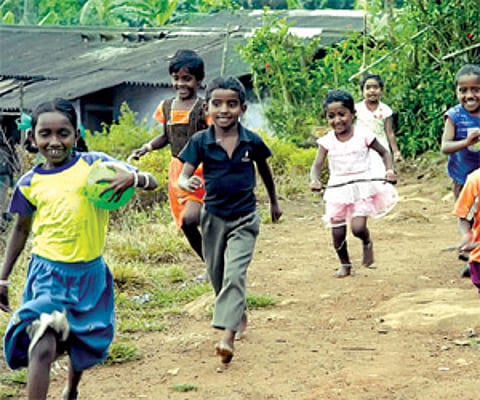
become a bother. “Rumours about our LTTE links spread like wildfire. Many times we have been investigated. We are careful now and consider well before talking to anyone from the past,” says Kalaikumar as we wade through a wave of the new generation returning home from the playground through the falling
silence that fortifies the solitude of Gavi.
— manoj_k_das@epmltd.com
Ethnic cleansing of a sort
There is a sizeable population of Tamils in Sri Lanka’s Central Province plantation workers brought from India by the British in the 19th and 20th centuries. Although they speak the same language, they are considered a community separate from the Tamils of the island’s north and east.
In 1949, the D S Senanayake government passed a law stripping the estate Tamils of citizenship. The effect was to tilt the island’s political balance away from the Tamils. Not content with this, successive governments tried to remove estate Tamils from the country. In 1962, prime minister Sirimavo Bandaranaike signed an agreement with Lal Bahadur Shastri, and a second one three years later with Indira Gandhi. They provided that 6,00,000 estate Tamils would go to India over a 15-year period, and 3,75,000 would be restored their Sri Lankan citizenship.
Not all of the former returned to India. Many stayed on without the ability to vote, travel abroad, or participate fully in Sri Lankan life. It was not until 2003 that full citizenship rights were restored to the community.
Sabarimala connection
Millions of pilgrims who visit Sabarimala will acknowledge the efforts of Gavi’s expatriate farmers in making their pilgrimage complete.
It is a little known fact that the cardamom seeds used in aravana, the dessert prasadam of Sabarimala, comes from Gavi’s organic farms. The Travancore Devaswom Board that administers the hill shrine procures 7,500 kg of organic cardamom from the gardens of Kerala Forest Development Corporation, which were planted for rehabilitating the Sri Lankan expatriates.
This is the purest form of the spice found in the whole of Asia. In over 80 per cent of KFDC’s plantations, cardamom is allowed to grow freely. There is no interference. No chemicals are sprayed. The naturally grown ones are small and have unseemly encrustations all over. Beneath, it is full to bursting with granules filled with oil of immense medicinal value. The chemically treated cardamom is soft to the touch. Reputed Ayurveda institutions like Arya Vaidya Pharmacy and Kottakkal Arya Vaidyasala have been using cardamom from KFDC’s plantations for several years.
