
In both his art and curatory work, Bose Krishnamachari strives to create new forms of expression that stay relevant to our cultural space, writes K Surekha
his works play with your senses long after they’re seen no more. Bose Krishnamachari’s paintings,
installation and curating are vibrant expressions of a powerful mind enriched by vivid experiences in the art and other worlds — a mind that observes and absorbs things and reacts to them. One that
explores the unconscious and depicts what’s beyond perception.
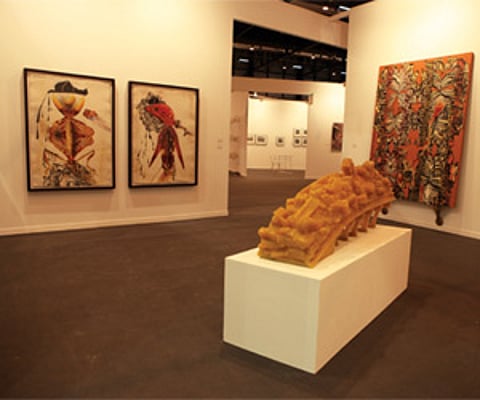
Recently, Bose curated the India Panorama at ARCO art fair in Madrid where 238 galleries from 32 nations came together. “ARCO chose India as the guest this year. Putting up 15 galleries and 45 artists was a big
challenge,” notes the Mumbai-based artist. Curating is also art. “You need a context which is relevant to time, space, politics, gender, contradictions, or any issue that can urge a person to think and evoke a response. Often there are schisms between artists
and the audience…a curator must be able to fill these gaps.”
Bose thus showcased the best of Indian contemporary art to the world. It gave
expression to conflicts between tradition and modernity, post-colonialism, urban-rural divide, ecology, caste, colour, gender,
politics, terror, sexuality and other
contemporary issues plaguing the country. “I visualised the works that would fit in that space and a thread to bind them. I never insist on themes…and I don’t believe in commissioning works. I rely on the talent of the artists.”
Bose believes well-curated shows are yet to develop in India and youngsters have begun to realise their worth. Curatorial work must be done in such a way that it affects the world in a powerful, personal and individual way. It’s art direction where all aspects of the show come into play. “Knowing contemporary artists is an
advantage. A practising artist has an edge in this field as (s)he knows the tricks of the trade. When I curate a show, I want the artists to practise the theories they
espouse. I want to create an opportunity to make astounding art. It is different from organising or facilitating.”
Bose enjoys curation much as he loves painting and installation work. Even as he is busy curating, his installation works are being showcased in India and abroad — in Indian Highway curated by Hans Ulrich Obrist and Julia Peyton Jones at Astrup Fearnly Museum of Modern Art, Oslo, which is on till September 23. It will go to museums in Rome, Denmark and Prague before returning to India in 2012. Bose was a co-curator for a show within Indian Highway.
Bose blazed the trail of curation with BombayX17 presented in 2004 at the Kashi Art Gallery in Kochi — not far from his ancestral house in Angamali. The same year, he curated Bombay Boys at Palette Art Gallery in Delhi followed by Double Enders where he got together more than 69 artists and showcased their installations, sculptures and paintings in Mumbai, Delhi, Bangalore and Kochi. “I have it in my blood, having inherited my father’s
profound knowledge in designing interiors and carpentry.”
His LAVA project (Laboratory of Visual Art) was a big hit with its rare collection of books, DVDs and a range of information on fashion, culture and photography. It will now be developed into a mobile museum that will roll across the country. “Two
mobile trucks are being readied,” says an excited Bose. “India has a dearth of art museums and this truck will be of use to art students.” He also plans to open a
museum in Aluva off Kochi and hopes to
become a curatorial director and organise global exchanges.
Installations fascinate him. “The early 1990s saw a lot of installation art. Experiments with new media have given installation art different dimensions. I confabulate with space and medium to find newer meanings of expression. These thoughts — and more —resonate in my work. Like in my first installation project called
AmUseuM (1992). It travelled to Mumbai, Bangalore and Chennai.”
Bose played on the word museum by associating it with the meditative concept of the ‘aum’ (to affirm its association with the museum and the temple), to be juxtaposed with the term amuse so as to
demystify the museum as a space of art. This show, which was composed of paintings and installations, was layered with both bold colours and strokes.
Bose likes to juxtapose extremes — something akin to the life that he sees around him, living contradictions that can’t be framed into fixed notions. Most of his solo shows are projects, juxtaposition of live paintings and abstract works and they are open-ended. “Opposites attract.”
A 1989 winner of one Kerala Lalithakala Academy award during his student days, Bose has come a long way from his formative years in Kochi. Kerala Kalapeetom in Kochi was full of encouragement. His friend in Mumbai persuaded him to apply to the JJ School but “poor English” failed him. After roaming around in the City of Dreams, “where every moment is a learning
process”, he managed to gain entry to JJ.
But he learnt more in the library and among renowned artists. He spent the nights in hotels drawing portraits of customers and earned Rs 10 a piece which he spent on books and organising art programmes in college. His talent won him a teaching job at JJ, but disagreement with many things prompted him to leave the institute. But soon his works began to win attention — in India and abroad. Opening a gallery in Mumbai is his one ambition these days.
— surekakrishnan@gmail.com
