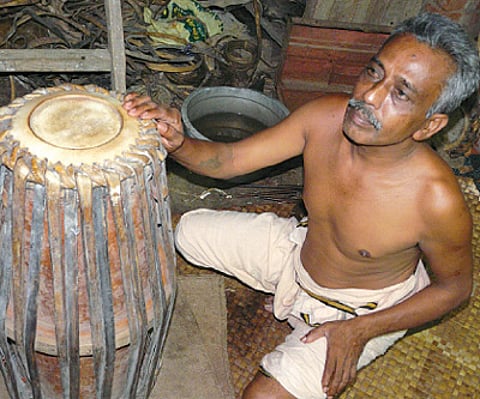

The sanctity attached to them as percussion instruments allied to temples contrasts awkwardly with the smell of tanned animal hides that wafts from the workshop of its maker. Inside his house that has an extended room where Vettukad Raghavan makes the ethnic drums, the middle-aged man is busy tightening the leather strap for the horizontal maddalam. His wiry son Sivan is helping Raghavan to keep the face of the heavy Kerala instrument taut and intact.
As the southwest monsoons are through with their rainy spell in God’s Own Country, Raghavan is getting busy — because the festival season is fast approaching. From mid-November to early May, the state’s temples — even some churches for that matter — are going to reverberate with the traditional drum-and-pipe ensembles, some of which (manned by some 180 artistes) would last as longs as five hours.
For Raghavan, now 54, the art of manufacturing the drums called maddalam is a legacy he has inherited from his ancestors. But unlike them, Raghavan has been lucky to carry the name and fame of this instrument beyond the contours of Kerala and even India. Only last year, he travelled to Paris on a fortnight-long tour that exhibited his expertise in repairing hordes of percussion instruments from the Malabar Coast. “My sponsor, Michelle, bore all the expenses, you know,” he gushes.
Then, returning to the present and taking an immaculately folded piece of tanned skin from the piles of the stock in his room, Ragavan says, “It took me several months to give this strip its sheen and fineness you see now.” The piece has been carefully peeled from the chest floor of a cow, and is specially treated to make the handy idakka, an hourglass-shaped Kerala-style damaru — shruti-aligned and one that can even produce raga notes.
The window in the room provides a glimpse of the little houses in the neighbourhood — and no hills that are typical of the tough Palakkad terrain. Raghavan’s native Peruvembu is home to a number of traditional instrument-making artisans. There are around 25 families belonging to the Kadayan community who are into it. Some of them are settled in Nenmara and Lakkidi — also in Palakkad district.
The instruments the community churns out together include the vertical chenda known for its loud beats and lovely rolls with slender sticks. Then, there is the maddalam, which is Raghavan’s specialisation. Besides this, there is the petite idakka and the slim timila. The Kadayans even produce the Carnatic music instrument, mridangam — after all, the Tamil Nadu border isn’t far away from here and the south Indian classical idiom has for long had its branches in Kerala too. Why, the artisans even make the tabla, an upcountry instrument by origin but one in vogue even in devotional, semi-classical, film and light music genres popular in Malayalam.
All these instruments are made out of animal hide. The maddalam — a key instrument in the neoclassical harmonic concert called Panchavadyam besides providing acoustic prop to Kathakali and Mohiniyattam shows — requires skins of both cow and buffalo for its making. “The skin is pegged down to the ground and stretched out to dry in the sunlight for three days,” explains Raghavan. “It is then cut according to the requirements, scrubbed thoroughly, and hung from the wall for a month. The skin is stuck on the instruments made out of hollowed two-foot-long logs of jackwood. Leather strings are used in mridangams and maddalams on the outer surface.”
More steps are to follow. “After sticking the leather,” says Raghavan, “we apply an ash-like mixture of arecanut leaves and rice flour on the left face of the maddalam.” (The making of this paste is usually done by the women.) The circular grainy patch lends the maddalam its rich tonal quality. “In the past, green arecanuts were pounded and used as gum. But now, fevicol substitutes for it,” Raghavan adds.
So, are there more such time-tuned changes? “Yes,” says Raghavan. “These days, they make the face of the timila and idakka with fibre — not leather.”
A photograph of frontline maddalam player Cherpulassery Sivan adorns one of the walls of Raghavan’s workplace. “He buys his instrument from us, and gets it serviced from here.”
Recently, the NABARD organised a camp for the benefit of these artisans. “Our objective,” says the bank’s district development manager S Padmanabhan, “is to transform these individual artisans into group entrepreneurs.”
Not all of them, as Raghavan ratifies, are employed throughout the year. The monsoon, inevitably, acts as their jobless vacation. However, for now, Raghavan is back at his work. He knows a string of percussion artistes — big and small, young and old — will begin to stream into his workplace. In fact, not just Raghavan’s, but many similar households of the Kadayan community. That is, till summer ends, and the next gush of monsoon wind blows.
— The writer is an art enthusiast based in
Palakkad. mgirishnair@gmail.com
