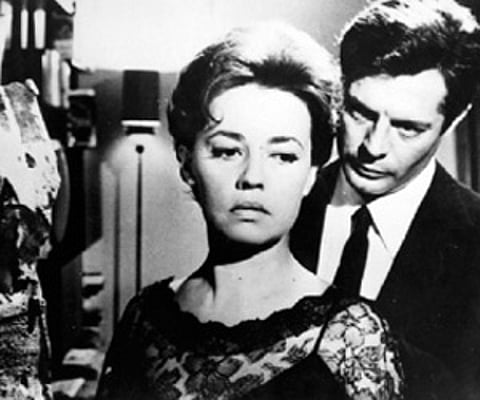

By the end of a single day whose bleak course is charted in black and white, Lidia (Jeanne Moreau) loses two men — one from the past, one from her present. The man from long ago is Tommaso (Bernhard Wicki), the friend whose deathbed she visited earlier that day, along with her husband Giovanni (Marcello Mastroianni). Tommaso is now dead, and this revelation comes when Lidia and Giovanni stroll through the gardens of Mr Gherardini (Vincenzo Corbella), whose party is beginning to wind down.
Giovanni breaks the silence. “Want to hear a good one? Gherardini offered me a job.” Lidia says, “I phoned the clinic. Tommaso is dead.” Giovanni is upset. He asks, “When? Why didn’t you tell me?” Referring to his dalliance with Gherardini’s daughter, Lidia says, “You were playing. Was he really your good friend?” He thinks. Lidia continues, “He was much more to me. He convinced me, despite myself, that I was more clever than I am. He spent days trying to make me study, even though I wasn’t interested; I was concerned with my problems... He never talked about himself. Only me... me... And I never understood. I thought so little of myself.”
Lidia turns to Giovanni and says, “You talked only about yourself. That was something new for me, I was so happy with it, that nothing in the world was more beautiful.
Because I loved you. You, not him.” Lidia accomplishes two things here — first, she compliments her husband, telling him that she chose him over a former suitor, and yet, there’s a sting attached. She says the suitor cared about her while Giovanni cared only about himself, and it wasn’t so much love as low self-esteem that made Lidia choose Giovanni over Tommaso.
And now, Tommaso’s death appears to have made Lidia question her choice. She tells Giovanni, “I feel like dying because I no longer love you.” Giovanni says, “But if this is true, if you feel like dying, it means you still love me.” He adds, “I love you. I’m sure I’m still in love with you. What more can I say? Let’s go home.” But Lidia isn’t ready to go home. She opens her purse, extracts a letter and begins to read. “When I awoke this morning you were still asleep. As I awoke I heard your gentle breathing. I saw your closed eyes, beneath wisps of stray hair and I was deeply moved. I wanted to cry out, to wake you, but you slept so deeply, so soundly.”
“At that moment I realised how much I loved you, Lidia. I wept with the intensity of the emotion. For I felt that this must never end, we would remain like this all our lives, not only close, but belonging to each other in a way that nothing could ever destroy except the apathy of habit, the only threat.”
“Then you wakened and, smiling, put your arms around me, kissed me and I felt there was nothing to fear. We would always be as we were of that moment bound by stronger ties than time and habit.” Lidia finishes reading and wipes a tear from the corner of an eye. Giovanni asks, “Who wrote that?” She looks hard at him and says, “You did.”
He’s so far-removed from the dewy-eyed romantic who wrote the letter, he doesn’t even remember that part of him anymore. If it’s a test, he’s failed. Or perhaps it wasn’t a test — merely Lidia’s way of proving to Giovanni that they don’t belong together anymore. Lidia knows now, for sure, that she’s lost both Tommaso and Giovanni. That’s why, when Giovanni weakly attempts to show her she’s wrong, by trying to make love, she begins to push him away. “No... I don’t love you any more. You don’t love me, either.”
