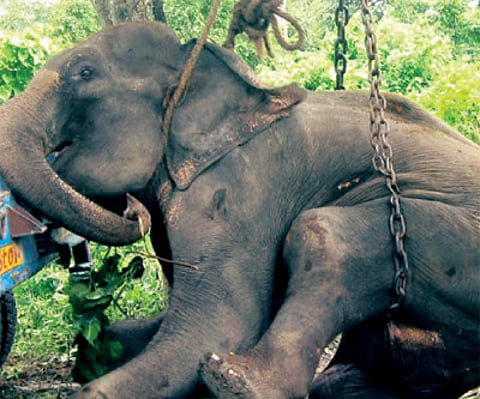

Forty-year-old Sakuntala died of her intense romantic forays. She had no semblance of Sakuntala in the great poet Kalidasa’s Abhijnana Sakuntalam. This Sakuntala was a female element, born in 1969.
Sakuntala had been desperately in love with Makhana for several years and one day felt an urge to rush to her love, in early July this year. She broke her fetters and tore off after him, but as a result her left leg was wounded as nails pierced through the leg. Profuse bleeding began immediately yet she made it to her beloved. Then, she fell down in excruciating pain.
She never recovered from the wound despite instantaneous veterinary treatment, according to officials of Jaldapara Sanctuary, Sakuntala’s home. Actually, a big nail got stuck in the leg, affecting the artery too. The vet surgeon took out the nail but not fully. It caused gangrene. Sakuntala’s condition deteriorated further and she couldn’t stand on her feet. Forest officials tried in vain with a crane to help her stand up. Signs of collapse were visible. She was weeping continuously.
Vets stepped up clinical treatment with broad spectrum antibiotics to reverse fast-escalating infection through intravenous route along with saline infusion. But all this failed. Even the bleeding could not be stopped in three weeks. She breathed her last at 7.15 am on July 26 when Makhana was a little distance away, tears rolling down his cheeks. She was cremated the day she breathed her last.
Sakuntala’s permanent address was Pilkhana inside Jaldapara at Madarihat in Jalpaiguri district, north Bengal. She belonged to the ‘Kunki’ brand of elephants, never wild or destructive in nature. The Kunkis are quiet, amiable. Her mother Irabati is still alive.
Sakuntala’s death created resentment among forest staff at Jaldapara, which is a favourite tourist spots for one-horned rhinos and Kunki elephants. Their grouse is against the apathy of top bosses in beefing up veterinary support and treatment and access to modern veterinary tools alongside improved forest conservation methods. Sakuntala could have been saved but for good and experienced vets and equipment, forest staff strongly believe and they say so openly.
Why should such painful episodes happen when everyone talks of ecological imperatives? In the long run, the tourism industry is affected even though Jaldapara has some absolutely stunning scenery. A ride through its meandering paths on an elephant is memorable. The lovable Kunkis only add to the experience. The need for their proper care can hardly be overstated.
A month before Sakuntala’s demise, there was an international refresher course (with funding from the US Fish and Wildlife Service) on “Getting along with Elephants” in Dooars, a 90-minute drive from Jaldapara. There were 25 participants — over half a dozen from Dooars in Jalpaiguri.
One of the subjects was how to treat elephants — including tuskers — who meet with accidents. Whether the lessons were applied to Sakuntala is a “big question” — to quote a participant who attended the refresher programme as a representative of Bangladesh.
However, the absence of adequate clinical care is not confined to north Bengal, or
Bangladesh. The disgust which led to the termination of a four-year contract by the American elephant-care specialist Jason Kauntze-Cockburn after only one year at the Western Plains Zoo in Africa a few years back not only raised many eyebrows but unnerved the bureaucrats. Kauntze-Cockburn competence in zoo-keeping is well known.
He was furious at the inadequate staffing, which hindered even routine medical care. Kauntze-Cockburn was shocked at the death of a 35-year-old African elephant, Cheri.
The attitude of neglect seeped down from the top. The management refused to pay for a heater to keep sick elephants warm, after it was installed. Kauntze-Cockburn felt insulted and decided to put in his papers. “We are supposed to be raising the standards of keeping elephants in captivity, but (the zoo) doesn’t even meet basic husbandry needs,” he wrote in his parting letter.
Kauntze-Cockburn became sick and tired of protracted indifference of the Western Plains Zoo bosses who were sitting over his proposal for hiring adequate numbers of keepers for foot and skin care of elephants.
What would have happened if Kauntze-Cockburn were in Jaldapara Sanctuary or Gorumara forest? Perhaps he might think of changing his profession of zoo-keeping.
— sankar.ray@gmail.com