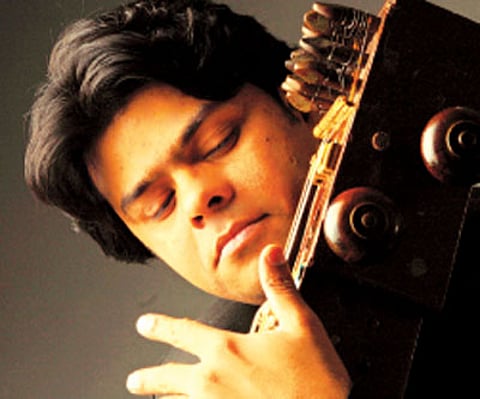

A streak of deceptive indifference defines his face at a concert. When his co-artistes make a show of crossing complex musical hurdles, the sarangi artiste won‘t even break into a smile. He fixes his gaze upon the vase on one side of the dais — anticipating the moods, turns and twists and covering up for the blunt edges in the
vocalist’s performance. All this, with a crumpled ego. As well-known sarangi artiste Sarwar Hussain says, “We have to play with a very heavy heart.” He says there are so many times the sarangi artiste is made aware that the vocalist’s improvisations are way below theirs in terms of quality and content. “But sarangi artistes usually do not like competing with the artistes they are accompanying,” claims Hussain, who is from Kolkata’s ITC Sangeet Research Academy.
The most descriptive story of self-appreciation from a sarangi artiste would be a modest frown that vanishes in moments — melting into the meend he so meticulously strikes out with the bow. A lot of pain goes into acquiring the skills that are founded and initiated by rubbing the back of the fingers,
below the nails on a tough string. “The instrument does not even leave you the time for pursuing academics. Most yesteryear sarangi stalwarts were illiterates,” says young Murad Ali Khan, the sixth-generation artiste from the Moradabad gharana who performs duets with his sitar artiste twin Fateh Ali Khan. Murad has also collaborated with Carnatic vocalist Bombay Jayashree, and is preparing to perform with violinist Lalgudi Vijayalakshmi (daughter of veteran Lalgudi Jayaraman).
Solo sarangi concerts, which require enormous knowledge, riyaaz and an immense readiness of the hand, are becoming rare. At a time when folksy and traditional instruments from the north Indian scene are fading gradually
owing to sort of a dereliction, sarangi — for its sound quality and proximity to the gayaki ang — is trickling into the fusion and the lounge music circuit, besides the unforgiving Hindi film cult and the indefatigably dramatic Hindi soap industry.
Yet the instrument is still not part of the curriculum at Indian universities. It is used only for accompaniment. Notes an up-and-coming artiste who doesn’t want to be named: “I’ve been part of the music faculty of a very prestigious Indian university for six months now. I’ve rarely got the chance to play the sarangi with the students learning vocal music. They do not have the time or the courage to practise with the sarangi.” However, there are a few exceptions like Kolkata’s SRA, where jewels like Sarwar Hussain are required to teach the students learning vocal “the tenets of accompaniment on the sarangi”.
In such a scenario, which has lasted several decades, there have been artistes born and groomed, like Kamal Sabri, son of Delhi-based Sabri Khan who typically whirls around the globe for collaborations. When in the country, you may see Kamal huddled with his sarangi in a greenroom with Appaji (as Benara Gharana’s icon Girija Devi is addressed) — all ears to her jibes and Jayawanti. What usually transpires between these two artistes in the garb of a coded hurried backstage strategy usually transforms to a divine partnership in khayal singing.
Kamal says he was the first to try the ‘ensemble format’ in sarangi: with the 2006 album, Dance of the Desert. Well, there is Murad, on the other hand, who, along with his father has brought together a dozen sarangi artistes to play Hamsadhwani and Bageshri in the “Sourang Sarangi Ensemble” — since 2002. Sourang’s approach to the ragas is free-spirited. It’s like a celebration that melts into the grand duet between the pakhawaj and the tabla. Its music may not have the spunk you associate with the star-studded vadya vrind production of yore. Yet it’s a promise to the sarangi; its sound and life.
Brothers Sangeet Mishra and Sandeep Mishra shuttle between native Benaras, where they take music lessons under father Santosh Mishra, and Mumbai, where they are now based. Apart from playing the traditional solo format, Sangeet contributes background scores and fillers for Hindi soaps for a few prominent production houses. “The tracks I have recorded for soaps are used in bits and pieces,” he says. “I have not cared much to know whether they are used appropriately or not.”
To an artiste who pursues the sarangi — an instrument widely used in the Hindustani genre of music, Kathak and tabla playing — things like velocity, virtuosity and volume usually trickle in, much later in systematic scatter of priorities, skills and opportunities. But is that really true for artistes today? World-renowned sarangi maestro Pandit Ram Narayan says the young crop lacks in technique. “There is no systematic methodological approach to the fingering techniques. Also, nothing is documented or organised. There is hardly any importance given to the theory in practice by people pursuing the sarangi — unlike the artistes in the West who give so much attention to the theory of technique in viola, violin and cello playing.”
Ram Narayan blames it on sarangi’s past. “The sarangi had suffered during the 1980s after being overused in Hindi film music the previous decade. The instrument was languishing at brothels during Raj-era India and later. Its use for accompanying the nautch girls did the maximum damage to the technique and sound.”
Sarwar Hussain agrees, but differs at the same time. “The way sarangi was projected and played during the ’60s and the ’70s has a lot to do with its association with the dancing girls. Sarangi was not the only instrument
being played at the ‘kotthas’ (brothels). There were instruments like the sitar, tabla and harmonium being used as well. Even so, sarangi couldn’t be as popular as the other three instruments despite great artistes like Ustad Shakoor Khan, Bade Ghulam Sabir Khan and Abdul Latif Khan.”
Are the artistes to be blamed for it? “Yes. We should have worked towards projecting the instrument in a better garb. No one cared to think out of the box,” adds Hussain.
(To be concluded next Sunday.)
— The writer is a freelance journalist based in Delhi. sumati.mehrishi@gmail.com