
It is said, not incorrectly, that the pulse of a nation can be felt or rather sensed by the kind of films produced in its popular cinema. Since India is a composite of many ‘nations’, each region with its own language, distinctive culture, and (if it does not sound too far-fetched), collective psyche, would it be completely erroneous to suggest that through the works of certain individual directors, glimpses of social and political realities are seen presciently? In the last two years, there have been some films that ask to be seen, for reasons both cinematic and extra-cinematic.
Prakash Jha, by now a veteran of the Hindi cinema of Mumbai, offers in
Rajneeti, his latest production, a skewered view of Indian politics. He and scriptwriter Anjum Rajabali have come out with a script that is a mishmash of the Mahabharata and The Godfather, courtesy Mario Puzo and Francis Ford Coppola. It is a story of politics and warring political families in contemporary (hindi-speaking) India. A star–studded cast comprising Ajay Devgn, Katrina Kaif, Nana Patekar, Naseeruddin Shah and Manoj Bajpai and, intrigue piled upon intrigue in the narration, do not really make for probing, perceptive cinema but despite these limitations, the state of (north) Indian politics evoked is strangely apposite. Jha’s province in commercial Hindi cinema has been provincial politics — literally: His three films Mrityudand, Ganga Jal and Apaharan, bear this out. In a larger sense Jha’s films are, indeed ‘reportage’ on the state of north Indian politics, which, in certain quarters, is mistaken for
Indian politics. The mentioned films do tell us in the form of clichés — it is generally agreed that there is great truth hidden within them — about the vaulting ambitions of people who want to control the lives of others and their respective abilities to do so. Rajneeti in this sense, is no exception.
Dibakar Banerjee’s, LSD (Love, Sex Aur Dhokha), is a digitally shot film with completely different ambitions. It is supposedly shot with hidden cameras, and a bunch of unknown actors. Unlike his first film Khosla Ka Ghosla about modest middle-class aspirations of possessing a piece of land to build a small house, featuring such fine character-actors as Anupam Kher, Boman Irani and Navin Nischol supported by talented youngsters like Pravin Dabas and Tara Sharma, LSD is more about the frustration of the libido amongst the young, aspiring middle-class. The film’s producer Ekta Kapur, the undisputed Queen of pulp TV serials was startled to see the final product. Banerjee’s earlier film, Oye Lucky, Lucky Oye starring the interesting Abhay Deol, was about a young thief in Delhi, and was not without some charm. LSD is not even like the curate’s egg, there is hardly anything to redeem it. There is a half-hearted desire to achieve the kind of sonorities that some European films do while dealing with sex. Shooting with digital video cameras for Banerjee did keep his budget down and make his film feasible but it did not rise above being a promotional trick. One must not forget that he cut his teeth in advertising before entering cinema proper.
Paresh Mokashi’s, Harishchandrachi Factory, in Marathi, produced by UTV, a production house with ample resources and a sound record of commercial success, is a beautifully realised film about the making in 1913 of Raja Harishchandra, India’s first feature film. Quite naturally, it is equally about its director Dada Saheb Phalke, also known as the father of Indian cinema. It is that rarity, a sparkling film full of droll wit and robust humanity. Mokashi, a first-time film-maker — he is famous in the Marathi Theatre — has revealed a natural aptitude for cinema. He has an instinctive awareness of the medium’s cardinal virtue — plasticity. He invests his film with touching humour and a creative intelligence rarely seen in Indian films these days. It was sent for the Oscars last year to Hollywood, and was the best film from this country in the last 20 years to have been selected for this honour. Sadly, the film’s quiet, effortless mastery went unnoticed in a country and a cinematic culture given to theatrics.
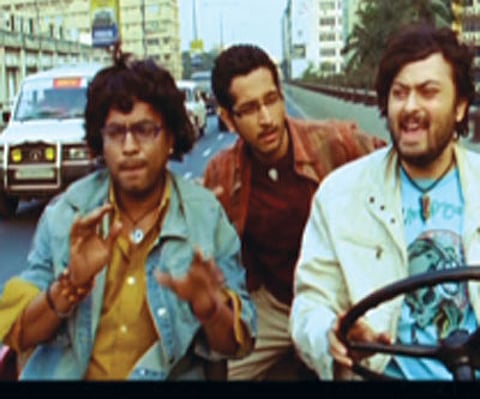
Birsa Dasguta’s 033 in Bengali shows promise and goes beyond the outward struggles of a Bangla (pop) band with its adolescent underpinnings. The young director had first attracted attention four years ago with his ‘no budget’ Bengali films for television. They were made with practically no money. In Ekti
Romarsha Dakatir Kahini (The Tale of a Hair Raising Dacoity), he showed a mature grasp of craft and a creative use of available resources. Dasgupta’s films, regardless of their content, reveal a ‘healthy pessimism’ without which, any artistic attempt is rendered suspect. He does, in his quirky way, reflect the aspirations of some urban Bengali Youth.
— parthafm@gmail.com