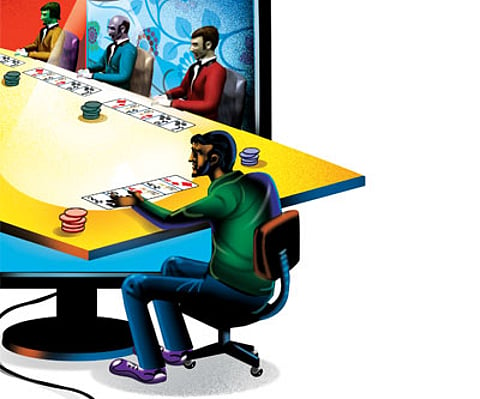

The cards on his laptop screen flop. His eyes — close to the screen nose almost touching it — squint, and then widen. A number at the bottom-right corner changes. He exhales in relief. Abhibeta, his moniker at online poker tables, has just made himself richer by $2,000.
It’s a Saturday night, slowly changing into Sunday and the lanky 29-year-old chief technology officer of a Bangalore-based start-up is exhausted. He has played poker online for seven hours straight. He plays all nights, weekends and weekdays alike. "It was a super-tight game," he says later.
Abhibeta is just one member of an expanding underground culture. Every day hundreds log on to popular websites like PokerStars or FullTilt and play, with real and virtual money. Thousands others try to learn using Facebook’s poker application. Once confident, they will graduate to online tables or seek out groups in their city. The American game is capturing Indian hearts, especially young ones, across all the major cities.
One group is meeting in Bangalore at 10 pm on a weeknight. The host, in 30s, heads the India operations of a US company. Six players are in Mayank’s (not his real name) house, in an upscale east Bangalore neighbourhood. Soon, a Rs 2,000 buy-in (the minimum to participate) and the game is on.
For the next five hours, words acquire different meanings.
Blinds mean bets, river is the last bet after a group of cards go face-up, pot is simply money or chips on the table, and if you have a flush, you’re in luck. In the end, somebody will go home with Rs 40,000. Only to come back again.
“There are more than 10 games in Bangalore every night,” says Mayank. “Weekends it goes up.” He’s talking about serious poker. “On weekends, at the bigger tables the buy-in can be Rs 50,000 to Rs 1,00,000. People play with 3-5 times the buy-in. The winner could take away Rs 10 lakhs."
The “poker scene” is picking up big time, with hundreds of games every night in Mumbai, Chennai, Kolkata, Hyderabad, and Pune. Kolkata, in fact, is known for games where the minimum bet is Rs 2 lakh, sometimes more.
How do you enter this close-knit community?
You have to be recommended by a member. Then there are discreet background checks before you’re invited to the table. Information on games is passed by word-of-mouth and phones. Players keep in touch with punters in other cities, too. So when someone from Bangalore goes to Mumbai, he knows where the games are. It’s all very hush-hush. Poker for money is considered gambling, prohibited everywhere save Goa.
There is no stereotype of the poker player. It could be the intelligent boy next door, the MNC-working neighbour, a cop or a journalist. The closest, Peter Abraham, director (events and marketing) of India Poker Championship (IPC), a professionally-run company that aims to take poker to the "next level", offers, is: “Twenty-six to 35, middle management and affluent”.
How is poker finding new converts? Oddly enough, through education. Kaushik Paul, senior manager in a biotech company and a poker player, says, “More youngsters go abroad, especially to the US, to study. Poker is a big part of campus life. Also, techies travel abroad frequently and catch the game there. It’s not difficult to learn poker, most Indians know teen-patti. Poker is the next step.”
The game-changer was television. Sports channels now broadcast the World Poker Tour and the World Series of Poker Championship, held in Las Vegas every year.
That was the introduction and Facebook’s poker applications, the opportunity. Abraham says a random IPC survey shows that one in six college-going students plays poker on Facebook. Student centres like Pune and Hyderabad are emerging hotspots.
Paul, who plays only in Goa because it’s legal there, says an increasing number of students play for huge sums of money. Many regularly visit Goa’s off-shore casinos. Insiders say that in the top schools of Bangalore and Kolkata, students sometimes play up to RS 1,000 a buy-in.
“It’s a rich generation out there,” says Paul. “Parents are successful and kids are flush with money. I once saw a group of students from Kolkata with Rs 3 lakh in Goa.”
Five years ago when he shifted base from the US to India, Paul had trouble finding even one poker player. “Three years ago you’d have made a killing in any Goa casino. Businessmen, students, your teen-patti players, they were all figuring out poker. These days it’s tight. Skills have gone up exponentially.” The fish to shark ratio (small players versus big) was 30:70; it’s just the other way now, he says.
The IPC experience is instructive. Its first of its kind tournament in March, had about 50 players. In June, it had 100. The winner of the Rs 20,000 buy-in tournament took home a “very healthy six-figure sum”, says Abraham. In the latest event starting September 2, he expects more than 200 entries.
That’s good news for the IPC, which wants to make Goa a destination on the world poker map and offer Indian players a Vegas or a Macau experience. Macau, with revenues close to $14 billion last year, is the world’s biggest gambling destination.
The game’s popularity is changing mindsets. Some are starting to think that this can be a living. At Mayank’s table is a man who gave up a job with an IT company two years ago to play poker full time. He’s still playing.
The next turn of the card will bring in the professional, somebody who lives off the game. Abhibeta tells of a graduate from the Massachusetts Institute of Technology, who’s now playing poker online. Based in Bangalore, he earns Rs 5,000-10,000 a day.
Mayank says: “These are exceptions. Most of us have day jobs. Poker is fun, but solemn because of the money.”
The jury is still divided. A cultural studies professor asks: “What is the gambler’s contribution to society?”
But Paul feels differently. “I wouldn’t rush to judge. What is a stock broker’s contribution, or an investment banker’s?” Poker, he says, is the next golf, a vital tool for corporate networking, and business schools should have a module on it.
Players often speak of “tells” — reactions like twiddling of thumbs, sweating, craving for a cigarette, a twitch of the lips — that give them hints of their adversaries’ next move. It’s part of what gives the game its charm. So, if you’re a betting person, put your money on the future of poker.
- saurav@expressbuzz.com
‘‘Poker is a lesson in human behaviour’’
THE game is beyond the pale because the government thinks it’s a game of chance, that the outcome is independent of the player’s skills. But ask any poker player and he’ll talk at length about the intense mathematical calculations that precede a hand.
Then, there is the psychological aspect. Good players can tell, by the way a player fidgets, the eyes move, and other little give away mannerisms, the next move. Good players don’t betray any “tells” either.
“Poker is science, poker is intuition, it’s a lesson in human behaviour,” says Abhibeta (online identity), 29. “Look, I’ve got this notebook full of card combinations. I’ve studied them and memorised them. It’s helped me. Now, what has chance got to do with it?” He aims to win $100,000 in two years. He’s close to the $10,000 dollars mark.
Kaushik Paul, who owns the Facebook group Bangalore Poker, says: “If tennis is 95 per cent skill and 5 per cent luck, poker is 70 per cent skill and 30 per cent luck. In both, good players win despite the luck factor.’’
He regrets that almost no one in the community is trying to rid the game of the gambling tag. A techie who plays every day says: ‘‘It’s difficult to change mindsets. You say cards and people think gambling. Who will fight this?’’
In any case, whatever the tag, once you like it, you’re hooked. You always think you have a chance; one hand is all it takes to strike gold. It’s what keeps the players going, even when the chips are down.
— SK
Indian laws ambiguous when it comes to online gambling
The games go on, money changes hands and moves between bank accounts — all under the drowsy gaze of the law. The business is still, technically speaking, illegal.
Debasis Nayak, founder director of the Pune-based Asian School of Cyber Laws and co-author of the Cyber Crime Manual, says in an email interview that while gambling is prohibited, there are grey areas in the law.
Excerpts from the interview:
What is the legal position on online gambling in India?
Gambling is a state subject. Most states outlaw a game of chance played for stakes. Whether it is played offline or online is immaterial.
Most players play online, on sites hosted offshore, in countries where poker or other forms of gambling are not barred. The legal repercussions?
Gambling laws in India actually penalise a person in charge of a gaming house and a person found in such a house. Whether connecting to a computer server and playing poker for money from one’s house is equivalent is not legally clear. Site owners could face prosecution from India but enforcement will be difficult.
What if a game is held privately, in someone’s house and a select group invited to play for money?
Gaming laws penalise a person who keeps a common gaming house or is found gaming in a common gaming house. This is a place where gaming is allowed for the profit of the person who keeps or maintains such a house.
Generally, the law is not applicable to private places where the owner does not keep any profit and does not allow the general public
to play.
— SK
