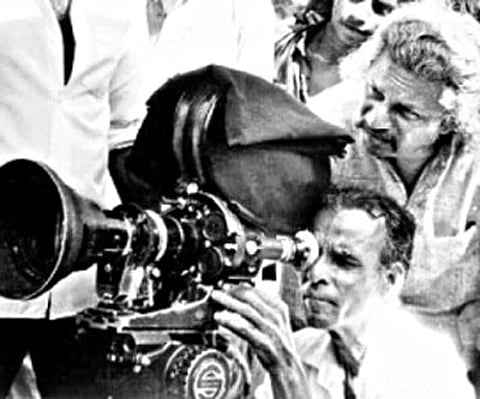

Mankada Ravi Varma, the most, gentle, self-effacing and talented of cinematographers in parallel cinema, passed away in Chennai, on November 22. He was 84. This would be a reasonable opening line in a newspaper obituary, which this piece is not. He was to be sure, a really effective interpreter of a director’s vision; a claim which would be very readily confirmed by Adoor Gopalakrishnan, the most celebrated Indian filmmaker abroad, after Satyajit Ray. Mankada Ravi Varma’s association with Gopalakrishnan began in 1971 with Swayamvaram, when the director, fresh out of the Film and Television Institute, Pune chose him as his cinematographer. The choice was probably dictated by two factors — Varma’s daring black and white camerawork in P N Menon’s Olavum Theera Vum and the man’s unflappable temperament and intelligence. It was a meeting of minds.
Ravi Varma had a cool but no-nonsense approach to work. He had, in no small measure, been influenced by his senior contemporary, Subrata Mitra, the man who had photographed the great films of Satyajit Ray, in the first and most productive phase of his career. Varma however, was his own man. While learning the many virtues of verisimilitude in the cinematographic interpretation of a director’s vision, he brought his own sensibility into play. His photography in Swayamvaram reminds one of the Italian cameramen who brought alive neorealism in cinema, immediately after World War II. Names like Otello Martelli and G R Aldo come to mind. Varma did not copy their work consciously but imbibed their virtues through osmosis. His self-effacing personality gave him the room to operate subtly.
Ravi Varma had studied at the Madras Film Institute, after graduating from Victoria College, Palakkad. He had worked as an assistant cameraman for a short while at the famous Gemini Studio in Chennai. I met him once at the Artists’ Village in Cholamandal. It was a learning experience for this scribe, who was then a fledgling documentary filmmaker. Sitting on the beach in February, 1978, at sunset, he answered my seemingly inane questions with unfailing politeness. When asked about levelling the tripod to get the horizon line right, he answered simply, “I never level my tripod’’. This declaration was, of course, not to be taken literally; what he meant to say was that it was essential to know the basics, and equally necessary to ignore the rules to make a psychologically more effective shot. He was a great devotee of the script, which he thought would determine the look of a given film. He always worked closely with the director and the art director. Adoor Gopalakrishnan always gave Varma the script first after he had completed it: he relied completely on his cinematographer’s balanced, critical feedback. Anantharam (1987) was a particularly difficult idea to execute because all the action in the deeply disturbed world of the protagonist coming unhinged, was happening in the mind, and visual equivalents needed to be found to express his pain. Varma did highly expressive photography in colour, and also pitched in as uncredited co-art director. It is believed he helped choose the costumes and found the house where the action in the film takes place.
In the years of his ‘apprenticeship’ Varma was employed by the Films Division of India, a government enterprise with its peculiar set of problems. He travelled all over the country and gained vital experience that allowed him to work effectively under adverse conditions. Over the years, he also photographed other documentaries including Yakshagana, Chola Heritage, Krishnattam and Kalamandalam Gopi for Adoor Gopalakrishnan. His photography here helped enunciate the director’s intentions as clearly as they did in his feature films. Varma had put his valuable experience acquired during his Films Division stint to considerable use in the feature films he photographed. He went to great lengths to get the ‘feel’ of a film just right.
Take for instance, a film like Mukhamukham (1984) mirroring the struggles of a once-respected trade unionist, who falls from grace because of circumstances beyond his control. The action on screen, and the unexpressed thoughts in his mind, are at odds with each other. Varma’s camera helped director Gopalakrishnan articulate his ideas with the right mix of clarity and ambiguity. In Mathilukal (1990) the prison world of (Vaikom Mohammad) Basheer, a writer jailed by the British during the freedom struggle in the early 1940s, is recreated with the right dose of realism and fantasy.
He could create poetry with his camera out of the plainest of surroundings, as he went on to prove in film after film. Late in life, Mankada Ravi Varma, went on to direct two films — Nokkukuthi in 1984 and Kunjikoonan in 1989. He won both a national and state award for his first film. He will always be most remembered however, for his splendid, understated cinematography.
— parthafm@gmail.com
