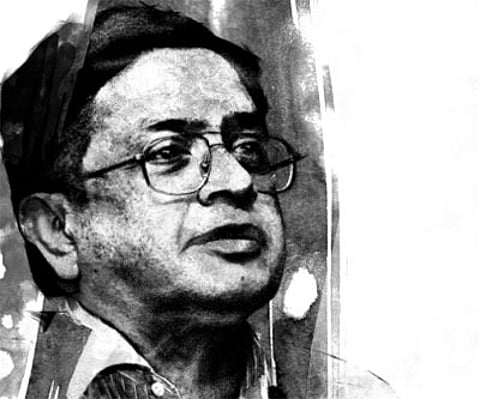

It’s a lesson for the babus of the nation. Whatever good deeds they do, once they dip their hands in the slime of corruption, not necessarily palmolein, it is quite difficult to wash the grease off. Though it is three months since he has sworn in as Chief Vigilance Commissioner of the nation, PJ Thomas, IAS, could not initiate any steps to fight corruption as he himself is in a tight spot owing to the corruption charges against him.
A native of Thaikattuseery in Alappuzha district of Kerala, PJ Thomas is a 1973 batch IAS officer. During his nearly three-decade-long innings, this Kerala-cadre IAS officer had held various key positions in the state as well as the Centre, including that of the State Chief Electoral Officer, Chief Secretary of Kerala and Union Telecom Secretary.
Even while documentary evidence points fingers at Thomas’ involvement in the `2.3 crore palmolein import scandal, which broke out in Kerala in the early Nineties, not only the Congress leadership at the Centre but also his IAS colleagues back in Kerala insist that Thomas is an officer of impeccable integrity. Unfortunately for Thomas, he has found himself tangled in the 2G scam, too. Though he became the telecom secretary only after the controversial spectrum allocation was made, there are charges that Thomas helped to cover up the muck.
With regard to the 2G scam, one can argue that the allegation is unproven. But in the case of the palmolein import deal, documents in the possession of
TNSE make it hard to believe that Thomas has ‘proven’ integrity.
How Thomas’ hands became oily
The palmolein scam pertains to the import of 15,000 metric tonnes of palmolein from the Singapore-based Power and Energy Corporation to Kerala under the ‘Rupee Clearance Scheme’ during the term of the K Karunakran-led Congress ministry in Kerala during the early ’90s. The investigations had found that the state exchequer suffered a loss of Rs `2.3 crore in the whole deal. Thomas was then Kerala’s Food and Civil Supplies (F&CS) Secretary.
The irregularities in the scam, which was first brought to light in 1992 by V S Achuthanandan who was then the Opposition Leader, were later confirmed by the Comptroller and Auditor General of India in 1993. A subsequent probe conducted by the Vigilance and Anti-Corruption Bureau (VACB) had also concluded that there were irregularities in the deal. PJ Thomas has been arraigned as the eighth and last accused in the case, along with the then chief minister K Karunakaran, then civil supplies minister TH Mustapha and several other IAS officer including the then Kerala State Civil Supplies Corporation managing director Jiji Thomson, IAS, who is also now holding a key position at the Centre.
The VACB had filed charges under the Prevention of Corruption Act against Joseph and Jiji Thomson. Since the Centre did not grant prosecution sanction, the charges under the Prevention of Corruption Act were later withdrawn. But the two IAS officers were charged under Section 120(B) of the Indian Penal Code for criminal conspiracy with the permission of the state government.
Apart from the chargesheet filed by the VACB, an action-taken-report prepared by the Congress government in Kerala in January 1995 in response to the CAG’s report also clearly establishes the role played by Thomas. It was categorically mentioned in the
Action Taken Report that though the Singapore-based firm had sent a letter to Karunakaran in November 1991 offering to import palmolein under the Rupee Clearance Scheme, the letter was neither put up to the Chief Minister nor seen by him, before Thomas, the then F&CS Secretary, sent a proposal to the Centre for the import of palmolein. The name of the Singapore-based firm was also specified in the letter. The ATR also mentions that the proposal forwarded by Thomas was accepted by the Centre and it formed the basis of the entire palmolein import deal.
Moreover, the documents available with Express also show that PJ Thomas had initiated the proposal to the Centre much before the state cabinet accorded sanction for the proposal. While Thomas sent the letter to the Centre on November 18, 1991, the state Cabinet granted its nod only on November 27, 1991.
The court of Enquiry Commissioner and Special Judge (Vigilance) in Thiruvananthapuram had even issued summons to Thomas and others accused in the case in March 2003 and Thomas had appeared before the court on April 2, 2003 and was granted bail.
Are these sufficient to put the CVC under a cloud of suspicion?
Slipping on palmolein
If it is the CVC’s post which is now hanging in the balance for Thomas, a couple of years ago Thomas faced a similar embarrassing situation while there was a move to overlook his seniority during the
appointment of the Chief Secretary in Kerala.
In 2007, when Chief Secretary Lizzie Jacob took voluntary retirement, the VS Achuthanandan-led Left government handed over the baton to KJ Mathews of the IAS, overlooking the seniority of Thomas who was then serving as Additional Chief Secretary (Higher Education). Achuthandan who had exposed the palmolein scam was quite reluctant to post Thomas, an accused in the case, as Chief Secretary in
his government.
However, the IAS Officers’ Association in Kerala had protested strongly against the move and thus the government was left with no option other than to give way to Thomas.
The CVC post, with a term of four years, has come to Thomas months before he turns 60 in January 2011 and retires from service. The nation is eagerly waiting to see if the palmolein scam will take the coveted post away from him.
Setting a bad precedent
By making an all-out effort to retain Thomas as the Chief Vigilance Commissioner, the Congress-led UPA Government is indeed setting a wrong precedent.
As it is quite certain that Thomas is still an accused in a vigilance case, the appointment of Thomas would work as an excuse for tainted officers to claim critical posts in the future. Whether Thomas is tainted or not is a matter to be decided by the court of law, but there are many civil service officers who are similarly tainted, but not convicted by any court of law owing to the loopholes in the judicial system. The appointment of Thomas to the post would give an edge to such officers to stake their claim for the sensitive posts.
Though Thomas had held various other senior posts in the centre and the state, it did not invite any criticism. But the post of CVC is considered a sacred one and hence the Government has to ensure that a person with proven integrity is posted there.
Left parties conspicuous by their silence
The hardcore communist leader and Kerala Chief Minister VS Achuthanandan had played a key role in
exposing the palmolein corruption case about two decades back. But his efforts seem to have been
ignored by his party colleagues both at the state and the Centre.
While the BJP’s national leadership has started up a hue and cry against the appointment of an IAS
officer accused in a vigilance case as the CVC, the leaders of the Left parties are turning a blind eye towards the issue.
The picture in the state is also not different. The CPM state supremo Pinarayi Vijayan, while inaugurating an anti-corruption convention recently, had strongly come down on all contemporary corruption issues, including the spectrum scam, CWG scandal and the Adarsh flat issue. But neither the palmolein case nor the SNC Lavalin scandal in which he is an accused featured in his diatribe!
Moreover, the Left parties lack the morality to raise their voices against Thomas as he was once appointed as the Chief Secretary by the current Left government in Kerala in 2007.
— arjun_raghunath@expressbuzz.com