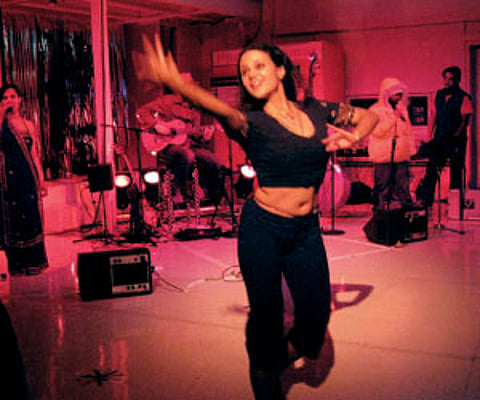

I would be an understatement to call Sandra Chatterjee a dancer. Trained in Kuchipudi, Bharatanatyam, Polynesian dance and contemporary dance with a PhD in Culture and Performance from the University of Los
Angeles California, the part-German, part-Bengali, clearly has a lot to work with.
My interaction with Sandra began some years ago with conversations on Queer-dom. Her work and politics while being hard to explain tells us a lot of what could possibly be desired within ‘speaking queer-ness’ in this country in the long run.
Through her work with the body in the
medium of dance, Sandra has consistently pushed the boundaries of body, desire and sensuousness in the performance space. Through this, very often, a complex comment is made about all of the themes she addresses. While this is the strength of dance itself, Sandra’s insistence on her doing this with a conscious acknowledgement of the political
debates that her work is part of, is rare among many (especially dancers).
Sandra is also a founder member of the Post Natyam Collective, a group of dancers and scholars who are based in countries across Europe and South Asia and the US who collaborate and work independently to create academic work and dance pieces.
I have seen two solo pieces by Sandra and another duet with her co-member of Post Natyam, Cynthia Lee. Lajja, a piece that juxtaposes the dancer to a video projection of herself in the performance space, deals with a few simple themes that merge into one
another. What is interesting from a queer perspective is how this piece so effortlessly brings in all the themes central to the varied discussions around gender and sexuality such as body and desire to the fore. It achieves this without the oft repeated sweeping statements or over simplified identity tags.
A similar process is underway in another piece called Dasi (displaced) which addresses body and desire in the context of race. A
response to the dancers’ own experiences with the exoticised brown ‘temple dancer’ image in Europe, the work makes a poignant statement on race without being, yet again, simplistic. Her duet with Cynthia Lee called Counting the Moons is described by them as “a North and South Indian classical dancer collaborate to evoke love, loss, and the slippery relationships between self, friend, and lover, in this contemporary abhinaya (emotional expression) piece...”.
When they performed this piece at an event organised by Nigah, a Delhi-based queer media collective, there was no doubt of the piece’s relevance. And yet, when presented, it also goes on to give us ample opportunity to read multiple meanings into it as any
artistic work would. At the same time, it is unabashedly sensuous and has at its core many a theme that still remain difficult to articulate, in this case, love, desire and the complexities of the same.
Another interesting observation about her work is the classic feminist practice of coming from a subjective position — the personal — and speaking of broader politics. This of course is done rather creatively and pushes the boundaries of what some feminists might have even meant by ‘personal is political’. It often makes the boundaries blur.
One such useful theme is the way in which Sandra’s work resonates with this constant question that many activists grapple with within the queer movement. In most of her work, if one were to look for the themes of sexuality, they are apparent as are that of race or nation. Notable is the consciousness she seems to hold close of not going into that realm of obscurity that leaves art unapproachable. The tropes she uses are familiar ones such as that of the goddess Kali in Lajja for instance. This is not just in the choice of content but also in the use of the various dance forms that she is trained in which is rooted, neat, rigorous and yet simple.
Sandra’s work is inspired by her own subjective position of being a number of identities. Those that she may never claim allegiance to but is constantly boxed within by many at different moments in different contexts. But her thought and work emerges from the cracks, journeys, transgressions and translations between fixed identities which themselves are an illusion to begin with. But on the other hand, it is an articulation that is rooted in a number of places, dance forms, philosophical world views et al. This rooting however, never seems to be uncritical.
Roots remain powerful only as long as they can ground us enough to let us grow, travel and transgress. The minute they hold us back, they become a burden. Identities are one such root. While their strength within the realm of advocacy and the fight for rights and basic freedom of expression is immense, if we don’t question it while we use it, it is and it will continue to keep us down and not let us grow. And if we don’t grow, soon we will be no different from the systems of oppression we
oppose. We already are often forced to speak the language of the system as that is the only comprehensible one. If we are to question and critique the roots of that system effectively and actually imagine a different reality then we need to always question our own roots. This, Sandra seems to not-so-mildly suggest to us with contemporary dance movements, mudras, bhavas, adavus and rasas.
(Check out the work of Post Natyam and Sandra at www.postnatyam.net)
Mailponni@gmail.com
