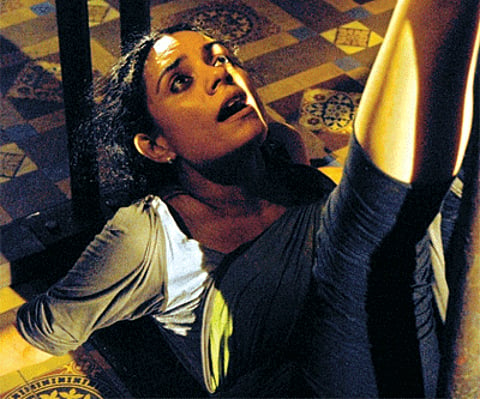

When Jyoti Dogra performs, her body virtually becomes a fluid mass and sculpts through the surrounding space — flowing up and down, rising, shrinking and elongating with a dream-like ease. Voice accompanies the body, ascending and falling, creating a strange soundscape entirely made up of the human timbre, even appearing as a separate identity, independent of the body. Evidently, movement becomes music.
The Doorway, a devised performance piece being presented by the Mumbai-based theatreperson-turned-film actor, is an exploration into the potential of the artiste‘s body (and voice) as the subject matter of the performance. It breaks free of linear narration. Whatever text uttered during the performance plays just the role of being elements of sound. Just disconnected sentences that appear more or less like sound motifs. Like, ‘I stayed back… in a jar of pickles… I stayed in a jar of pickles,’ or the Punjabi, ‘achar da martban tuppe rakhe yu…’ (keep the pickle jar in the sun), or ‘It’s a butterfly I dried it through the spring. See it is still so beautiful, and pure and intact…’
This performance evolved out of the Growtowskian theatre exercises that Jyoti started doing in her Mumbai apartment in 2006. That time, she was re-entering theatre, after taking a break for trying out Bollywood. The re-entry had really started with the play Man to Man written by the German playwright, Manfred Karge. The celebrated one-woman performance was directed by Rehaan Engineer, the Mumbai-based theatre and film personality.
To say that theatre is a passion for Jyoti would be a gross understatement. For her, it is life. Theatre arises out of life, and life gives rise to theatre. And, actor becomes the material. “It’s as if I myself become the material,” she said, talking of The Doorway.
This performance was the result of a yearlong research project, starting off in a Mumbai art gallery in April 2009. She developed it with a grant from Bangalore’s India Art Foundation, as part of its Extending Arts Practice. Since the first performance, Doorway has travelled to art galleries, theatre institutions and other alternative spaces spread across the country. She has performed not only in the metros, but in smaller cities like Ujjain, Bhopal, Indoor, at Pondicherry’s Adishakti Laboratory for Theatre Arts Research, at Ninasam Theatre Institute in Heggodu (a village in rural Karnataka) and different parts of Kerala including Thrissur and Kochi and the capital city of Thiruvananthapuram.
Jyoti, thus, faced a diverse range of audience at all these venues, interacting with them and letting the spaces intervene in her performance. “Small-town audiences always had a different response, they were more vocal, while the big-town audiences were more cautious. In Ujjain, nobody said ‘It was nice,’ or anything like that. But they asked many questions, like Why did you say this? Why did you do that?”
She is planning to take Doorway finally back to the starting point at Gallery Beyond, in Fort, Mumbai, in April, and perform before the same audience who had attended the opening performance, to let them observe how it has evolved through the different venues.
A Delhiite, Jyoti had been involved in theatre from early in life. However, her graduation was in English literature. And interestingly, she did a diploma in hotel management. Training in theatre started quite early. For eight years, she learnt Saraikela Chhau from Shashadhar Acharya in the capital city. She has also got training in Kathakali for four years, also in Delhi. Though the National School of Drama was not part of her academic records, she was part of the Theatre in Education Repertory Company of the NSD for three years, as a teacher.
In 1996, she shifted base to Mumbai, “to make a living”, in her own words. It is difficult to sustain in Delhi with acting as a means of earning. “In Delhi, we did many jobs, just to keep doing theatre; we were earning money, then doing theatre, then again working…. It was kind of a vicious circle.” The only advantage to this scheme of things was the freedom to experiment. “You didn’t have to look up to theatre to bring you revenue.”
Apparently, this is supposed to give you more freedom, but truth happens to be just opposite. “It took the edge out of you. You will never be competitive.”
That’s how the move into Mumbai happened. And films followed. Ram Gopal Varma’s Satya, (1998), Susant Misra’s Dharini (2002), Nagesh Kukanoor’s Hyderabad Blues 2, (2004), Tanuja Chandra’s Film Star, (2005), Anil Ahluwalia’s Kya Tum Ho, (2006), Kunjan Mendke’s One Night Stand, (2006) and Anurag Kashyap’s Gulaal, (2009) are among her major films. In between, Jyoti also acted in some teleserials. A Seaside Story, a documentary film directed by Laxmikant Shetgaonkar from Goa, co-written by Jyoti, won the Golden Conch at the Mumbai International Film Festival (MIFF) 2004.
Jyoti has also been part of an increasing association between the performing artists and the visual artists, a new trend seen in Mumbai. She was associated in many projects involving visual artists and art galleries, apart from The Doorway. In June, 2007, she associated with Whose in Town, a collaborative project between the visual artist Neha Choksi, Rehaan Engineer, actor Faezeh Jalali and Arindam Mitra, which was put up at Project 88, a prominent Mumbai art gallery. In March 2007, she had performed That Time, Sun Sets for Sam, a piece by Samuel Becket that Rehaan Engineer directed, with Neha Choksi collaborating on the installation, again at Project 88. Man to Man itself was a collaborative project with Rehaan Engineer, Jyoti and the video artist Tejal Shah.
During her theatre career, Jyoti has worked with some prominent directors including B V Karanth, Kanhai Lal, Barry John, Khalid Tyabji, Prassanna, Maya Krishna Rao, Wold gang Kolneder (Gripps Theatre, Berlin), Sou Weston (USA), Sita Ramamurthy (Theatre Centre, London) and N K Sharma. She has also acted in One Night with the King, a Hollywood film directed by Michael Saibel. Currently, she is working in two Hindi films — Rahul Dholakia’s Lamhaa and Rajeev Virani’s Sach.
— The writer is a critic based in Kochi and
editorial coordinator of artconcerns.com.
renuramanath@gmail.com
