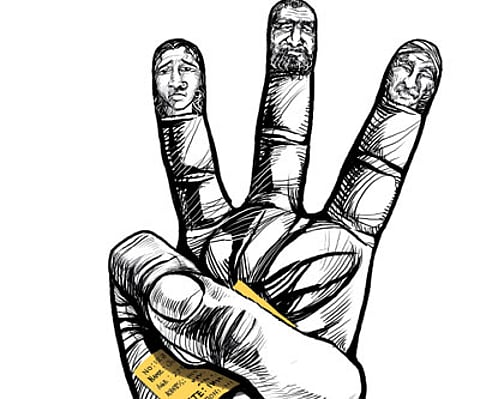

Once in 10 years, the government sends out its enumerators to count the number of people it is supposed to serve and provide for. These enumerators fan out across the country to collect information on the name, age, address, etc, of millions of individuals to feed into the giant sausage maker of the Planning Commission and other government bodies that prepare for the future. But there’s one thing no enumerator has asked since 1931. No one has asked what caste you belong to.
Thus, the government knows the number of Hindus in the country, the number of people with TV sets, the number of people with telephones, and the average size of the family. In other words, the government knows how to slice and dice the population in various ways, but it does not know who belongs to which caste. So, for instance, it doesn’t know if the maximum number of TV users are from the forward castes or the backward castes. It doesn’t know what percentage of children from the backward castes go to school in comparison with the forward castes, much less why there is a gap, if there is a gap. Of course, there are assumptions about income levels, and so on, but there is no definite information.
The question then is, why no caste enumeration? Here’s what J H Hutton, commissioner of the 1931 census had to say: “It has been alleged that the mere act of labelling persons as belonging to a caste tends to perpetuate the system, and on this excuse a campaign against any record of caste was attempted in 1931 by those who objected to any such returns being made.”
But Hutton (1885-1968), an anthropologist-cum-administrator, had his own view. “It is difficult to see why the record of a fact that actually exists should tend to stabilise that existence. It is just as easy to argue, and with at least as much truth, that it is impossible to get rid of any institution by ignoring its existence like the proverbial ostrich. In spite of the recognition of caste in previous decades the institution is of itself undergoing considerable modification. Indeed the treatment of caste at the 1931 census may claim to make a definite, if
minute, contribution to Indian unity.”
Nearly 80 years after that statement the question of a caste-based census has been revived by several politicians. It has been opposed by many people on the grounds that it will reopen old divisions and divisive ways of thinking unworthy of the new India, but it really begs the question of what the new India is about. Nor is there any effort to ask what people may feel about it. Then there is the
plea that it will complicate the logistics of this massive exercise, making it even more difficult to complete.
The New Sunday Express spoke to a number of politicians, academics and others across five states to find out their opinion on a caste-based census. It is interesting how many people felt this is an overdue exercise.
There was a need for a keeping a database and statistics on the beneficiaries of such scheme. Proper planning will be not possible in the absence of such data. Recent commissions like the Sachchar Committee and Ranganath Mishra Commission had tried to identify the issues relating to backward castes and minorities. The purpose of appointing these commissions will be defeated in the absence of such data.
— E T Mohammed Basheer , IUML leader, MP and former Education
Minister of Kerala
Looking at the big picture, there are certain remote pockets in India where the population has been deprived of the benefits of welfare programmes. Once the caste-based census is carried out, it would be possible to know the strengths and weaknesses of the programmes and how they have fared in these pockets. These programmes can then be focused in these regions. Besides, regional imbalance is one aspect which can be addressed through the census because it aims at looking at disparity that has been caused. The outcome of caste-based census can help manage the policies on removing regional imbalance by way of an equitable distribution of government assistance.
— Pradip Majhi , Lok Sabha Member from Nabarangpur and President of Orissa Pradesh Youth Congress
Caste is a part of social structure and nobody could deny that. There are reports of so-called honour killings. It is a proof of the existing caste discrimination. While revoking the death sentence of brother of a Brahmin girl for killing her husband and family because they belonged to a lower caste, the Supreme Court on December 10, 2009, has made an observation, which supports the existence of caste discrimination. That judgment even justified honour killing. If such kind of social discrimination exists, then caste-based reservation must continue.
— Dr M S Jayaprakash , Human Rights Activist
The caste census will help to fine-tune welfare schemes and allocate funds in accordance with the needs of the population. It will also help provide the basis for political reservation for BCs in legislative bodies. The NDA government in principle agreed to carry out a BC census. No additional funds are required to carry out a caste census. No extra men are required for it. Census staff should be given instructions to create an extra column in the present format and just ask the respondent to tick in the column to record his or her caste status. On various occasions, courts have questioned how schemes could be implemented without accurate population figures of BCs. Despite this, the government has never bothered to do a caste census. The ruling Congress fears that once the real numbers are known, BCs will demand their due share in power.
— K Yerran Naidu , TDP LEADER and former Union minister
Without the census, the government is basically working in a vacuum. The census will not perpetrate casteism, that is done by casteists and social customs.
— Christodas Gandhi , IAS officer
The very meaning of census is selection of every democratic detail including caste, religion, language, sex.... Many deserving sections of the society have been unjustly denied the benefits available to them, while undeserving sections of the society continued to enjoy the benefits meant for the genuinely backward. In Karnataka, 25 per cent of the state’s population which has been certified as belonging to the forward classes continues to enjoy the benefits of reservation in government jobs there by denying the benefits to the genuine backward classes.
— Ravivarma Kumar , Senior Counsel and constitutional expert
Socio-economic development can be planned for OBCs like for the SC/STs. Every group must get their due.
— KV Thangabalu , TN Congress Committee president
Right-wing academic forces — particularly a group of sociologists and anthropologists — advised the Bharatiya Janata Party-led National Democratic Alliance government not to go for a caste-based enumeration in 2001 as it would go against the interests of the ruling upper castes and communities. It is fallacious to argue that society would get further divided if the population of each caste is known to the policymakers and to the public.... It is true that we cannot distribute everything based on caste. But caste census is the right basis for statistics such as literacy rate and issues like the proportion of representation. Once we cite the Census data there cannot be any authentic opposition to that evidence....
In a democracy based on numbers, any section of society can come to power. If caste census is done, the Indian democracy would thrive on the firm support of the lower castes who keep hoping of getting their share based on their numbers.
— Kancha Ilaiah , academic