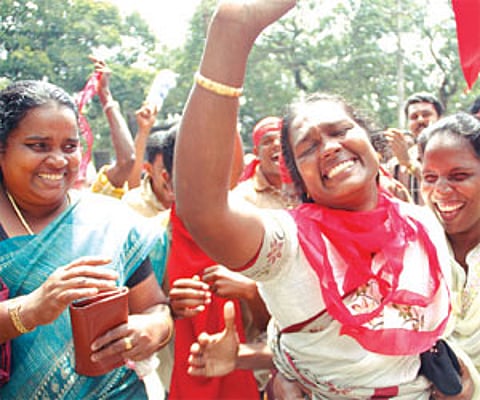

Whatever women do, they must do twice as well as men to be thought half as good. Luckily, this is not difficult,” Canadian feminist Charlotte Whitton once said. The words are decades old, but the truth in them refuses to turn grey. Hundreds of women representatives in local bodies across Kerala would endorse that.
Fifty per cent reservation in local bodies was a raw deal. But they have clasped the opportunity with much vigour as the just concluded local body elections in Kerala have proved. Women now head 489 grama panchayats in the state out of the total 978. They are the bosses in 76 block panchayats (out of 152), 31 municipalities (out of 60), seven district panchayats (out of 14) and three Corporations (out of five). And where they are not at the top, they are the second big figures, adorning the posts of Vice Chairpersons or Deputy Mayors. Out of the 21,682 wards to which elections were held, women contested from more than half, as several women candidates were fielded from general seats as well.
If this is women empowerment at its best, then the change would now set in. But the direction is unpredictable. Though there is no denying that it has opened doors to a holistic empowerment for women, promising them everything that men enjoy in the public sphere. Whether it truly encompasses an empowerment that is social, economic and political — all at the same time — will
be doubtful.
If you scan the list of elected women representatives, you will find most of the names are new. Some fresh out of campuses, some crossing the threshold of their households for the first time, wives or sisters of high profile male leaders and some pure dummies for the sake of seat-filling. Easily prone to the wrong trends in power, with a predominant male society to mislead, that might see their downfall in five years, paving way for the entry of fresh faces again. Many see this as a blow to the gradual yet meaningful pro-women changes in the grassroots, that had begun way back in 1997 with decentralisation and then the 33 per cent reservation and continued with the emergence of the Kudumbasree movement.
The next five years will test the very idea of ‘empowerment through reservation’. Change is possible, only if intense training is given on their new roles and clarity brought in about their power-holds. “It also depends on how the gender relationships in this male-dominated society change with the coming of so many women in power. It would not be a sudden empowerment as many consider it to be, it would be a long process. Maybe, it would take years, but the presence of women in decision-making areas would herald a change, sooner or later.” Rajya Sabha MP T N Seema is confident. She was involved with the working of the People’s Plan Cell after the introduction of decentralisation in the state in 1995.
According to Seema, only when the political parties accept the presence of women, without the pressure of the Constitution, would the real change begin. “There are no women at the decision-making tables within parties. That is because fewer women make it to the active political circles. They revolve around the smaller spaces they have been granted, that too by the Constitution. But if you see it positively, then this is an entry point. A chance to be visible, which is important. Those women who are really bitten by the political bug and empowered in the true sense would remain visible,” she says.
Studies in this direction have shown that women position tend to position economic empowerment much lower on the list of priorities — individual freedom usually features at the head of the list. The chance to go out of their houses, to taste public life, to feel that “I am a useful being in this world” is often the intoxicating factor for many. Maybe that’s why even after finding themselves in debt, unable to make ends meet with the meagre remuneration as an elected representative, they do not whimper.
So, does that leave only social empowerment in the offing for women entering politics through local bodies? “A holistic empowerment happens only when there is socio-political-economic and even cultural upliftment. Cultural, because the male-centered society needs to accommodate these women into their decision-making circles without Constitution-backing, sans any mandatory clauses pressuring them,” says Gregory Placid, Director of Sahayi, an NGO that has been conducting studies about women in local governance. Sahayi has also been offering training programmes to elected women in administration.
Putting it in perspective, Gregory says that the experiences of the last 15 years have shown that women, however reluctantly and crudely they enter politics, are transformed beings at the end of five years. There are attitudinal changes happening, confidence is built, there is role clarity — a social
empowerment is certainly happening. Sample the women from Kudumbasree units who covered more than half the reserved seats this time, he says.
Often, that is all. At the end of five years, new people come in. Women return to where they began. But that does not take the sheen away from the revolution that has already happened. Kerala has been forced to reckon with women power, men have been taught to share. It’s now up to the women to prove that the impossible can easily be overcome.
— asha.nair@expressbuzz.com
Profiles of political power
A K Premajam, Mayor, Kozhikode
This is not the first time a woman is donning the mantle of Mayor in the historic city of Kozhikode. But this time, the CPM did not hesitate to ask the 72-year-old Premajam to occupy the seat. Her experience in Lok Sabha and an earlier stint in the Mayor’s seat made the former college principal the ideal choice for the post.
Premajam began her teaching career at the Sree Narayana College, Kannur. She then moved to Government Arts College, Meenchanda, Kozhikode. Politics was nothing new to her — she unsuccessfully ran for magazine editor as a candidate of Kerala Students Federation, when she was a post-graduate student. She plunged into active politics after her retirement as principal. CPM chose her to contest the elections to the Lok Sabha from Vadakara, the party's bastion, in 1998. She resigned as Mayor, a post she’d held for two-and-a-half years to contest. She represented Vadakara constituency for two consecutive terms.
She was elected to the present Corporation council from the Pottemmal ward. Premajam, known as a strict disciplinarian and administrator, will have to marshal all her acumen to face a rejuvenated Opposition that has swollen from seven last time to 34 in the present council.
— M P Prasanth
K Chandrika, Mayor, Thiruvananthapuram
K Chandrika, the Thiruvananthapuram Mayor will be leading a Council that has gifted a simple majority, of just one seat, to her political front — the LDF. But, Chandrika appears unruffled, as if nothing can take the hard-earned seat away from her. Born in Thiruvalla, Chandrika made Thiruvananthapuram her home after her marriage. She was practicing as a junior advocate till a job at the Kerala State Electricity Board came calling. In 2005, with a year left for her retirement, she took voluntary retirement to contest as councillor from the Muttada ward in Thiruvananthapuram Corporation. She won and presented a term that was seemingly flawless. It was the close relations she had maintained in her ward and the goodwill she had earned that brought her name to the forefront when the top post was being considered this time. That the party decided to field their Mayor candidate in a general seat was telling of the high levels of confidence they had in her. She beat UDF’s Silvi Mathew, also a former councillor, again from Muttada. The new Mayor has already spoken about her priorities. Sanitation, cultivating civic sense, motorable roads, drinking water — everything has been listed.
— Asha P Nair
Prasanna Ernest, Mayor, Kollam
Prasanna Ernest of the CPM, who has been sworn in as Kollam’s Mayor, is the second Woman Mayor of the “Cashew capital” of the country. When Prasanna Ernest was elected for the third consecutive term to the Kollam Corporation Council, it was a forgone conclusion that she would be the next Mayor. As the CPM Kollam Area committee member and District secretary of the Democratic Women’s Association, Prasanna has been active in taking up women’s issues for years. “If we are committed, we will work for society without even knowing it,” she says.
She started her political career as an SFI activist and became the vice chairperson of the College union at the Fatima Mata National college in 1987. She was the chairperson of the Corporation Standing Committee on Taxes, Appeal (2000-05) and Health and Education (2006-10). She has also served as District secretary of the Child Welfare Council and Member of the Board of NS Memorial Institute of Medical Sciences and the Mundakkal Service cooperative bank. Her husband, X Ernest, is the CPM Kollam East Area secretary and District committee member.
— N V Raveendranathan Nair
