
Hay’s not a brand. It’s just a bunch of us from a small town in Wales who get to go on these big adventures sometimes,” says Peter Florence at the author’s green room in the Kanakakunnu palace, Thiruvananthapuram. Florence, along with his father, started the Hay Literature festival in Hay-on-Wye, a town with just over a thousand people and about 30 second-hand bookstores. And since it started he, along with his fellow organisers have been on many such adventures, taking the festival and its ideas all over the world to places as varied as the Maldives to Qatar to Mexico.
Trivananthapuram 2010 though, marked the first time that Hay was coming to India and in its choice of venue Florence makes two things clear: that they wanted to keep it as far away from the Jaipur Literary Festival, the current heavyweight on the circuit, as possible and secondly, that in Kerala, they found one obvious draw.
“In Kerala the big advantage was that there’s a huge amount of literature that we could showcase. And it’s literature that’s almost unread outside of its own diaspora. And that makes it very different than the Maldives, for instance, where the focus was largely on local concerns.”
Comparisons with Jaipur are inevitable, especially if Hay becomes a successful fixture. But in Florence’s statement there’s also the small print that could come to mark Hay as being distinctive. Put simply, Hay is about more than literature, or more than the showcasing of high art. In intention at least, it is a festival that attempts an interplay of different ideas and different forms of storytelling — a place where journalism, film, politics, even history, can meet literature.
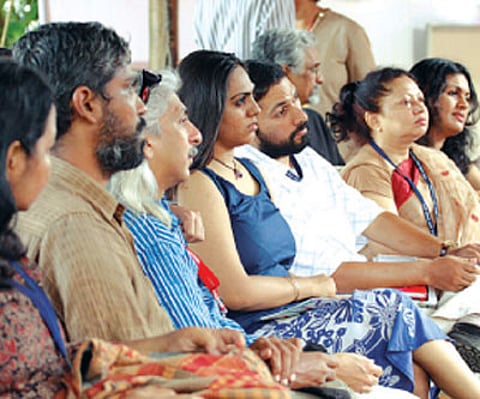
Of course, this creates its own problems and Hay Thiruvananthapuram was a little baffling at times, especially if one were to go solely by audience response. The most heavily attended session over three days (trumping Vikram Seth, Sebastian Faulks and even Bob Geldof) was a debate featuring Tarun Tejpal and Lord Meghnad Desai on whether economic growth in India was at the expense of social development. And next on the attendance scales were Nik Gowing, the BBC anchor on citizen journalism and its effect on structures of power and Tejpal and English journalist Rosie Boycott talking about media and politics in India.
At one point, all this focus on social messages seemed to have a cascading effect. In an adjoining room where the best-selling children’s author Michelle Paver was describing the incredible research that goes into her stories, one gentleman in the crowd got up to ask, “What is the message in your books”? To which Paver replied, “I’m glad you asked me that question. There is absolutely no message in my stories.”
And yet there were moments at which Hay was genuinely about literature at its best — Mexican novelist and essayist Jorge Volpi speaking of his work and explaining that not all of Latin American writing can be bracketed as magic realism was one such moment, while K Satchidanandan reading with Welsh poets Paul Henry and Menna Elfyn made for a scintillating session.
For the most part, forays beyond literature, when with the right people, worked for the good. Documentary filmmakers Hannah Rothschild’s session on the art of writing screenplays was brilliant as was the intense debate that followed Basharat Peer’s reading from Curfewed Night, with Mani Shankar Aiyar leading the questions. An excited PR person’s remark that it was like a Shakespearean dialectic might have been pushing it, but it was quite something.
A more interesting subtext, still, was in the writing of history and it was embodied by the presence of one Simon Schama who is that rarest of beings — a best-selling historian. History writing is starting to take on a new direction in India that’s taking it out of academic confines and Schama is perhaps the best example today of a historian writing for a general audience. Watching him talk about the problems of Obama’s presidency on Day 3 was more like a performance than a lecture.
And, of course, there was Bob Geldof, who is actually something of a fixture at the Hay festivals. There is the Geldof of pop culture and there’s the Geldof who founded Band Aid and the Live 8 concerts. For two whole days in Thiruvananthapuram, it seemed like it was the latter who had appeared, though there were touches of the irreverent rock icon. I walked in to his session as he was uttering the immortal (almost) line: “I think Margaret Thatcher was just Johnny Rotten in drag.” All that was until Geldof finally appeared in concert at the end of the festival (but more on that elsewhere).
In between admitting that he was secretly there to ensure that the Jaipur Literary Festival had no serious competition, William Dalrymple, its co-founder, pointed out just why Hay can only get bigger from here on. “Book festivals are very sexy all over the world now and Hay started this whole trend off. And Peter Florence, in his own way, has changed literature.”
Florence himself, says they need three more years. “There are three things a festival has to do. Showcase exciting great writers, bring back forgotten literature and the most exciting thing probably, is to find new writers and bring them through. I think we’ve just started with phase one now.”
— jayantsriram@expressbuzz.com
Celebrity by marriage
The newly-minted celebrity Sunanda Pushkar is signing autographs for the students of the Institute of English, University of Kerala. One of them says, “Ma’am, we have read so much about you.” She replies, “Don’t believe a word of what you have read. There are too many wrong facts.”
As another journalist comes up, he hears her say, “He is so fabulous.”
Immediately, he asks, “Are you talking about Shashi Tharoor?”
Unfazed Sunanda says, “I should hope so. After all, he is my husband.”
Sex scenes do not equal porn
Tamil writer Charu Nivedita looks smart in a bright green T-shirt, a gold earring and necklace and white sneakers. His ground-breaking novel, Zero Degree, has graphic language and uninhibited sex scenes and language. “I wanted to
expose the double standards in Tamil society regarding sexuality,” he says.
But he was taken aback when he was attacked by intellectuals and the masses who labelled his book pornographic.
“They could not distinguish between porn and erotica,” he says. “The song sequences in our Tamil films are like blue films, such is the vulgarity of the costumes and the provocative way in which they dance. But no outrage has been expressed about that.”
Learn the Malayalam alphabet in two hours
Photographs of wildlife photographer Balan Madhavan are hanging in a corridor of the Kanakakunnu Palace, the festival venue. One photo shows a Niligiri Tahr mountain goat standing alone on a rocky crag. “Look how lonely it is,” says writer Vikram Seth. Balan asks the author to sign on a flex board and, astonishingly, Vikram does so, in Malayalam. Watching him is DC Books Publisher, Ravi Deecee. Ravi had met Vikram earlier in the day. The author had asked Ravi to write his name in Malayalam. Vikram observed it carefully, Soon, he asked to see all the letters of the Malayalam alphabet. Two hours later, Seth wrote his own name in Malayalam. “He is a genius,” says Ravi.
We just cannot handle the whole truth
The most intense session during the festival is with Kashmiri writer Basharat Peer. Basharat restates what writer-activist Arundhati Roy said recently: “The people of Kashmir want azaadi (independence), no question about it.” But he is also self-critical. “Kashmir holds the record for the largest number of strikes anywhere,” he says. “But it has not led to any political solution. In fact, there is a bankruptcy of ideas.” The long question-and-answer segment seems to tire the young man. Following the conclusion of the event, a perspiring Basharat stands outside, on the lawn, holds his forehead in both his palms, and says, “I think my head is going to explode.” He lights a cigarette and takes a few urgent puffs. A visitor tells Basharat that he seemed to be restraining himself when he wrote his book, Curfewed Night, about growing up in strife-torn Kashmir. Basharat gives an interesting answer: “If I wrote the full truth the book would never have been published. So I held back. I will increase the truth in stages.” Basharat’s friend, Najeeb Mubarki, a journalist, says, “At last, we are able to tell the true story of what is happening in Kashmir to an Indian audience. For too long, biased reports have been published in Indian newspapers.”
— Shevlin Sebastian
