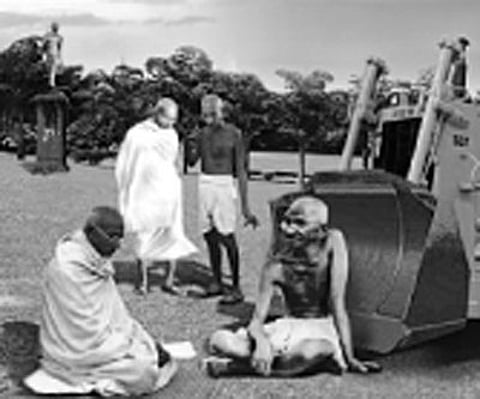

Mohandas Karamchand Gandhi was the best performance artist produced by the bygone century. Today performance art is a fad after its flourish in the West since the 1970s. While performance art struggles to connect with the people both within and without the gallery walls, Gandhian performances and remembrance of those still evoke political and cultural ripples amongst the masses. Freedom to March: Rediscovering Gandhi through Dandi, a recently concluded exhibition at the Lalit Kala Akademi Galleries in New Delhi, curated by Anubhav Nath and myself was an effort to showcase the responses to Gandhi’s greatest political performance art ever, Dandi March in 1930.
During the days of frantic conceptualism in art, Joseph Beuys, a well-known conceptual artist from Germany said that anybody could be an artist. It was the declaration of post-modernist liberalism in art and interestingly Joseph Beuys’ oeuvre is mostly constituted by performances and actions rather than paintings and sculptures. Seen against the history of performance art as a genre, Gandhi’s efforts to connect with the people, taking their history, culture, life-style and economic conditions have all the nuances of great performance art pieces.
As curators, we recognised the performativity of Gandhi’s actions as the manifestations of higher forms of political, economic and cultural resistances. Today, seen against the growing influence of imperialism in all walks of human life, resistance is that one word which loses its currency within daily parlance. As fine arts has the great responsibility of debating social imbalances and issues pertaining to the larger interests of societies, as curators we thought of looking at Gandhi’s Dandi March as a metaphor of resistance. Gandhi walked along with his disciples to the Dandi seashore and on April 6, 1930 to break the draconian salt law of the British, which was a pivotal incident that spurred a series of resistance acts all over India and elsewhere, which eventually led to the independence of India in 1947.
The uncanny beauty of Gandhi’s performance vis-a-vis Dandi March in 1930, walking through the backward villages located along the route from Sabarmati to Dandi and spending time with the villagers to collect the data of their education and economic levels, spreading the knowledge of Khadi and speaking to them about national freedom and so on, in itself had a double metaphor. On the one hand Gandhi took up a vital issue like salt which for him was not just a
legal issue, but a metaphor. And the walking itself was a simulation of the culture of Indian mendicants who walked through the villages, singing the praises of gods, helping people to forget their daily woes.
We thought of re-visiting this Gandhian double metaphor through the eyes of the artists. Hence we took 23 artists, V Viswanathan, Rameshwar Broota, Atul Dodiya, KS Radhakrishnan, Sumedh Rajendran, Gigi Scaria, Manjunath Kamath, Murali Cheeroth, Vivek Vilasini, Shiv Verma to name a few, along the same route, from Sabarmati to Dandi. Considering the busy schedule of the artists, instead of walking we travelled by a mini-bus but made sure that we walked in those same villages, met people and interviewed them. The artists found this exercise a great experience.
This trip that we undertook in early 2010 yielded great fruits for us in the form of anecdotes and finally in the shape of a good show. The artists came back to their studios with a great experience; some were critical of their own relationship with Gandhi and some were critical of their relationship with the images of Gandhi that had been in currency since his demise in 1948. However, they all
experienced the locations in which Gandhi had performed his great act. The artists studied Gandhian history, the history of the Dandi March and came up with their own visual interpretations of it.
Owing to health reasons senior artists like KG Subramanyan and A
Ramachandran could not come with us for the walk. But they contributed their drawings, especially the ones they had done with the precise context of Dandi, years back. Dandi became almost an obsession with the artists once they undertook this project. Gigi Scaria, in his digital work titled, Who Deviated First, skillfully extracted the image of Gandhi from the illustrious sculpture of D P Roy Choudhury on Dandi March and put it in an opposite direction behind the people whom he had once led. With this simple twist of image, Gigi could bring forth a critique on a society like ours which has deviated considerably from Gandhian idealism.
Interestingly, Vivek Vilasini also based his digital work on the same
image of D P Roy Choudhury, but as depicted in the middle of an Indian currency note. By enlarging the image into mammoth proportions against a backdrop of hologram, Vivek converted the Dandi procession into a spectacle of economics. In his digital work, Manjunath Kamath recreated a series of Gandhi images as if Gandhi were in conversation with his own different selves. Gandhi’s dilemma as a political performer was brought out well in this work.
In sculptures and sculptural installations KS Radhakrishnan converted his protagonist, Musui into Gandhi in the famous posture of him picking up salt in Dandi. Arunkumar H G created a floor installation with many layers of footwear soles stitched together to simulate a pair of huge ‘chappals’. In his wall installation Sumedh Rajendran in his typical style created a perforated pair of legs meeting its leather counterpart. Prasad Raghavan in a humorous simulation created a huge wall work of Gandhi’s portrait using thousands of wooden saltshakers stuck together.
Importantly, the Freedom to March show was not just about praising Gandhi in the name of nationalistic pride. It was a critical view on the aspects of performative resistance initiated by Gandhi in our politico-cultural scenario. Artists like Murali Cheeroth, K M Madhusudhanan, TV Santhosh and so on could deconstruct contexts in which Gandhiji is vandalised at different levels, through their paintings.
— johnyml@gmail.com
