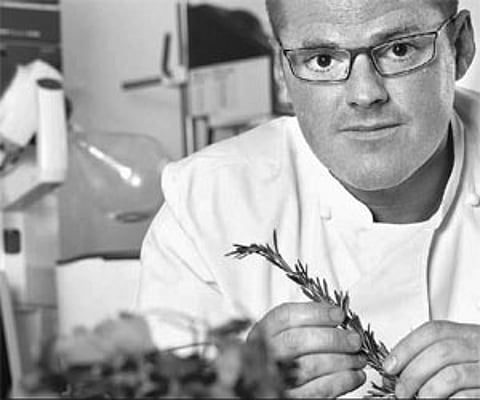

English food has the reputation of being the world’s worst cuisine — steak, kidney pudding, shepherd’s pie, and fish and chips ad nauseum. Brits eat more chicken tikka masala than residents of Ludhiana. Fat Duck chef Heston Blumenthal decided last year to change the way gourmands perceive British food. Dinner — the world’s only fine dining restaurant serving British cuisine, at the Mandarin Oriental, Hyde Park — is the result.
The first day saw more than 6,000 bookings. In an interview with the food bible Square Meal, to be published this month, the 44-year-old chef said: “Dinner is really a modern dining experience.
It’s in a grand location, yet the atmosphere is very relaxed.
It’s the type of restaurant you can enjoy a special occasion, or just pop in for a great steak and glass of red. If in the process Michelin recognise us for a star then that would be fantastic.” Dinner got its first award in February 2011 — the best restaurant award from Square Meal — a first for any restaurant serving British food. Blumenthal’s romance with ancient English food is well known — he pioneered bacon desserts in 2004, with his sweet-and-savoury bacon and egg ice cream.
Two centuries ago, dinner was the day’s main meal, eaten at midday because nightfall came early in Britain. The availability of cheap candles and gaslight in the 1800s meant dinner time got delayed.
Cities had become job magnets — workers packed lunches to work, and dinner was served at 5 pm when they got home. In many parts of rural England, old habits die hard — even today, dinner might be lunch or supper. In Dinner, Blumenthal uses medieval recipes to give the 21st century gourmet the Meat Fruit (a ball of chicken liver parfait encased in orange-coloured jelly, topped with a leafy stalk — to resemble a glossy mandarin), Salmangudy (chicken oysters, bone marrow and horseradish cream) and Roast Marrowbone (with parsley, anchovies, mace, and pickled vegetables).
There is much in common between Blumenthal and Ferran Adrià of El Bulli; both are molecular gastronomists, but hate to be called one; both closed the restaurants that brought them Michelin fame; both have decided not to repeat their restaurants.
Blumenthal opened his own research and development kitchen in early 2004 where he pioneered the use of a vacuum jar to maximise bubbles during food preparation.
He used this technique for dishes like aerated chocolate soufflé.
Less air pressure inside the jar means bubbles get larger.
Blumenthal also used amplification technique to enhance food sounds such as the crunch. He prefers low temperature, ultraslow cooking, (meat cooked for up to 24 hours to retain fat content while preventing collagen molecules from re-forming); he says this way, fat doesn’t melt and only minimum juices are released by the meat, preventing the formation of gravy. According to him, gravy is unnecessary since meat itself contains enough moisture.
Blumenthal has borrowed the sous vide technique — i.e., cooking food vacuum-sealed in a plastic bag — from the French, to great effect. The bag is treated in a thermostatically controlled water bath at a low temperature for a long time. His signature dishes include Snail Porridge and Parsnip Cereal.
With the success of Dinner, the maestro is contemplating creating more brasseries.