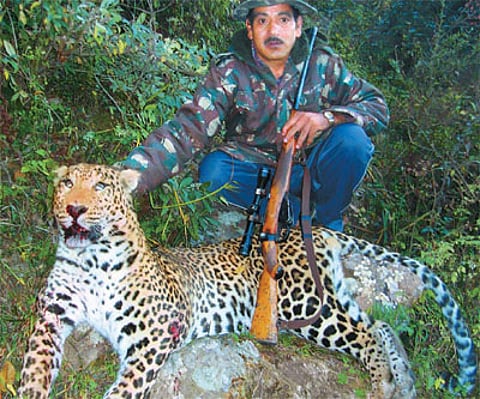

It was the afternoon of January 27, a day after a young man had gone missing in the Sunderkhal area on the outskirts of Corbett National Park. Lakhpat Singh Rawat, a schoolteacher from Garsain in the heart of Uttarakhand, a man better known as the state’s top hunter of man-eating leopards, had located the half-eaten body of the unfortunate man. To Rawat’s experienced eye, it was clear that the man had been taken by a tiger when he parked his motorcycle to relieve himself. Local residents had blocked the national highway as day broke; five persons had been taken by the tiger in recent months, and they were an angry mob. It took all morning to convince them that the animal would be killed, not just chased away.
Rawat led a team of policemen and forest guards mounted on seven elephants and soon surrounded the spot where the tiger was hidden, barely 20 metres from his victim’s remains. A ragged volley broke out as soon as the tiger was sighted. “Thirty-four shots were fired,” says Rawat. Three hit home; two of those were Rawat’s. The tiger was fatally injured but alive when two of the elephants charged and trampled him dead. That was Rawat’s only tiger, the 35th of the 36 man-eating big cats he has shot in the last nine years. Number 36 followed soon when Rawat killed a leopard in Ghansali block of Tehri district after it had snatched a three-year-old girl from inside her home.
Rawat is the man the hill state turns to when a man-eating leopard has to be killed, a problem that the pressure of growing population and destruction of the spotted feline’s natural prey base has unleashed. When humans—usually children— are carried away by a leopard, an official permit is issued by the state’s chief wildlife warden, allowing Rawat to kill the animal. Rawat, who has been feted by the chief minister, is a hero across the state for the efficiency with which he eliminates these killers.
Rawat saves lives, no doubt, but his is a heartbreaking vocation. “It’s a magnificent animal,” he says of the leopard. “But once it starts killing and eating people, we have no choice.” Rawat, a crack shot who is wellacquainted with the ways of the jungle, was spurred to act in 2002 when one rogue leopard killed and ate a dozen children over a few months. There’s been no looking back ever since.
Rawat is at pains to clarify that he doesn’t enjoy killing: “It’s got to be done. Think of those who have lost their children to maneaters.” He believes radio-collaring leopards will be a great help in ensuring the wrong animal is not killed if a man-eater appears in a particular area, something he says can happen despite all due care.
Rawat tracks the leopard down first, tessellating and triangulating recent sightings and kills all the time in his mind. He usually zeroes in on the animal’s location within days. Then it’s a question of sitting up in the bushes, sometimes over a cow or goat kill that is beyond reasonable doubt the rogue animal’s, or at some place known to be frequented by it.
Leopards usually lie up in their lairs all day, beginning a night-long prowl at dusk.
So it’s in poor light, rapidly fading to night by the moment, that Rawat must wait silently for a man-eater, spot it, draw a bead, and shoot the animal where it stands. He has one shot, the first one, and it must count, for a leopard’s reaction and speed are like lightning. But Rawat doesn’t have any of the tall tales that hunters are wont to churn out: Yes, there were failures, almost as many as the successes, but giving up hasn’t been an option.
Nor can he afford to treat the hunt like sport, for this is not killing for pleasure, a Raj-era hobby that nearly wiped out the country’s tiger population before poaching and ever-increasing human numbers took over to try and complete the job. To even his odds of survival and improve those of completing his mission, Rawat uses a powerful searchlight when he can. A leopard’s usual reaction is to face the light and snarl, giving Rawat the moment he needs to send a bullet into it at 2,000 feet per second.
It’s no modern, high-powered rifle he uses. Nor is it some old handmade European classic inherited from his shikari father. Rawat swears by his Indian Ordnance Factory .315 bolt action rifle. It’s an archaic calibre, and he must rely on Indian-made ammunition, whose quality many find suspect. A misfire is no big deal at the range but when your sights are on a man-eater that is one leap from your throat, it can have unpleasant consequences. And that is a measure of Lakhpat’s good luck: he hasn’t had a single misfire in all these years of hunting.
How long does he plan to keep it up? “As long as my eyes last,” Rawat says, the weariness of his task written all over his face.
