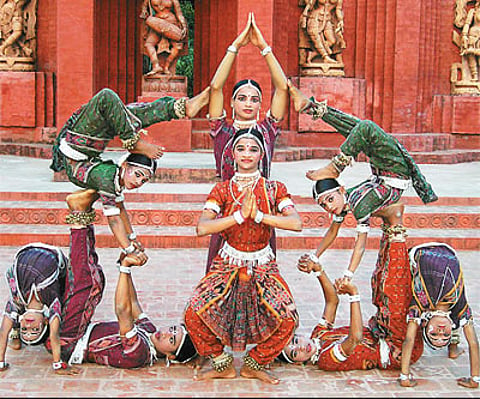

Bijay Kumar Sahoo doesn’t like to talk, or even remember his past. That was a time marked by hunger and struggle. Today, as founder-director of the Nakshyatra Gotipua Gurukul in Bhubaneswar, Sahoo is on top of the world. At least the world of Gotipua, the four-century- old dance form of Odisha. With reason. His dance form is again being recognised by the culturati.
“Three months back, I was invited to perform at the Jodhpur Festival before an audience made up of celebrities and royals. I was paid Rs 3 lakh for the show, the highest-ever for any Gotipua dancer,” he gushes.
Sahoo’s story is symbolic of the resurrection of the dance form that’s exclusive to the Puri region. A dance that was once part of the temple services of Jagannath.
Although there are many performing arts that have men masquerading as women, Gotipua tops the table with gorgeously-dressed young boys between the ages of three and 12 singing and dancing to poetry from Gita Govindam, Oriya bhajans and Sanskrit shlokas. They are also famous for Bhand Nrutya, an acrobatic art form in which dance is interspersed with acrobatic movements and striking group formations.
While Gotipua’s exponents are very proud of what they do, they’re bitter that Odissi is famous across the world, while the dance that it originated from is little known outside the state. “It is ironic that Odissi has always enjoyed due patronage and publicity while Gotipua, from which the former borrows heavily, was marginalised,” laments Gotipua Guru Birabar Sahoo, a Sangeet Natak Akademi awardee.
It was under the maharajas and zamindars of British India that Gotipua really flourished. Post-Independence and the abolition of privy purses saw patronage drying up. Still, some stalwarts like the late Chandrasekhar Patnaik of Dimirisena village, Maguni Das of Raghurajpur village and Angadhar Pradhan of Konark persevered, trying to groom young Gotipuas through gurukuls, says Guru Birabar.
Many young boys did sign up—largely for economic reasons—but most used the rigorous training in dance and music to take to Odissi. In any case, the boys have to stop dancing as Gotipuas by the time they turn 14 and their bodies start to change.
Kelucharan Mohapatra, Mahadev Rout and Gangadhar Pradhan are among the Gotipua dancers who switched to Odissi and became famous.
Today, with new demand for stage shows and TV programmes like India’s Got Talent and Dance India Dance, Gotipua is again getting its due. And this time, it is no longer the refuge of impoverished children.
With institutions like Dasabhuja Gotipua Nrutya Parishad, Raghurajpur, Konark Natya Mandap and Akshyatra Odissi Gurukul offering schooling and boarding facilities, boys from all walks of life are enrolling. “The Sangeet Natak Akademi and Eastern Zonal Cultural Centre are offering grants to these bodies. The state Department of Culture is promoting Gotipua by sponsoring performances at festivals.
Happy days are ahead,” says dancer Aruna Mohanty, vice-president of Odisha Sangeet Natak Akademi.
