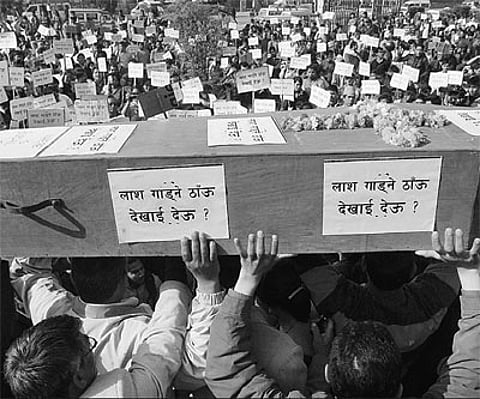

What was the world’s only Hindu kingdom till it became a secular republic four years ago has never looked so Christian.
And it’s all about last rites and religious rights as Nepali Christians demand exclusive burial grounds across the country. The ‘coffin protest’ movement is already a month old, and shows no sign of going away. Dozens of Christian leaders continue with a relay hunger-strike in the heart of the capital, Kathmandu, with empty coffins as the motif of their protest.
The crisis erupted in December last year when Nepali Christians were barred from burying their dead in the Pashupati Kshetra, more precisely the Sleshmantak Van.
The ban was imposed by the Pashupati Area Development Trust, the government authority responsible for the upkeep of Kathmandu’s famous Pashupatinath temple.
The Van is a lush forest on the banks of the Bagmati, right across the centuries-old shrine, where Hindus believe Shiva and his wife Parvati frolicked in different incarnations.
The Van is home to thousands of graves.
Traditionally, Nepali Kirats who revere Lord Shiva as their main deity, used to cremate their dead in the Van.
“We didn’t have any problem with it,” says Narottam Vaidya, Pashupati Trust treasurer. “But when the Christians started burying their dead and building graves with crosses, our sentiment was hurt. That amounted to sacrilege.” Christians started burying their dead in the Pashupati area—discreetly at first—after the first major political change in April 1990. “But after Nepal was declared a secular republic in 2007, they started doing it with a lot of fanfare,” Vaidya says. The Pashupatinath trouble is but one facet of Nepal’s post-2007 social and cultural revolution. In 2008, the Maoist government made a futile attempt to replace the Indian Mool Bhatta at the temple—a centuries-old Indo-Nepal cultural institution—with a Nepali priest. That backfired, and was soon forgotten.
Yet, other changes, such as Christian burials in the Van area, continued to simmer.
“In three to four years,” notes Vaidya, “the Christian graves just multiplied to number in thousands.” It boiled over last December, when the funeral procession of boxer Raju Magar, a Christian from Dhading who died in a Kathmandu hospital following a serious head injury in the ring in the southern town of Hetauda—entered the Pashupati Kshetra. The uninterrupted, daylight burial of Magar prompted the Pashupati Trust to clamp a ban.
As the news spread, the row grew into a raging conflict.
“Ours is officially a secular country,” says C B Gahat raj, a Nepali Christian leader, who has been demonstrating at downtown Kathmandu’s Shanti Vatika for more than three weeks.
“But we have been denied our basic human right: to let us bury our dead in peace.
Can’t Christians even rest in peace?” A decade-old census shows that more than 80 per cent of Nepal’s 30 million people are Hindus, 12 per cent are Buddhists; the rest are Muslims or Christians.
As of 2001, only 5 per cent of Nepalis were Christians.
Today, thanks to the proliferation of churches and Christian charities, missionaries, schools and hospitals, the Christian population has gone up manifold: one estimate is 25 lakh.
The Pashupati ban may have appeased local Hindus, but local Christians are in a spot. “The ban has hurt us as much; some of our folks have been compelled to burn their dead like Hindus,” says Gahatraj, who’s also a member of Christian Advisory Committee for the New Constitution.
As the brouhaha over Christian burial row continues to grow, the Jhalanath Khanal government—beset with its own challenges of readying a new Constitution and finishing the five-yearold peace process by May 28—has formed a committee to look into the issue.
The committee, headed by a senior official at the Ministry of Culture, is to submit its suggestions within 45 days.
Few believe that will resolve the escalating crisis.
Says Gahatraj, born to a Dalit family: “We want a high-level commission which will also have our participation.
We are not hellbent on burying our dead in Pashupati Kshetra itself. We don’t want to destroy the traditional religious and communal harmony of Nepal. All we are asking for is exclusive burial grounds for Christians in all 75 districts.”