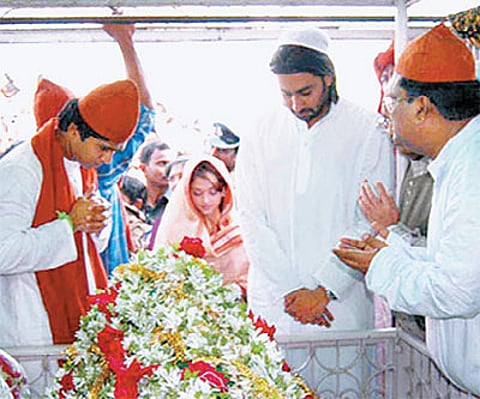

A R Rahman is generally unruffled, but there are times when the celebrated composer feels downcast.
That is when the Mozart of Madras would pay a visit to Ameen Peer Dargah, popularly known as Pedda Dargah, in south-central Andhra Pradesh. This tomb—of a 16th-century Sufi saint—in Kadapa is known for its tranquil air. And for the one belief that prevails among the devout: unburden yourself in the presence of Peerullah Malik, and your problems are solved, your wishes are fulfilled.
Not surprising, it is not just Muslims who take a pilgrimage to this dargah. Also, it isn’t just the less famous who offer prayers here. It’s no recent phenomenon either.
Late prime minister Indira Gandhi, president Neelam Sanjeeva Reddy and singer Mohammed Rafi used to visit the Dargah of Malik, whose full name was Hazrath Khwaja Syed Shah Peerullah Mohammed Hussaini Chishti Ul Quadri.
The other celebrities of an earlier era include Urdu poets Hasrat Jaipuri (1922- 99) and Shakeel Badayuni (1916-70).
Among the politicians to visit the dargah today are Y S Rajashekar Reddy, N Chandrababu Naidu, Sushil Kumar Shinde. Then there are actors like Aishwarya Rai, Abhishek Bachchan, Jaya Bachchan, Aamir Khan, Akshay Kumar, Chiranjeevi and Allu Arjun and ghazal singer Kesiraju Srinivas.
As for Rahman, he makes it a point to come to the dargah before taking up any major assignment. “He comes with his family—and, sometimes, alone too,” says Md Noor, a khadim (help) at the dargah. “He silently offers his prayers at Peerullah Malik’s tomb, and then spends some time at the dargahs of Arifullah Hussaini and Ameenullah Hussaini.” There are several khadims and mujavars who instruct the visitors on how to conduct themselves and where to go and pray. “Before the eyes of God everyone is equal.” says S Ameeruddin, head mujavar of the dargah.
There is a belief that drinking water from the pots inside the mausoleum of Peerullah Malik can solve health problem. Hence the long queue for a glass of water.
The complex also has a Dadima dargah where women, especially those who are seeking a groom, pray. Garlands of flowers and beeda (betel leaves, nuts and sugar) are offered there. People also symbolically leave behind their worries and problems with Dadima by fastening locks to the grills and throwing away the keys.
For the last four centuries, the descendants of Peerullah have been the dargah’s Sajjad-e-Nasheen—working to spread the core principles of Islam and other faiths.
They also impart education and vocational training for poor Muslim girls, and performs free marriages.
