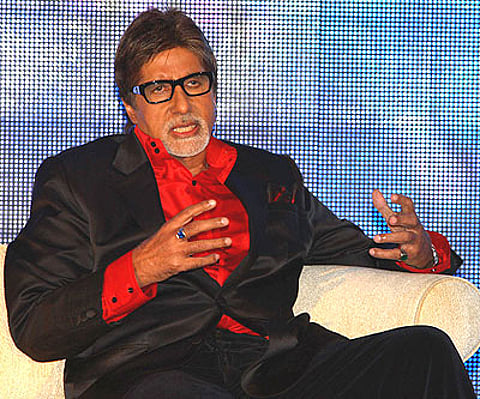

To truly understand Amitabh Bachchan, you must watch him walk—with giant strides, at a brisker pace than most people around him, purposeful and hurried even when not rushed. To see him in motion is to feel the need to rewrite the cliché: he’s not walking the talk, he’s living the walk.
While he wraps up promotions for Aarakshan, he’s also preparing for the launch of Kaun Banega Crorepati 5. Between brand endorsements and films with Ram Gopal Varma, Rakeysh Omprakash Mehra and Ashutosh Gowariker, he will also find time for a daily blog, his unfailingly regular posts on Twitter and his vog (a voice blog). If you didn’t know, you would never guess that this man is less than two months away from his 69th birthday.
As we chat at Delhi’s Le Meridien hotel, he explains: “I just look at it as my good fortune that I’m getting another job. My work keeps me occupied and busy, it keeps my mind alive. I get an opportunity to work with the younger generation, feel their temperament, see how they approach their work. That process is very exciting. I just feel that I’d like to be occupied. So, I keep working.”
But there are others who have kept working past the widely prescribed age of retirement. What sets Bachchan apart is that he has retained his relevance. Not surprisingly then, trade sources say he earns Rs 4.5-5 crore per film. And he charges Rs 8 crore a year for each of his brand endorsements, which is as much as SRK gets and just one step below Aamir Khan’s Rs 12 crore fee.
“Amitabh Bachchan is an exemplar model of what seems to be a larger trend of an increasing acceptance of age, particularly in a context in India where our demographics are showing a much younger population. As the number of old people decreases, they seem to be becoming more valuable not invisible in our society,” says sociologist Dr Radhika Chopra. “There has been an important shift in how age is viewed. What we think of as retirement has been pushed down the ageing line; people are living longer, living healthier, therefore appearing younger and seeming to be more fully capable a lot later into life so there’s no reason not to be in the public eye.”
This could explain the dichotomy between the appeal of Brand Bachchan and the increasing murmurs about how the average age of our politicians is too high. Says industrialist-MP Naveen Jindal, one of Parliament’s youth brigade: “I agree that older politicians who are physically unfit should make way for younger people. But if you are fit and making a meaningful contribution, there’s no reason why you should quit, irrespective of the field you are in. The thing about Bachchan is that he continues to do a good job. If you are unable to perform well but you still carry on, that’s when people get irritated.”
It also helps that when the going got tough, Bachchan adapted to a changing scenario. Tamil film audiences may embrace 60-year-old Rajinikanth still walking on walls and romancing heroines 30-40 years his junior, but Hindi film viewers rejected a then-50-plus Bachchan through much of the 1990s when his films presented him as much younger than he was in real life and/or cast him with much younger actresses. By the turn of the century he had reinvented himself, playing his age, playing character roles instead of the conventional hero and experimenting with newer media (the move to television with Kaun Banega Crorepati was in 2000). Today, says Anirban Blah, MD of celebrity and entertainment marketing firm Kwan, in Mumbai, “Bachchan represents a benevolent patriarch in the ideal Indian family. There’s a wisdom and warmth everyone relates to, a work ethic everyone aspires to, and if you look at the young-at-heart characters he’s played in films like Kabhi Alvida Naa Kehna, he’s also a contemporary patriarch, the kind of father a young person hopes to have.” As Radhika Chopra puts it: “Bachchan is not just an old man or an uncle in his films and ads, he’s looking at himself as a competent uncle and a sexy old man. He may be playing an older man, but the character’s attributes of elderness are not devoid of youngness.” This then is what makes him that rare role model the youth look at and think: When I am that age, that’s how I want to be—fit, successful and still having fun.
And so Bachchan defies the four ashrams or life stages of Hindu tradition embedded in our national psyche, in a way that young India is increasingly doing. Technically, he is at the age of Vanaprastha Ashram, the time band when most Indians are still sub-consciously socially attuned to retire from work, take advantage of their diminished household responsibilities, relax, spend time with the grandchildren... But as middle-class urban youth increasingly reshape their own instincts and turn their backs on convention, retire early if they wish, take mid-career sabbaticals that their office-bound parents would not have risked or change professions in their 30s and 40s, Bachchan is perhaps India’s most famous student without a classroom!
His teacher could be anyone. “The thing I enjoyed about working with him was that he listened to me,” says 16-year-old Ayesha Kapur whose age had not touched double digits when she shot Black with Bachchan. “He would take my suggestions, we’d even make changes or re-shoot if I was not comfortable with the way a shot had gone.”
Bachchan’s favourite gurus these days are the public on the social networking platform Twitter where he seems more “with it” than most of his industry colleagues, including many in their 20s. Does he have someone advising him on how to deal with his nearly one million followers? “The people that I write to are the ones who teach me,” he replies.
The actor’s social media adventure has not been devoid of controversies. In 2009, he wrote on his blog that if what people told him about Slumdog Millionaire was true, then it bothered him that the film was projecting India as a “Third World dirty underbelly developing nation”. He responded angrily to press headlines that said “Bachchan Slams Slumdog” with “but I never said it’s showing our dirty underbelly to the world. I said if what people tell me about it is true, then …” Last year, during a Twitter conversation with a journalist, he explained that the editing of Raavan had made Abhishek’s actions in the film seem odd. He was furious that his tweets were quoted in the press though he considered it a private conversation and insisted he’d been quoted out of context. The only snag in that argument is that there’s nothing private about such a public space, besides which the truth is out there for his readers to verify. Mahesh Murthy, founder of digital and social media management firm Pinstorm, does not see these as newbie “mistakes”: “The important thing in social media is to get talked about, and that happens when you say something controversial. Younger stars must know that they do not get press with bilge like ‘my director’s the best’ and ‘my co-stars are wonderful’. So there’s a real possibility these aren’t mistakes, but at least in part are acts by a clever person who understands the value of creating word-of-mouth-worthy bites. Even if these were inadvertent, there’s no damage done: you get known for having non-conformist, non-nice-nice views, and that increases your engagement and audience size.”
Controversies or not, Bachchan is not slowing down. One possible reason is that he’s afraid to. Having witnessed his mother’s descent into Alzheimer’s Disease, he is conscious of how age has diminished his mental capacity. “Unless you keep at it, keep yourself mobile, keep yourself occupied and your mind working you tend to stagnate,” he explains.
It is this determination to stay alert that keeps him alert, the desire to stay fit that keeps him fit. Wherever he is in the world, Bachchan religiously devotes himself to his daily two-hour workout which includes cardio exercises, weight training, yoga and pranayam. Says his fitness trainer Vrinda J Mehta: “Amitji’s fitness comes from his discipline and mental strength. I added surya yoga to his fitness routine about a year-and-a-half back, but I’ve not had to make any changes keeping in mind his advancing age in the 11 years that I’ve worked with him.” Bachchan’s commitment to fitness prompts this remark from Dr L K Malhotra, senior neurologist at Delhi’s Vidyasagar Institute of Mental Health and Neurosciences: “Bachchan is a role model not just for the elderly but for the youth too. Everyone should know that if you stay physically and mentally active through your younger years, the habit will continue into your old age and you are likely to at least delay the onset of many ageing disorders. There is a lot people can learn from observing him.”
But the agile body audiences witnessed dancing up a storm and throwing punches recently in Bbuddah Hoga Terra Baap is wracked with problems. Bachchan has spent the past week combating the ill-effects of an intestinal problem that harks back to his 1982 accident while shooting Coolie. But where the medical community considers him specifically a role model is in the manner in which he has combatted myasthenia gravis that surfaced at the time. Myasthenia gravis is a rare and potentially debilitating auto-immune neuromuscular disease that leads to fluctuating muscle strength and fatigue. After his accident, Bachchan recalls being physically incapacitated. Says Dr Sumit Singh, HoD of neuromuscular disorders at Gurgaon’s Medanta Medicity: “It’s remarkable that a man who has suffered from such a serious disease could overcome it and be so active in public life. I tell my patients who are diagnosed with myasthenia gravis, if Bachchan can do it, so can you.” Adds Dr Satish Khadilkar, professor and head of the department of neurology, Grant Medical College, Mumbai: “Sometimes in practice, when patients discover that they have a disease that Bachchan has, they seem to be able to cope better. It’s incredible that he’s come out of the shadow of myasthenia gravis and is doing so much.”
Bachchan is the sort of man you may love or hate, but whose steely grit, professionalism and passion for work you cannot deny. Says Anita Kaul Basu, producer of Kaun Banega Crorepati: “He may be a megastar, but he arrives on set with his homework done. He insists on rehearsals, and unlike many younger stars, he won’t say, ‘Arrey, please fix that mistake on the editing table’, nor does he look for short cuts.” Twenty-seven-year-old Rana Daggubati, rising star of Telugu cinema who will work with Bachchan in Department says: “When I saw Mr Bachchan on a film set for the first time, he was not sitting under the umbrella designated for him, he was sitting on a chair under the sun, waiting for his shot to be taken unlike other actors who will go back to their vanity vans, rest and wait to be called.” Sonu Sood who played Bachchan’s son in Bbuddah Hoga Terra Baap has a similar memory from the sets. “Actors can learn from Mr Bachchan—if you don’t keep technicians waiting but give a shot the minute it’s ready, you save hours and considerable production costs.”
Deepika Padukone—Bachchan’s co-star in Aarakshan—points to a long dialogue that he has with a journalist in the film. “A few days after the scene was shot, I heard it was being redone and thought perhaps there had been some technical error. It turned out that Mr Bachchan was not happy with it and kept SMSing Prakashji (director Prakash Jha) saying let’s redo it, though Prakashji said he’d got what he wanted. Finally Mr Bachchan insisted, so we got all the actors together again and reshot it.” Clearly, this is a man who lives to learn.
Click here for an interview with Amitabh Bachchan
The writer is on Twitter as @annavetticad