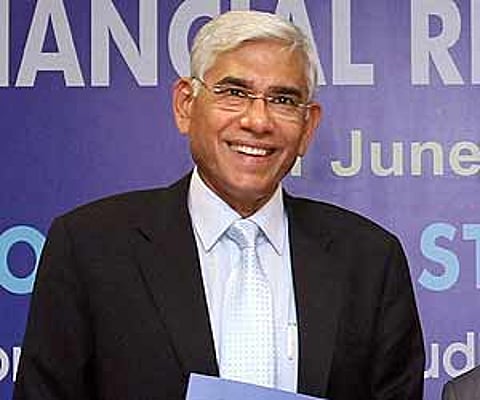

The government hated him. The Congress made him Enemy No. 1. Undeterred, the man who watches over government spending called it to account in 2011, and exposed corruption in high places for the national epidemic that it is. He is the custodian of national wealth. His unforgiving audits are the nightmare of politicians in power. He has been meticulously examining government expenditure ever since he assumed office on January 7, 2008. Sixty-three-year-old Vinod Rai, the 26th Comptroller and Auditor General of India and The Sunday Standard’s Face of the Year 2011, has put the scandal tossed UPA government on the mat: every case of loot of public money this year was exposed by him. His audit of the 2G spectrum allocation — which estimated the notional loss to the public exchequer as Rs 1.76 lakh crore — created a storm that has shattered the credibility and will of Manmohan Singh’s government. “The fact that there has been loss to the national exchequer in the allocation of 2G spectrum cannot be denied,” the CAG wrote. Says D Raja, MP and CPI national secretary, “Vinod Rai, as the CAG, exposed the biggest scams of post-Independence India, whether it is 2G or CWG, without fear or favour.”
The prolific crusader
Between 2008 and 2011 till date, the CAG has prepared and submitted 123 Union audit reports: 26 in 2008, 12 in 2008-2009, 23 in 2009-2010, 36 in 2010-2011 and 42 this financial year, with more being audited. He also prepared 237 Union plus state audit reports. The CAG conducts three kinds of audits. After the initial Financial Audit, the Compliance Audit examines whether expenditures and outlay tally. The third is Performance Audit, which is the critical audit because it allows CAG unfettered access to all relevant documents. A letter from the Finance Ministry in June 2006 states that the performance audit falls within the CAG’s powers. Rai has clarified many times that audits on 2G spectrum allocation or profit sharing in petroleum are performance audits “because public goods have been made available for a private partner to exploit”. It is this exploitation that comes under Vinod Rai’s ruthless scrutiny. On KG Basin, CAG raised the following points: 1. RIL started procurement activities late 2. RIL is guilty of non-relinquishment of area 3. RIL extended contracts violating Production Sharing Pact 4. RIL did not relinquish non-performing wells 5. Amend all future production sharing contracts 6. Director General of Hydrocarbon (DGH) should have stopped RIL from proceeding with phase II. 7. RIL violated production-sharing contract in KG-D6. The report doesn’t mince words: the production sharing contracts with Reliance Industries has “again exposed the nexus between policy-makers and big business”. It went to ask for a probe into the petroleum ministry’s role in the affair. The CAG also asked for RIL to be penalised for “gold-plating contracts and cornering almost the entire share of the profit petroleum”. It was a damning indictment of corporate profiteering.
Many of his reports have exposed questionable government deals. 2011 was UPA’s worst year. CAG’s Report No. 19 put the glare on hydrocarbon production sharing contracts issued by the petroleum ministry, mainly RIL. Reliance criticised CAG for ignoring its viewpoint. But Rai’s audit of the petroleum ministry was done at the government’s behest. In November 2006, the government wrote to the CAG that concerns have arisen over the profit-sharing contract with three parties, and not just Reliance. The private operators objected, saying a CAG audit was never part of their contract. But the government stood its ground, saying the CAG should do a performance audit. For three years, the matter was argued in court and the CAG won. The audit was done under the aegis of the petroleum ministry without dealing with the parties directly.
The second performance audit of the year was on the ministry of civil aviation. Calling it a “recipe for disaster”, the CAG report tabled in Parliament questioned the purchase and leasing of aircraft by Air India that increased its debt from Rs 38,500 crore from Rs 29 crore within a year. The CAG questioned the haste: the report states on December 30, 2005, when a GoM sent the Prime Minister a note supporting the purchase of 50 aircraft from Boeing and General Electric, it was immediately approved.
The third audit report on the Adarsh Co-operative Housing Society in Mumbai felled a Congress chief minister, and exposed a shadowy list of former CMs and shady land deals. The next audit was on the fertiliser subsidy, which attacked the government for deliberately pushing up costly imports, making indigenous production secondary. The report said during 2003-04 and 2008-09, fertiliser consumption rose by 46 per cent, but food grain, oilseeds and sugarcane production increased only by 16 per cent. Ironically, the report was tabled in the House on the same day a GoM approved inclusion of urea under the nutrient-based subsidy scheme (NBS).
The controversial audit on the Commonwealth Games 2010 followed the fertiliser subsidy performance audit. It was the beginning of the UPA’s slide. The CAG had devastating questions and conclusions. 1. There were delays relating to venue development at all stages 2. Significant deficiencies in design inputs for execution were noticed in cases where foreign partners were involved 3. Different implementation agencies followed different processes for award of major construction works 4. Deficiencies in the process for award of major works related mainly to pre-qualification and eligibility 5. Inconsistencies in eligibility criteria, but also delays in the process of award and execution. 6. Appointment of Consulting Engineering Services (CES) as the main design consultant for the five main stadia was seriously flawed 7. The main work of Dr. Shyama Prasad Mukherjee Swimming Pool Complex was awarded on a lumpsum contract 8. Concessions given to the contractor was in deviation from the spirit of the lumpsum contract 9. A firm, otherwise ineligible for the composite work of the indoor cycling velodrome, was irregularly qualified for upgradation and construction of Indira Gandhi Stadium Complex 10. There were deficiencies in the bidding process for the wrestling stadium, ultimately resulting in a single financial bid, which raises concerns on the competitiveness of the bidding process 11. In the case of the Major Dhyan Chand Stadium, audit revealed dilution of pre-qualification criteria benefiting a particular contractor. 12. Key issues related to selection of Commonwealth Games Village site were not properly addressed 13. Emaar MGF also illegally constructed 17 additional dwelling units in the basement meant for parking. The ensuing furore cost one of the most powerful Congress politicians his liberty: Suresh Kalmadi, CWG Chairman, was jailed for corruption.
It was a sign of things to come. Then came 2G followed by three more reports, on Defence Estates management, Railways and the Ministry of Environment and Forests. Vinod Rai had become the Anna Hazare of the bureaucracy.
Targeting their tormentor
Like with Hazare, the Congress has gone on the offensive with Rai: senior partymen drafted for the purpose allege the office of the CAG is being misused by vested interests to malign the government’s image. A Congress spokesman, who was recently embarrassed by his comments on Anna Hazare being “steeped in corruption”, questioned Rai’s methods at a meeting of the Joint Parliamentary Committee (JPC) before which the CAG deposed on December 20. The JPC chairman, veteran Congressman and former Kerala MP PC Chacko asked Rai whether the member should withdraw his offensive remarks. In response, the unflappable tennis player fired a savage volley: “I do not make remarks I regret later and that need to be withdrawn.” The CAG is a constitutional authority that reports directly to Parliament, but when the JPC on 2G was set up, Rai himself offered to be cross-examined. The one being cross-examined in public, however, is the government. After the exposure of the 2G scam that sent UPA ministers, MPs and senior bureaucrats to jail, the CAG report on the Reliance 2G basin profit-sharing agreement threatens to cast a long shadow over the UPA. Rai’s reports have not merely helped the Opposition put the government in the political infirmary, but also have strained political-corporate relationships.
Ravi Shankar Prasad, MP and BJP chief spokesperson, says Vinod Rai is doing the job that was expected of him. “The CAG, after all, is a custodian of the constitutional mandate given to him to meticulously go through all the accounts of the government and bring out every wrongdoing to the public domain. In this case, the CAG brought to the fore the rampant corruption that has become the hallmark of the UPA government,” he says.
The Congress strategy is to allege CAG miscalculated the revenue loss in 2G allocation, thus questioning his credibility as an auditor. But CPI(M) politburo member Sitaram Yechury says, “I am glad to note that the CAG figure was a vindication of my four letters to the Prime Minister on the 2G issue. I had calculated the figure of 2G loss at Rs 1.90 lakh crore, while the CAG in his report, which came out later, put figure as Rs 1.76 lakh crore. When I personally asked Mr Rai about this, he told me you are an economist by training, but you forgot about the element called ‘product differentiation’.”
Winning the fallout
Rai’s bold stand on 2G placed him on top of the growing list of UPA foes. At a briefing of five chosen editors in November, Prime Minister Manmohan Singh accused Rai of exceeding his brief: “Never has a Comptroller and Auditor General held a press conference as the present CAG has done.” The PM had also said, “It was not right for the CAG to go into issues which are not its concern. It wasn’t the CAG’s business to comment on policy issues.”
In protest, Rai shot off an angry letter to Singh. “We follow the mandate given by the Parliament and we have not transgressed our mandate,” he wrote. Within two hours of receiving the letter, a shaken Manmohan Singh immediately asked Rai to meet him and spent around 45 minutes soothing him to defuse an unprecedented confrontation between a constitutional authority and the government. The prime minister’s remarks on the CAG were removed from the PMO website immediately after.
“Does the CAG have an agenda? Does he want to follow the footsteps of TN Chaturvedi (ex) CAG, of Bofors Report, BJP MP and governor?” asked Congress general secretary Digvijaya Singh. It was Chaturvedi’s report on Bofors that spelled the beginning of the end for the Rajiv Gandhi government in the 1980s. Former finance minister Yashwant Sinha says, “The CAG played a stellar role. The Parliamentary Accounts Committee was examining the matter and then CAG was asked to expedite the probe. The CAG acted in the best traditions of his office, exposing the losses and irregularities.”
Irregularity became the norm when the dirty tricks department of the Congress party launched a whispering campaign that the CAG was leaking its own reports in bits and pieces for publicity. Rai’s response was caustic: what does CAG gain by leaking its reports? It would be stealing its own thunder, because when submitted on the floor of Parliament, the report would have greater national impact. However, Abhishek Manu Singhvi, MP, Congress national spokesperson and Chairman of Standing Committee of Law and Justice, denies any attempt at character assassination. “Contrary to media distortions, the Congress is in no way antagonistically opposed either to the constitutional post of the CAG or the incumbent,” he says. “Objections, whenever raised, are purely principled objections, when anyone exceeds constitutional jurisdiction. The Lakshman Rekha has to apply evenly to all — be it the President of India, the CJI, the Prime Minister or the CAG.”
An IAS officer & a gentleman
Vinod Rai has never hesitated to cross the Lakshman Rekha on his beliefs. In 2002, Rai moved to Delhi from Kerala as Joint secretary in the Finance ministry when Jaswant Singh was finance minister. In 2006, impressed by his capability and credibility, the UPA government promoted Rai as Special Secretary, Finance. P Chidambaram was finance minister then. Rai was known as an officer who spoke his mind, even on issues that he and his boss differed on. The same year he was appointed, all public sector banks decided to raise the BMPLR (Benchmark Prime Lending Rate). As a result, interest on corporate loans became prohibitive and business leaders complained to the finance ministry. Banking came under Rai’s jurisdiction. The ministry decided that BMPLR should be rolled back. Rai was instructed by the ministry to implement it. The pugnacious bureaucrat’s response was typical; there should be no interference in the autonomy of public sector banks, even if it is the government that owns them. Rai was instructed to direct the banks to hold board meetings. The first meeting was of the Bank of Baroda board in which Rai was a director on behalf of the government. BOB decided to defy the government’s diktat to lower lending rates. Rai agreed, and put his signature on the minutes. Chidambaram was upset, but he decided to support his special secretary because he realised Rai was a man of unimpeachable integrity.
This is not the first time the 1973 batch Kerala cadre former IAS officer has taken on powerful interests. The steel in the steel frame of bureaucracy revealed itself first in 1977. Rai was heading the Kerala Cooperative Marketing Federation (KCMF) also known as MarkFed. The then-Left front government had issued an ordinance making KCMF the sole procurer of cashew in the state for export. It was meant to curb Kerala’s powerful cashew mafia that smuggled the product with impunity, causing loss to the state coffers. Rai was active on the ground, seizing several trucks carrying smuggled cashew. One day, a minister, P K Vasudevan, intervened, asking Rai to release some captured trucks. He refused, leaving the CPI politician ashamed.
His independence as a bureaucrat was known throughout Kerala when from 1977 to 1982, he was Kerala’s finance secretary. He was known to be so unbendingly correct and financially knowledgeable that during a budget debate, Congress MLAs asked the state finance minister why he bothered to present the budget since the real finance minister — read Rai — was present in the official’s gallery. The Speaker forced the legislators to withdraw their remarks, but it did not go unnoticed in the state.
People’s panjandrum
KCMF employees remember Rai as a hands-on officer with integrity. A V Usha, an accountant, still remembers the young Vinod Rai climbing sacks in the MarkFed godown to inspect the grain. “He used to know every stage of the functioning, from the godown to the shipping. Those days we had conversations with foreign exporters by telex. He would just stand beside the machine and instantly dictate the reply. No getting tangled in procedures and paperwork,” she says.
Aryadan Mohammed, now Kerala’s electricity minister, served as KCMF director during Vinod Rai’s tenure. “He was efficient and dynamic. We won the national Export Award thrice in a row. We began exports in all possible areas, from spices to even tapioca,” Mohammed remembers.
Mohammed praises Rai’s innovative abilities. Exporting tapioca chips was Rai’s idea. “We exported the chips to Japan and Germany. Ginger, Cardamom, Copra boomed,” says Sethumadhavan, now KCMF Marketing Advisor. He clearly remembers a job interview two decades ago. “On the interview panel were Vinod Rai, a couple of officials and Aryadan Mohammad. “Out of the blue Rai asked me, Have you sought anyone’s influence to get you the job? I was taken aback but replied in the negative.” It was only later that Sethumadhavan came to know the reason for Rai’s query. Aryadan Muhammad was a senior officer in the organisation he was working for at that time. Rai was only voicing his doubts whether he approached Aryadan to put in a word. “Rai was bold enough ask the question in front of Aryadan,” says Sethumadhavan.
MarkFed staffers remember Rai as an ideal boss. “He used to know the names of each and every staff member. Sometimes when labour issues cropped up, he would go and pacify the labourers. From the warehouse to the ship, he knew every stage. People were free to approach him with problems. After him there have been several IAS officers. But he is the one I can never forget. It is our loss he had to leave so early,” Usha says.
Rai was a champion of his colleagues too. He was the president of the Kerala IAS Officers Association from 1977 to 1980. After the Emergency, the Left government suspended six bureaucrats for dereliction of duty. Rai led a delegation of 40 IAS officers to then chief minister E K Nayanar. The CPM state committee tried to target Rai, but in the end the suspension of four officers was taken back.
Strategist par excellance
The Congress party may be calling Rai names now for fearlessly exposing the scam-a-minute government, but it was the UPA that chose him as CAG. Of seven names shortlisted — Sanjeev Misra, former finance expenditure secretary; M S Swaminathan, former petroleum secretary; MN Prasad PMO official; HC Gupta, former Coal Secretary and three others — it was Rai who made the cut. But the unkindest cut was government MPs attacking him on the 2G calculations. Newspapers reported an offended Rai telling a group of MPs and senior officials that if the UPA desires to impeach him, it could bring a no-confidence motion in Parliament. Perhaps the wily strategist in Rai remembered a precedent: in the 1960s, when former Defence minister V K Krishna Menon objected to the CAG report in Parliament on the army jeep scam, the then Lok Sabha Speaker, Anamta Shyanam Ayyenger, gave his ruling on March 17, 1960, “The Auditor General is not an officer of this House. He is an officer under the President. Under the Constitution, he is bound to send a report to the President and he (the President) causes it to be laid on the table of the House through a Minister. The Comptroller and Auditor General is appointed by the President, by Warrant under his hand and seal.” He ruled that the CAG cannot be attacked in Parliament and Krishna Menon can move an impeachment motion if he wants to criticise the office. An impeachment motion would suit Rai well. He would be able to counter his critics on the floor of the very Parliament they have been voted to. “Vinod Rai is a nice person. But the CAG needs to get professionalised. The CAG reports are pretty shallow and the CAG thinks it is in the publicity business. It is exceeding its limit. But this is not a comment on him as a person,” says Congress MP and chief whip in the Lok Sabha Sandip Dikshit.
What Dikshit probably does not see is that Rai is a man who is constantly pushing the limits. Mountaineering is his grand passion. Standing on the pinnacle of his career, with two more years to go, Rai has a bird’s view on corruption. Congress MP Hamdulla Sayeed remarks nonchalantly, “Vinod Rai did his job. He was paid to do it, that’s all.” Vinod Rai doing his job has set off avalanches that threaten to bury the UPA’s credibility. Their worry would be, “What next, Mr Rai?”
- with bureau reports
**************
RAISPEAK: THE BIG ONES
Commonwealth Games 2010
“The Indian Olympic Association (IOA) bid of 2003 estimated an all inclusive cost of just Rs 1,200 crore. By contrast, the overall budget estimate for CWG 2010 for Government of India and Government of National Capital Territory of Delhi (GNCTD), including Municipal Corporation of Delhi, New Delhi Municipal Council and other agencies as of October 2010 was Rs 18,532 crore.
2G spectrum allocation
“Auction of 3G spectrum was recommended by Telecom Regulatory Authority of India (TRAI) in its report submitted to the government in September 2006. In its report of 2010, they have observed that it was fair to compare 2G with 3G and recommend 3G prices to be adopted as current price of 2G spectrum by in 1800 MHz band. If these recommendations, which have not so far been accepted by the government are taken into account, then the value of 2G spectrum allotted to 122 new licensees and 35 dual technology licensees would be much higher at about Rs 1,52,038 crore against the amount actually received.” That was around Rs 12,400 crores. The report stated that the total loss to the exchequer was Rs 1,76,645 crore.
Production-sharing contract (KG Basin)
“Given the similar conclusions that two independent agencies, the Chawla committee and audit, have reached as regards the adverse impact of the profit sharing mechanism in protecting Government of India’s (GoI) interests, linked to investment multiple, designed in the late 1990s,there does seem to be enough ground to revisit the formula. The PSC drawn up then was with the limited expertise available with the GoI at that point of time. In view of the fact that we have now gained the knowledge, there is a need to conclusively address this issue in view of future PSCs.
“Our audit review revealed that, by and large, the Ministry of Petroleum and Natural Gas (MoPNG) as also the Director General of Hydrocarbons (DGH), both through the Management Committee and otherwise, did not pay adequate attention at every stage of exploration and production (E and P), be it exploration, development or production, to Government of India’s (GOI) financial interests. Adequate attention was not paid to specifically how every proposal/decision would potentially affect GoI’s share of profit petroleum. In addition to their failings, the constraints of adequately skilled resources with MoPNG/DGH for monitoring several hundred PSC’s simultaneously cannot also be ignored. By contrast, it is inconceivable that the private contractor would fail to protect his financial interests, and assess every investment/operational proposal to see whether it would result in incremental revenues for him both in terms of cost recovery and contractor’s share of profit petroleum.”
*************
The reports that hurt
■ 2011-12 Report No. 19: Performance Audit of Hydrocarbon Production-
Sharing Contracts (Ministry of Petroleum and Natural Gas)
■ 2011-12 Report No. 18: Performance Audit of Civil Aviation in India (Ministry of Civil Aviation)
■ 2011-12 Report No. 11: Adarsh Co operative Housing Society, Mumbai.
■ 2011-12 Report No. 8: Performance Audit of Fertiliser Subsidy
■ 2011-12 Report No. 6: Performance Audit of Commonwealth Games, 2010.
■ 2010-11 Report No. 14: Performance Audit of Canteen Stores Department.
■ 2010-11: Performance Audit of Issue of Licences and Allocation of 2G Spectrum by Department of Telecommunications (Ministry of Communications and Information Technology)
■ 2010-11: Report on Performance Audit of Defence Estates Management.
■ 2010-11 Performance Audit of Union Government — Railways.
