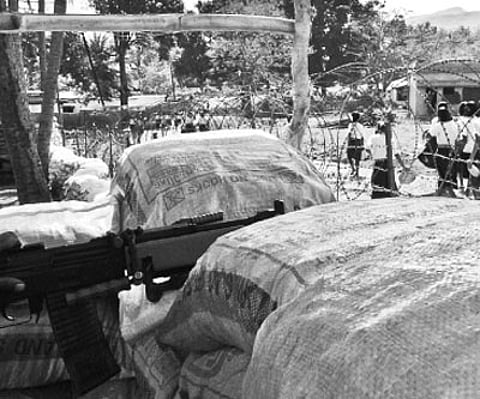

This used to be Nachika Linga’s owner’s house,” says the Border Security Force commander of the newest BSF camp set up at Podapadar village, one of the flashpoints of the Chasi Mulia Adivasi Sangh movement.
The house in question belonged to Nila Kancha Parida who literally owned Nachika Linga — a bonded labourer on his own land who earned Rs 5 per month before becoming the leader of the Chasi Mulia Adivasi Sangh tribal movement — now one of the most wanted people in Narayanpatna block. It is petty symbolism that the once-oppressor’s house is now used by the Border Security Force to track down the members of the Chasi Mulia Adivasi Sangh, who stood up for their land rights in 2009.
Today, the entire movement has gone underground, with over 150 of their members and their supporters in jail, including Gananath Patra of the CPI (ML), who was arrested as a Maoist, as well as his associate Tapan Mishra, who has already clashed with prison officials after going on numerous hunger strikes. Yet the vast majority of the CMAS lives in fear, further within the jungles, often on the move, without food, in constant risk of being apprehended.
Nevertheless, six Kondh tribal women and four infants got onto the Hirakhand Express at Koraput railway station on January 25, 2011 to travel to Bhubaneswar.
For many of them it was the first time on a train. There had never been any need to go to Bhubaneswar, or anywhere beyond their homes in the jungles of Narayanpatna or Laxmipur before. But secretly, and quietly, these six women travelled to Bhubaneswar, and were told that they would have to testify at a public hearing, to the National Human Rights Commission. All the six women have lost their husbands to state violence.
Balsi Kendruka w/o Andru of the village of Baliaput, Narayanpatna lost her husband during the November 20 firing/’camp attack’. Sonai Kendruka w/o Singana of the village of Podapadar, Narayanpatna also lost her husband in the same incident.
Kamla Tadingi w/o Ganguli of the village of Bagam, Narayanpatna lost her husband when he was picked up by the police in Narayanpatna, and died in custody at the Koraput Jail on April 12, 2010.
Kamla Sirika w/o Ratna of the village of Siriguda, Narayanpatna lost her husband when he went for treatment for an unspecified illness to Narayanpatna town, and was arrested by the police and died in a hospital in Berhampur on June 8, 2010.
Saibo Honika w/o Jimme of Jogipalur, Narayanpatna lost her husband when security forces raided her village. He was allegedly drowned in the Janjawali river.
Singaru Huika w/o Katru of the village of Talameting, Laxmipur lost her husband after he was shot dead by the security forces the day after Maoists raided the nearby NALCO plant where they killed 10 CISF jawaans and lost four of their own on April 12, 2009. Katru Huika is surprisingly mentioned as a ‘public witness’ in the FIR filed regarding the NALCO attack.
All of them barely spoke at the hearing. The irony is that K G Balakrishnan, chairman of the NHRC returned to Delhi a day before the hearing. (The bigger irony was that he would have been sharing the dias with the senior advocate Prashant Bhusan who, along with his father, had indicted him as one of the ‘eight corrupt Chief Justices of India’.)
The hearing itself indicted the government of Orissa regarding “state repression on the rise in the state particularly on people’s movements against displacement and land grabbing,” and the recent spate of encounters in Bargarh, Keonjhar, Jajpur and Rayagada. It had called for “an independent and impartial investigation” into all the encounters.
The way of the gun
Since the firing on November 20, 2009, still widely considered to be a ‘camp attack’ by the police and the administration, all that the Kondh Adivasis of Narayanpatna have seen is the slow militarisation of their lives. Not only have three BSF camps been set-up in Narayanpatna block, Maoist activity has also been on the rise.
One IED blast claimed four civilian lives in January 2010, and since then there have been numerous IEDs recovered by the police at regular intervals. Only recently another IED exploded on January 11, 2011 near Jogi Palur, injuring three government officials.
There have also been a series of killings by the Maoists in August of 2010, most infamously, of Anand Kirsani, the leader of the embryonic state-backed anti-CMAS group, the Shanti Committee, who was also a Zilla Parishad member and a Congress party leader.
The Maoists also killed a member of the CPI (ML), Arjun Kendruka as an informant. Another villager, Ghasi Kendruka from Gotiguda village was killed on August 15.
The general secretary of the CPI (Maoist) Ganapathy himself has acknowledged in a recent interview the gains that his party has made in Narayanpatna block, and spoken strongly against the ‘revisionist’ tendencies of members of the other communist parties working in both the Narayanpatna and Bandhugaon blocks.
It’s no secret that the Bandugaon movement and the Narayanpatna movement have been at odds over the last two years. And yet the core issue remains land.
Though the Shanti Committee has been “finished” after the murder of their leader Anand Kirsani, there is still no guarantee that the paddy that rightfully belongs to the tribals would not be illegally split 50-50 between the tribals and the non-tribal Sahukars and ‘landlords,’ as happened last year, right after the suppression of the Chasi Mulia Adivasi Sangh.
Cultivation is taking place in many of the strongholds of the Chasi Mulia Adivasi Sangh at Narayanpatna, and yet the BSF presence is ominous. On January 27, reports emerged that six homes in Musalmanda village of Narayanpatna were allegedly burnt down by the security forces.
A soldier’s crisis
“You know what would solve this whole Maoist problem?” asks a BSF commander. “There should be mandatory military service either in the CRPF or BSF for all citizens of India. This way some politician’s son can also end up at Podapadar.”
The imaginary border is drawn across the jungles, cutting across mainstream India and that which belongs to the Kondh of the Chasi Mulia Adivasi Sangh at Podapadar. The Border Security Force is once again strategically isolated as most security camps within the jungles are.
A school functions a few metres from the camp, and hillocks surround the camp.
“If we’re attacked, we’re on our own,” said the commander, “And though we had asked for another spot, but they gave us this one.”
And the risks don’t stop there. “You don’t even have to ask us about mosquitoes,” said a BSF soldier, laughing, who mentions there have already been a handful of (malaria?) cases in the camp.
Yet what remains striking is that the BSF soldiers were aware of the existence of bonded labour at Narayanpatna block. “Five generations of Nachika Linga were slaves,” mentions the BSF commander, yet the manhunt against him continues.
No one in Narayanpatna can ever forgot the “dead or alive” posters of Nachika Linga that were posted across the town.
— javed@expressbuzz.com
