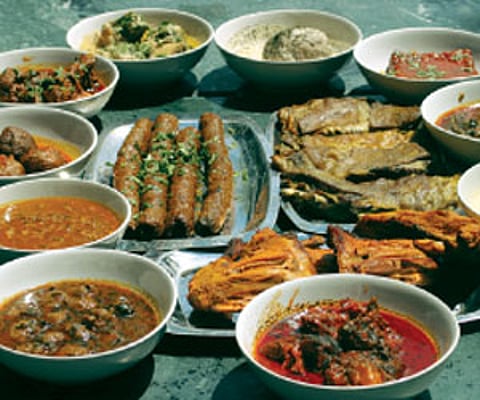

Ideally a visit to Kashmir should include a wazwan experience — a celebratory feast that involves days of planning and preparation. It is really an exercise in Kashmiri hospitality — the courses served are endless (up to 60 vegetarian and 40 non-vegetarian dishes) all prepared under the supervision of the Vasta Waza or head chef — so calorie counters and picky eaters should stay away. Groups of four diners seat themselves on the floor at a wazwan and share the meal from large copper plates known as tramis .
For those of us who cannot partake of the real deal, The Royal Orchid had Vasta Waza chef Bashir Concha, from Srinagar, lay out an abbreviated version of the wazwan with specialties individually highlighted so that diners do not get confused with unfamiliar names and too many choices.
“Kashmiri food uses exotic spices such as cockscomb flowers, saffron, fennel and dry fruits like nuts and plums. The emphasis is on the subtle, milder flavours. The Muslim Kashmiri preparations are quite distinct from those of the Kashmiri pandits. Seven dishes are a must for a wazwan — rista, rogan josh, tabak maaz, daniwal korma, aab gosht, marchwangan korma and gushtaba. In fact, the wazwan style of cooking runs in my family so this form of cooking is a passion rather than a profession for me,” says Concha who hails from 10 generations of wazas .
We started with a selection of meat and vegetable dishes — there was chicken rogan josh, fish rogan josh, cauliflower cooked in a turmeric-infused sauce and rajma, which was lighter in colour and texture than its erstwhile Punjabi version.
“The rogan josh came to us via the Mughals, and is lamb and spices cooked together on a high flame. It is a classic Kashmiri dish but it can also work with chicken or fish,” said Concha.
The classic version definitely works better — although the chicken and fish were pleasant enough, they lacked the ‘wow’ factor. Kashmiris are big rice eaters, so breads were not really on the menu. There was a choice between Yakhni pulao, another Kashmiri staple made from rice cooked in lamb broth, which has a delicate light consistency. Or you could opt for plain steamed rice to go with the curries.
The highlight of the menu was definitely the gushtaba or lamb meatballs in yoghurt The lamb is hand- pounded for hours on end, along with spices until the texture turns almost silken. The meatballs are then simmered gently in a yoghurt gravy until fully cooked.
The gushtaba was delicious, the mild gravy infusing the tender meatballs with flavour. “Gushtaba is served at the end of a meal because guests tend to tuck in and finish the lot,” explains Concha. Rista, another meatball preparation in a tomato gravy, was also served but it paled in comparison to the gushtaba. Kahwa an aromatic tea brewed with saffron, cardamom and almonds was served as a digestive just after the phirni and a warm halwa made from wheat flour and saffron. Both desserts were excellent. Not too sweet or rich and they rounded off the meal perfectly.
— jackie@expressbuzz.com