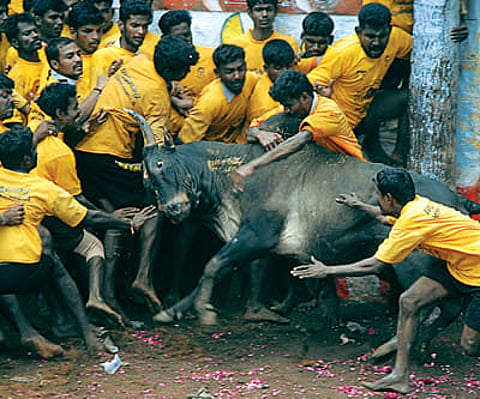

Every January, a day after Pongal, Alanganallur, a sleepy village 16 km northwest of Madurai, resounds to the stomping stomps of a thousand hooves. At the annual jallikattu festival, bulls from across the state stream into the village. This year, around 1,500 bulls, trained specially for the martial sport that pits man versus animal in a gladiatorial contest, congregated at Alanganallur.
The scent of bulls and dung is heavy in the air. The bulls, spray-painted in the colours of the rainbow and decorated with confetti, their curved horns sharpened to points, gleam in the sunshine. The narrow, barricaded streets form the thoroughfare through which they are led to the arena. Rows and rows of tethered bulls await the mandatory veterinary inspection that certifies them fit to take part.
The veterinary inspection is part of the rules recently introduced in response to the petition filed by the Animal Welfare Board in 2008 seeking to ban jallikattu on the grounds of cruelty to animals. The petition said the bulls were subject to inhuman practices such as being fed alcohol and given chilli powder to make them aggressive. It is a claim hotly debated between animal activists seeking to ban the sport and the pro-jallikattu lobby that seeks to preserve it as an indispensable part of Tamil culture.
A hush descends on the 50,000 spectators who throng the arena. Perched precariously on rooftops and specially erected enclosures, the crowd waits with bated breath. At 10 am, Alagar Nadar, the bull keeper, lets in Muniyandi, the six-year-old temple bull of Alanganallur. Muniyandi it is who starts the conclave of the bulls.
Around 1,500 men in the trademark blinding yellow T-shirts (their political sponsors emblazoned on them) and black shorts rise to the challenge of subduing the bulls. It is a rite of passage for young men who want to prove their manhood. Few can resist the test. In earlier times, taming the bull was a mark of virility and made men highly eligible in the matrimonial stakes. That machismo is still intact.
A clutch of testosterone-charged young men file in through the narrow entrance of the Vadivasal through which the bulls emerge unthethered, bundles of unbridled energy. They come into public view one by one. The master of ceremonies recites the lineage and ownership of each bull as it enters. As it shoulders its way through the press of men, the sport begins. A few short-listed men charge after the bull. One of them finally manages to take the bull by the horns and mount the hump. The bulls then canter to freedom through the streets of Alanganallur and into the wilderness beyond.
For every victor, there are several contestants. Even spectators could be maimed, injured, even killed. The recent jallikattu is no exception. There are casualties, but by the next year it’s all forgotten. The old wounds have healed and there’s a new crop of young men all ready to test their courage. It’s time for the bull run again, never mind the fact the culture and kindness to animals are the two horns of a dilemma that is unlikely to be resolved anytime soon.
nandini.murali8@gmail.com
