
It was election time in Andhra Pradesh in the summer of 2009. A friend and I left Hyderabad for a tour of coastal Andhra, and it was not long before the cab driver made out that we were journalists. “Sir, these days, it’s difficult to understand news by reading just one paper. You need to read two or more papers to know what is the truth.” That comment caused a twinge of shame but in one sentence the driver had summed up the media scene in Andhra Pradesh.
Two years hence, things have not changed for the better. If anything, they’ve got worse, with the media and big-time politicians openly and inextricably intertwined. Now, the distance between the media and political parties, not long ago considered healthy for both, has not narrowed or blurred. It has been erased completely.
What has brought this about? Is it the belief of politicians that politics can be more easily and effectively managed if they control the media? Is it because businessmen with interest in politics find access to the corridors of power far easier if they own a media establishment? Or is it because the media gives one the much-needed protective shield even if it means losing some money that can be recovered elsewhere?
The answer perhaps lies in all these. Old timers trace the beginning of this trend in Andhra Pradesh to the mid-1990s when N Chandrababu Naidu upstaged NT Rama Rao to become the chief minister of Andhra Pradesh. Questions are asked to this day as to how many MLAs Naidu really had with him when he launched his midnight coup against his father-in-law from a four-star hotel. But once the newspapers went to town the next morning that a majority of the TDP legislators were backing him, support for NTR dissolved in a trice.
During the nine years that Naidu was in power till 2004, the media was benevolent to him. That this did not prevent his decimation in the 2004 elections is a different matter. In hindsight, those close to Naidu confess that the media did more harm to him than good by not pointing out his mistakes because criticism would perhaps have helped him to embark on a course correction.
The Y S Rajasekhara Reddy regime started off its innings with an attempt to undermine the credibility of the media. “Don’t read those two papers,” he used to say, referring to the state’s largest newspaper, Eenadu , owned by Ch Ramoji Rao, and Andhra Jyothi , an old newspaper revived by a journalist-turned-enterpreneur V Radhakrishna, who took it to the second spot.
The YSR regime also saw the emergence of a neo-rich class thanks to the economic boom and the government’s unbridled gifting away of public properties to private persons. From just two news channels, the state saw the emergence of a dozen 24-hour channels dedicated to “news” as more businessmen and politicians rushed to invest in the electronic media. It helped to keep the establishment in good humour and bargain for a payoff in some other form. While a channel can be put on air for about Rs 40 crore, the minimum monthly expenditure ranges from Rs 80 lakh to Rs 1 crore. But for many of them the revenue does not touch even Rs 50 lakh. And yet none of these recently launched channels have folded.
“Most of the channels or newspapers launched in recent years are intended to serve the interests of their investors and help them use the media clout for other ends. This has had two negative effects: news is habitually distorted nowadays and newspaper columns or TV air time are used to promote individual politicians. It’s not good for a democratic set-up and does not help generate a vibrant debate,” says veteran journalist union leader K Srinivas Reddy.
Proprietors of a couple of channels have managed to wangle special economic zones (SEZs) while others sold out for various other favours. “We have to go through various channels before we get to meet the chief minister, however big we are in the industry. But if we put in about Rs 30 crore in a TV channel, we get immediate access to the powers that be,” says an industrialist who didn’t want to be named. This has become a mantra for anyone who has a stake in the state’s power sweepstakes.
The big change, however, happened a couple of years before the 2009 elections when Y S Jagan Mohan Reddy, son of the late YSR, made a big entry into the media scene with a multi-colour, multi-edition Telugu daily, Sakshi , and a news channel with the same name. Soon, the newspaper was giving a tough fight to Eenadu , the unquestioned leader for two decades. Today both papers sell 14-15 lakh copies each per day. Jagan is reported to also have acquired a stake, directly or indirectly, in two more news channels.
In no time, YSR had the backing of as many as three channels apart from a newspaper while Naidu had only Eenadu to fall back on even if one were to buy the theory that it’s positively biased towards the Telugu Desam. Soon, he too bought stake in a channel, Studio N — now managed by his son Lokesh — even as he is reportedly engaged in the task of buying out one of the existing newspapers or launching a new one.
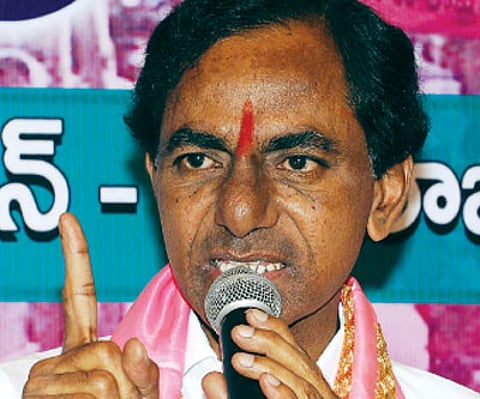
The return of the Congress to power in 2009, the demise of YSR and the consequent developments saw the Telangana agitation reach its peak. The man leading it, K Chandrasekhar Rao, is too intelligent not to see the benefit of having his own media empire. Since acquiring a licence for a new channel is time-consuming, he bought the lease rights of Raj TV for Andhra Pradesh, and now we have a KCR channel on air. A couple of months from now, his newspaper, too, is to hit the stands.
The battle lines have been drawn and politics is no longer confined to the Assembly or rallies or public meetings. You find the various shades of it in the media on a daily basis. Headlines are shrill and the reportage is openly partisan. “Ramoji is 420,” screamed a headline in Sakshi as it accused the owner of Eenadu of usurping land for his Film City project with help from Naidu. “YS Jagan Maya” said a banner headline in Eenadu accusing the late YSR of allotting limestone reserves to a company belonging to his son. “The stories in both newspapers are often exaggerated. The truth lies somewhere
between the two and we have to search for it,” says senior editor K Ramachandra Murthy, currently head of HMTV, one of the few Telugu channels perceived as independent.
In one sense, the wheel has turned a full circle. There were days when the Congress or other parties tried to keep media houses in good humour by obliging their proprietors. Andhra Jyothi founder KLN Prasad was once a member of the Rajya Sabha, and so also at one time were the owners of Deccan Chronicle and Vaartha.
But it was not that they completely served the interests of the party or those who led it. A veteran recalled how Andhra Jyothi once ran a big story on then Congress chief minister, Bhavanam Venkatram, securing an out-of-turn allotment of a landline telephone for his farmhouse near Nagarjunasagar. That is laughable compared with today’s scams running into hundreds of crores of rupees. But then, that is precisely the reason for the desire to own or control a media house, says social scientist N Venugopal. “The nexus between money, mafia and politics is so strong these days that it pays to be a media player to subserve other interests.”
The only editorial principle followed in these media houses is the diktat of the owner, which might change along with any changes in his political address. Thus, Sakshi , which began as a media empire biased towards the Congress has now turned anti-Congress after YSR’s death and Jagan’s exit from the party. “Ultimately, such entities will only serve the interests of the individual and not the party, whether it is Sakshi or Studio N or KCR’s channel. You don’t find Raj TV giving time to Telangana protagonists who are opposed to KCR. What does that tell you? That the channel will promote the interests of KCR and not necessarily of that of the Telangana movement,” argues Andhra Jyoth i’s managing director Radhakrishna.
This was brought out in relief by the recent flash point between Jagan and Congress. At a time when his relations with the party had already become strained, Jagan’s channel ran a story deriding the Congress and how its image has taken a beating under Sonia Gandhi. When Congressmen questioned how a channel belonging to a party MP could run such a story, the answer was that Sakshi is an independent media entity and had nothing to do with Jagan. Independent of Congress or Jagan? The channel chose not to run even a scroll, leave alone “Breaking News” when the AP High Court served notices on Jagan and 40 others on the allegation that the MP had amassed close to Rs 50,000 crore during his father’s rule. Studio N and Raj TV are not free from such criticism either.
What is the casualty in the entire process? “That this is an undesirable trend is obvious,” says Parakala Prabhakar, director of the Centre for Public Policy Studies. His dismay at the narrowing of the information spectrum available to the reader is obvious. “There is no problem with newspapers taking an ideological position, but what we are seeing in AP is politicians promoting their interests through direct or vicarious ownership of media establishments.”
Amid this gloom, is there anything positive to take home? Many say people are increasingly desperate for objective or independent media, be it print or visual. Any takers?
— vasu@expressbuzz.com
