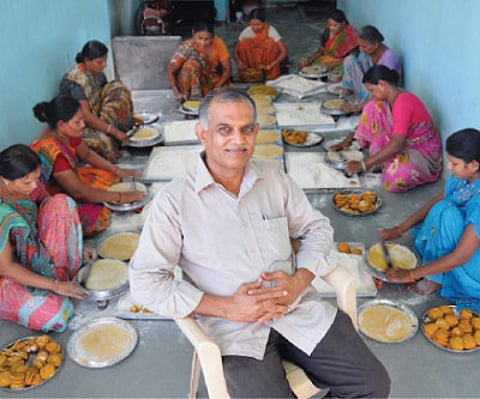

Gujarat is well-known for its farsaans, a term encompassing steamed snacks like khaman, dhokla, khandvi and patra, fried snacks like ganthia, fafda, small samosa and bhakarwadi, and breads like khakhra, thepla and dhebra. Not surprisingly, any visitor to Ahmedabad will find a large number of snack shops serving or selling farsaans in the city. The shop that comes as a surprise is Induben Khakrawala. This simple and sparely furnished shop is tucked away in a small lane, with its only nearby landmark being the Mahatma Gandhi International School, yet it is always crowded with patrons who line up to buy its khakhras and other farsaans. What is the success story behind this shop that is competing effectively with those at bustling junctions like the Manek Chowk Square, Stadium Circle and Nehrunagar Crossroads?
Explains Hiren Jhaveri, “My mother, Induben, started making khakhras for a living in 1970 when my father was unable to work because of his health problems. Her culinary skills became known in the Ratanpol area where we lived, near the textile, bullion and jewellery markets of the old walled city, and she earned enough to move to Mithakali in Ahmedabad’s upmarket residential district of Navrangpura during the 1970s. Since then, the sale of her khakhras began to increase and by the time she passed away in 1981, it was a flourishing business.” Hiren’s wife, Smitaben, continued the tradition of making khakhras and other farsaans from home till 1990, when the couple decided to invest in a shop near their house. “I gave up my job in a textile mill to start this shop in 1991. The move paid off and though there are other shops that call themselves by the same name, it has not deterred our patrons from coming to this lane to buy our products,” Hiren smiles.
Khakhras and other farsaans are an integral part of the Gujarati lifestyle. Not only are farsaans popular snack foods and teatime items, they are also a part of the travel culture of the state. Gujaratis have, for years, been great travellers, accounting for a substantial share of the leisure holiday market of India, going overseas for holidays or business, and settling in large numbers in the UK, the US and the African countries. However, Gujarati Hindus and Jains face problems when it comes to vegetarian food in many countries.
This is the reason why many snack items that travel well and can be kept for long spells are very popular. Khakras made from wheat or bajra millet can stay for a month in warm Indian conditions and more than six months if refrigerated or carried to cold regions like Himalayan hill stations, Europe, Canada, etc; thick rotis called bhakris stay for 25 days while whole wheat or bajra millet theplas and dhebras can be kept for three or four days, ideal for long train and road journeys. Bhakarwadis, lilva kachori, sakarpara and other fried or roasted snacks that can be kept for weeks are also sought after among travellers from Gujarat. Hiren says: “Our family has kept innovating and adding new kinds of khakhras, and now we have 25-30 different kinds available at any given time—oil-free diet khakhra, salt-free khakhra for those with hypertension or renal problems, cumin khakhra, fenugreek khakhra, khakhras made with chaat masalas, even dosa khakra, which is like a crisp dosa pancake. We also have 70-80 other snack items like farsaans and namkeens. To make the khakhras, we employ 90 women on a full-time basis.” However, it has not been easy to find women who want to work for them or make khakhras at home to supply to the shop, because of increasing opportunities in other sectors, and this limits their business. “We have tried using machines but handmade khakhras that are still extremely popular. My sons, Nishit and Ankit, are working on finding a solution to this problem.”
Hiren is proud to talk about the popular TV serial, Krishnaben Khakhrawala, the story of a woman who makes khakhra at home and becomes an icon. “While this is not about my mother’s life it does take inspiration from the success story of Induben Khakhrawala and other women entrepreneurs of Gujarat,” Hiren enthuses.