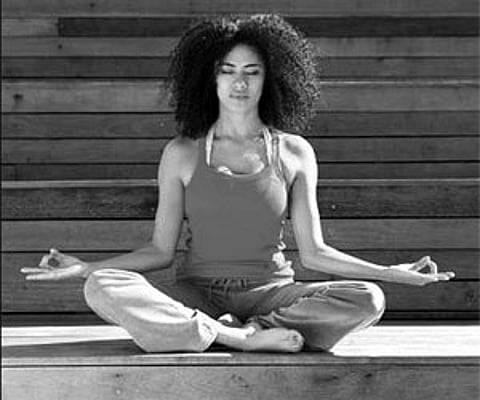

“Dhyana or meditation is the royal path towards realising who you are. All other actions that we may perform, rituals and prayers that we undertake, is to make the disturbed mind sit quietly where you are, and help it to meditate and turn within.” That is the point Sri Krishna makes, in the sixth chapter of the Bhagavad Gita, called the Dhyana Yoga or yoga of meditation. Yoga is the process by which the individual consciousness is connected with the supreme or cosmic consciousness.
This can be done through work or physical action, or in the mind through the emotions of divine love or Bhakti, the process of contemplation, and later on, through meditation.
This chapter continues from the previous one expounding the terms of a Sanyasi and a Yogi as one, who performs the actions prescribed without attachment to the results of the action. A person who does no action or rituals, cannot be clubbed in the same category. The verse means that the human being needs to be active and busy in creative pursuits until all attachments cease to be.
“Only the person who has renounced the faculty of thinking is in Yoga, and not the one who is filled with thoughts, making plans and schemes, using the faculty of the mind. Until that stage is reached, the scheme such people need to follow, is Karma Yoga or the yoga of action, without attachment to the results.” One who wishes to climb high on the path of yoga should be on the path of action. But once having reached that state of mind, a cessation of all thoughts, which are precursors to action is the way to be.
One who is not swayed by the sense organs of action and perceptions is not bound by the actions. A renunciate who has given up all thoughts and plans, is said to have achieved a yogic state of mind.
Next comes one of the most beautiful verses of the Gita. It is the one that is oft quoted by new age self-help therapists: “Uddharedhathmanathmanam Nathmanam Avasadhayeth| Athmaivahyathmano Bandhuhu Athmaivaripurathmanaha” (Raise yourself, by yourself alone. Lower not your self at any point of time). The self is your best friend if you deem it so.
It can be your worst enemy too.
The reference here is to the mind which in its best capacity can be your best friend and at its worst, it can be equal to the most dangerous enemy too.
The only way to have control over your self is with the help of your mind. If there are parts of you that vacillate and are torn between the senses, then the mind takes the position of an enemy. No friend or foe is external to you. They are existing in your own mind.
swahilya.soulmate@gmail.com
