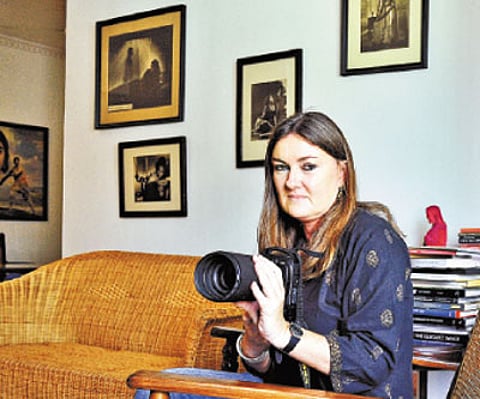

I come from a family who are very passionate about art and travelling,” says photographer Clare Arni. “I was only six when my father joined Madurai Garments, and we shifted to India. Most of my schooling was also done here. Thanks to my father’s career, we got to travel a lot and obviously there were lots of pictures taken in those trips,” continues the UK-born artist now based in Bangalore.
Her career in photography probably began with the family album. But she has travelled a long way. Recently, she exhibited her take on the disappearing professions of India. “The project is ongoing. It started from Bangalore and spread to Mumbai, Kolkata, Delhi and other Indian cities,” she says, expressing hope that one day, she’ll be able to translate her research and documentation in the form of a book.
For Arni, the project almost had a domino effect, what with one thing leading to another. “It started as a small exercise to reflect into the new urbanised changes in our city,” she says. Like a treasure hunt, she spent months researching her subjects. Then, as she ventured to various parts of the country on the heels of one fast-disappearing profession, she would stumble upon more. Over the years, she ended up visiting many cities, collecting a wealth of information on the way. “Every visit was an experience — from the noisy and loud Chickpet in Bangalore, to the last elephant bred and brought up within city limits in Rajasthan. It is hard to compare any of my trips. What I also found during my sojourns, was that almost 99 per cent of descendants of families, who moved out of traditional professions, also shifted base from their earlier settlements in search of newer pastures,” she adds, with the excitement of an archaeologist. While most photographers have one particular subject that they are passionate about, Clare defies the notion. She says she is fortunate that photography gives her the choice to do something different. “I have done many sorts of projects. One of my first was fashion and architecture,” she reveals. Back then, Arni did a lot of work for her late husband, an architect. But while architecture became her comfort zone, Clare did not shy away from other opportunities. “I have done pictures for books, travel, interiors and much more. I enjoy all kinds of photography,” she quips.
“My job has taken me to many places. One of my most memorable trips was the one to Hampi, where I met a lady who had been living in one of the caves there for 25 years. She is single, and lives without a lock and key in this day and time,” she says. Clare has been visiting her on and off for the last 10 years, documenting her life. “The change in her is so obvious, from when she was camera shy, to now, when she confidently asks to be clicked,” she says.
According to Arni, her professional engagement with photography gained momentum only recently. Until a few years ago, she hardly gave it a second thought. Could it be because of the digital revolution? “Well, digital photography has definitely helped a lot. Though, in the initial rush, I used to take many pictures and then select the best. Later on, I realised that this way, I was diluting the principle of photography. I’m much more relaxed and comfortable with the digital medium now,” she clarifies.
Classicist to the core, she says that she does not like editing her photographs much. “Every digital print has to be worked on. While editing, I try to bring the end result as close to what I saw in my frame. I do not like to edit for the heck of enhancing a particular object in the frame, or some unnatural effect,” she asserts.
