
In today’s world, the decision to go green is more than a path choosen to save the earth, it is an alternate lifestyle which is growing into a fashion statement. Alternate lifestyles have given prominence to many items which were overlooked earlier. Bamboo is one of them. Once the poor man’s timber, it is today the stuff of high fashion. Gone are those days when it was used just for fences, fishing rods, flutes, boatmen’s oars and the usual handicrafts.
Today bamboo is replacing teak and is being knocked onto floors and paired with fibre-glass on rooftops. And it’s also making its way into plush living rooms and dens, lending an earthy air to rich interiors.
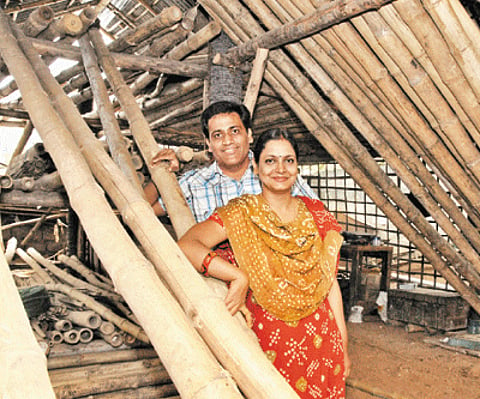
With a mission to generate green livelihoods, Hyderabad-based entrepreneurs Prashant Lingam and Aruna Kappagantula established Bamboo House India in 2008, a social enterprise that promotes the use of bamboo. Since then they have been going across the country and working very closely with the tribal communities and artisans across rural India from Tirupati to Tripura. “The search for a piece of furniture, introduced us to the benefits of the plant and made us realise the skills of people in the tribal areas who work with it,” says Prashant.
The couple scoured the Internet for more information on bamboo cultivation and furniture and were led to Prof M P Ranjan, head of the Centre of Bamboo Initiatives at the National Institute of Design, Ahmedabad. He introduced them to the world of bamboo furniture and a tribal community in the village of Katlamara, Tripura.
“The community in Katlamara whose livelihood was dependent on bamboo had no work due to multiple problems plaguing the Indian bamboo sector. Most of the community members had taken up different professions,” Prashant says. The aim of their enterprise is not only to create a space for bamboo in the Indian furniture market, but also to generate employment.
The Indian Forest Act 1927, classifies bamboo as a tree, not grass. The ruling means that it cannot be harvested and then transported elsewhere. It says that bamboo belongs to the tribals of the area, and only they can harvest it.
“We had to develop a business model within the constraints of the Forest Act apart from the fact that raw material was only available in forest areas which were highly Naxal-infested. Moreover all these locations are disconnected from rail, road and telecom network. Coupled with linguistic and cultural barrier, it seemed like the world’s most difficult raw material to work with,” says Prashant.
Bamboo House India’s products include sofa sets, (Rs 12,000 onwards) cots, (`3,000 onwards) various kinds of chairs (Rs 1,500 onwards) and little knick knacks (`60 onwards). Each product is priced according to the category and how labour intensive it is.
The couple has also spent decades researching on a particular species of bamboo—the Bambusa affinis—that grows in Western Tripura. Katlamara may be in the back of beyond (40 km from Tripura’s capital Agartala), but here a specific species of bamboo is giving the local rural community much to do. A little push can transform bamboo into a money-spinner, promises Prashant.
Working with IIT (Delhi), Bamboo House India has come up with a bamboo housing structure that can manage a load of approximately one ton on the roof. The pillars are also made of bamboo. In Hyderabad, an entire showroom has been built using primarily natural building materials like thatch, bamboo, palm leaves, cowdung and mud. This is a great way to showcase the practicability and beauty of natural building materials in construction.
So it’s now possible to convert your living room or bedroom into a stylish tropical paradise with bamboo furniture and accessories. Of course we are talking about sleek designed furniture, not dowdy garden furniture. There’s a striking beauty of colour and form that comes with doses of tranquility.
Bamboo House India, has value-added products displayed at their showroom, from flooring, mat board (plain & corrugated), bamboo tissue culture plants (saplings), bamboo charcoal, bamboo briquettes, bamboo veneer, bamboo shoots, bamboo furniture, bamboo handicrafts to engineered structures and even eco-friendly housing.
At their workshop in Uppal, Hyderabad trained artisans create window frames, three-seater sofas and tables among other articles. The Chinese exploits in bamboo work is a lesson for the rest of the world on how this industry is an important way of boosting rural income.
Prashant and Aruna’s firm has come a long way from its inception. The Andhra Pradesh Technology and Development Centre, The National Mission on Bamboo Application, and The Indian Institute of Technology Delhi are just some of its partner organisations. The government of India has also given its full support.
Once the products are made, Bamboo House India markets them. The wages are negotiated in consultation with the artisan. The artisans’ wages are not affected by how their products are doing in the market. They receive payments for the product even before they arrive at the warehouse. The couple’s motto is straight and simple—work towards achieving a “green livelihood”. Bamboo could be their ticket.
