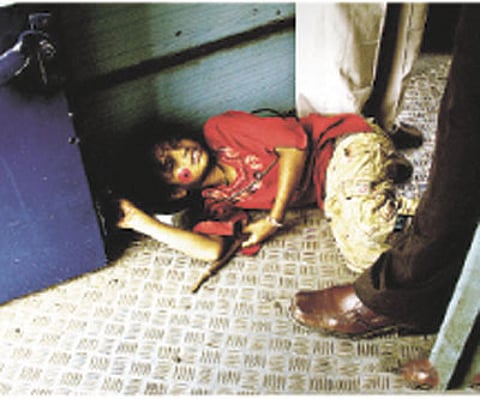

Some choose the bright and shiny sides of life, Pranab Aich found life’s meaning in filth and garbage. One of his major works, titled ‘Nobody Comes Here’, is a documentary on Delhi’s unhealthy heart. The slums, resettlement colonies and jhuggi jhopri clusters where about 53 per cent of Delhi’s 80 lakh population lives, found focus in his film. “With piles of garbage and refuge-littered pavements and muddy water from taps or hand pumps, people are living in one of the world’s filthiest cities, Delhi,” he says.
It was the coveted Sony World Photography Award for his photographic work on environment changes in Odisha in 2009 that threw the spotlight on him. He clicked destroyed bird nests and a century-old banyan tree that was axed by authorities to make way for an industry in Kalinga Nagar to highlight the issue of deforestation due to industrialisation in Jajpur district. Three years later, an extension of this award-winning work, his short documentary film ‘Once My Village’ on the fight of tribals to protect their lands in Kalinga Nagar, was recently screened at the India International Centre and Jawaharlal Nehru University in Delhi.
Following appreciation from various quarters, it went on to be broadcasted by Doordarshan for ‘Earth Issues’ series.
“‘Once My Village’ is a 20-minute film on industrialisation in Kalinga Nagar based on the tribals’ struggle against industrialisation, Tata to be particular. I was born in a small riverside village of Khanduala near Kalinga Nagar which is why the issue is so close to me,” says Aich, who studied photography and visual communication at AJK Mass Communication Research Centre, Jamia Millia Islamia in New Delhi. The film portrays the sorry plight of tribals and local farmers after they lost their lands.
Like ‘Once My Village’, Aich has been using his craft for spreading awareness on important social issues. He says he is more interested in focusing on realities, discovering the unknown in them as a documentary filmmaker, photographer, than creating fictional landscapes, characters. Aich has also made another short film for the Public Health Foundation of India on the struggle of allied health professionals in India.
For a 25-year-old who has filmed a dozen documentaries that poignantly portray the pain of people, he comes across as a cheerful young man.
Documentaries suit his “artistic sensibility, personality and small town upbringing” and “actually contribute, enhance and enrich the knowledge of the audience.” It is hard work for the filmmaker and demands a lot of audience attention, he asserts.
Aich is at present working on Posco-Kalinga Nagar, another pro-environment documentary on nature and lives affected by industrialisation in Odisha. His other project is a photo story and documentary on dying story-telling traditions in Odisha like ‘Pala’, ‘Daskathia’, ‘Ghoda Nacha’ and Shadow Theatre.
Most of his documentaries, photo stories have already become campaign materials, and screened at various forums. Being associated with various voluntary organisations since his college days, he has also made films stories for NGOs, private and public bodies, besides shooting for coffee table books like Qutub Festival 2011, Awakenings at Bodh Gaya and Andhayug.
Apart from art and activism, Aich has also been organising documentary film and photography workshops for children of Katha Schools, Manzil, Heritage International School and Adobe Youth Voices.
