
A group of young men stand in a line near paddy fields, their faces covered with red and black masks. They are portraying the ills of superstitions through the play ‘Bhoy’ (fear).
Tucked into the countryside 150 km from Kolkata is Tepantar, a theatre village at Satkahunia in Burdwan district. Set up by 35 year-old theatre personality Kallol Bhattacharyya in 1999, Tepantar provides an alternate lifestyle to the rural folk bitten by the acting bug. Tepantar is a congregation of theatre practitioners, most of whom live in the establishment spread across four acres of land. With concrete cottages and vegetable gardens dotted with thatched mud huts, it’s an idyllic locale set almost in a time warp.
There are 15 whole-time members who inhabit the village, propounding the aesthetics of theatre to willing participants.
“I have noticed that there is a lot of talent in rural Bengal; people who are genuinely passionate about it but have no recourse. This rural theatre centre is a way to inform, train and enlighten them about theatre and give them a platform to perform as well,” says Bhattacharyya who lives in Tepantar with his wife and four-year-old daughter.
Eminent theatre personalities from Kolkata such as Rudraprasad Sengupta, Usha Ganguly, Ratan Thiyam and Bibhash Chakraborty have helped train the acting enthusiasts. They have also worked with international groups such as Flying Fish Theatre Company (Berlin), Russian Academy for Theatre Arts (Moscow) and Dhaka Theatre in Bangladesh. It’s a self-sufficient theatre village with members specialising in music, acting, dance, martial arts, sound design and even prop-making. “We have trained people from neighbouring districts and hope to take this experiment to different parts of the state. We also mainly work with people from the Scheduled Tribes and Scheduled Castes and have been taking up issues relevant to them such as land acquisition, importance of health and education, ills of superstitions and so on,” says Bhattacharyya.
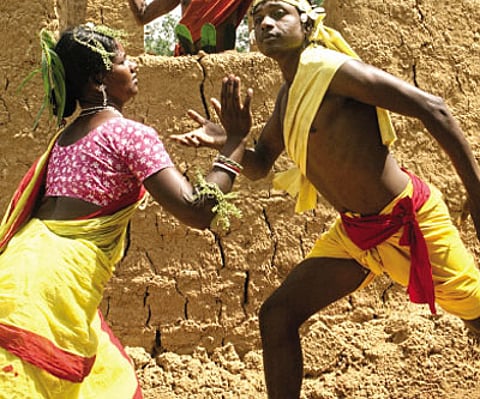
The plays enacted in Tepantar draw on the natural geography. “We use every aspect of the village to portray our plays. We use the open spaces; the pond, even the trees,” said Tanushri who has lived in Tepantar for the last five years. The members derive an intrinsic part of their livelihood through poultry farming, fishing, vegetable gardens and mango and guava orchards. Money is a persistent problem. “It’s difficult to make ends meet at times but we never lose heart. We love this way of life,” says 30-year-old Robin Bauri, a resident of Tepantar.
