
It was the year matters came full circle for the dictatorships of the Arab world and for the runaway financial wrongdoings of the West. And they got Osama, ten years after 9/11 had changed the course of world history.
From Arab Spring to Islamist Winter
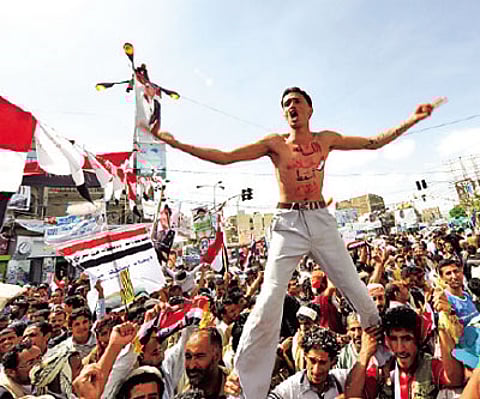
After decades of tyranny, the Arab world hit back through 2011. The swathe of protests across the Arab world came to be known as the Arab Spring. Caught up in the great revolutionary roil were Tunisia, Egypt, Libya, Bahrain, Syria, and Yemen. The disturbances had a ripple effect in Algeria, Iraq, Jordan, Kuwait, Morocco, and Oman. The uprisings were mainly non-violent, and featured demonstrations, marches, acts of civil disobedience, as well as labour strikes.
Tunisia was the catalyst, Egypt the epicentre; and as 2011 came to an end, Syria had become the tinderbox that could set the Middle East aflame. There were sideshows like Bahrain, where a Shia uprising was swiftly crushed by the ruling Sunni dispensation with Saudi help. Then there was the see-saw revolution of Yemen, where President Ali Abdullah Saleh left the country after being injured in a grenade attack, only to return later and be forced into signing a power-transfer agreement.
Col. Muammar Gaddafi, the leader of Libya, and the man who in 2009 called for Kashmir to be made a Baathist state between India and Pakistan, was brutally killed by rebels as the denouement of unrest in Libya that saw a UN-mandated intervention. R2P, or responsibility to protect, was the buzzword.
As 2011 wound to a close, the resumption of political processes in the Arab Spring countries began to reveal an Islamist assertion. October saw the first post-Spring elections in Tunisia, where the moderately Islamist Al Nahda emerged as the largest single political entity in the constituent assembly. In Libya, hardline Islamists were positioned to lead the country into its post-Gaddafi era. In post-Mubarak Egypt, the first round of elections to the lower house of Parliament saw the Muslim Brotherhood’s moderately Islamist Freedom and Justice Party and the harder right Al Nour begin their march to victory. Syria remained Alight; time was running out for Bashar al-Assad.
A maid-in-America fall
Sex is a great leveller. Former International Monetary Fund Managing Director Dominique Strauss-Kahn was getting by quite fine: the French economist was tipped to get the Socialist nomination for the presidential election in 2012. That’s when things went down the drain. Nafissatou Diallo, a 32-year-old maid at the New York Sofitel, accused Strauss-Kahn on May 14 of sexually assaulting her after she entered his suite. The case exploded into the media, and unsavoury details like a semen sample from the maid’s shirt providing a DNA match to Strauss-Kahn. Painted as a lecherous old man and practically judged by the media, Strauss-Kahn insisted he was not guilty. The man who was going to unseat Sarkozy found himself under house arrest in New York till July. In August, prosecutors dropped charges against Strauss-Kahn, saying they were unconvinced of his culpability beyond reasonable doubt. Strauss-Kahn later admitted to a “moral fault”. But the damage had been done. Strauss-Kahn’s career was in ruins.
Death of a newspaper
It was called “Screws of the World” for its sexually charged scoops and celebrity-based news. But it went too far. Allegations of phone hacking had swirled around the Rupert Murdoch-owned tabloid for years, but a revelation in July that a private investigator working for the NoTW had hackled into and deleted the voicemails of missing teenager Milly Dowler who was later found murdered were the last straw that broke this red-topped back. Senior NoTW staffers were arrested. A House Committee summoned Murdoch and his son James. The senior Murdoch, who said NoTW was “just 1 per cent” of his News Corporation, was the target of a pie attack at the hearing. The attack failed as Murdoch’s wife Wendi slapped the attacker hard. But NoTW was dead, and Murdoch had egg, if not pie, on his face.
Bin there, done Awlaki
Osama bin Laden, the man for whose head the US invaded Afganistan immediately after 9/11, was killed in Pakistan on May 2, by a United States special forces military unit. The operation, code-named Operation Neptune Spear, was ordered by US President Barack Obama and carried out by Navy SEALs. Osama was secretly buried at sea by US forces. The fact that Osama was in hiding practically at the door of Pakistan’s military academy, and that Islamabad wasn’t told of the operation, caused a great deal of bad blood
between the two so-called allies.
In September, a US drone ‘took out’ Anwar al-Awlaki, the “bin Laden of the Internet” in Yemen. Awlaki’s 16-year-old son was killed similarly soon after.
Nailed by a journalist
Going Rogue may have sold over two million copies, but in the year before her widely expected bid for the Republican vice-presidential nomination, it was a book that practically sealed the fate of the former Alaska governor. Celebrated writer Joe McGinniss’s The Rogue: Searching for the Real Sarah Palin hit the shelves in September 2011. Replete with allegations of premarital sex and cocaine use, the book was heavy on innuendo, hinting darkly that Trig Palin was not Sarah’s biological son. Palin threatened to sue, but her career went into meltdown. At the end of 2011, she was, however, hinting at reviving her bid.
Licence to loot in London
Liberal immigration policies, the dole and cops afraid of racism charges combined into one big riot in the UK. The fatal shooting of one Mark Duggan by police officers sparked four days of rioting, arson and looting. British Prime Minister David Cameron cut short a foreign tour, police leave was cancelled, Parliament was recalled. Five persons died, and over 3,000 were arrested. There were tales of heroism, like Sikhs guarding their neighbourhoods with kirpans drawn. A great debate ensued; many blamed the Blair legacy of appeasement and political correctness.
The fall of Italy’s darkened knight
Three-time Prime Minister Silvio Berlusconi’s bunga-bunga run was too good to last. Italy’s third richest man, a media magnate, did not relinquish interest in his businesses even after promising to. Pounded by allegations throughout his leadership, including some very bizarre sex scandals, Berlusconi’s heart went on and on, till a crisis not of his making finally felled him in November. After losing his majority in Parliament amid growing fiscal problems related to the burgeoning European debt crisis, Berlusconi officially resigned as Prime Minister on November 16, 2011. A former Goldman Sachs employee, Mario Monti, stepped into Berlusconi’s luxury-size shoes.
No rest for the Wiki
The world’s No. 1 leaker, WikiLeaks founder Julian Assange, seemed sunk when Sweden sought his extradition from Britain on allegations of sexual assault by two women. 2011 saw Assange fight the extradition: it was upheld in February, and the London High Court dismissed his appeal in November. Assange was, however, allowed to appeal in the Supreme Court against the extradition request, which some fear is only the first step in his removal to the United States, where his whistleblowing has made him powerful enemies across the patriotic spectrum. As the year closed, evidence linking Assange to Bradley Manning, a US soldier arrested on suspicion for passing on restricted material to Assange’s website, had emerged. The pieces are falling into place against Assange. 2012 will be a make-or-break year.