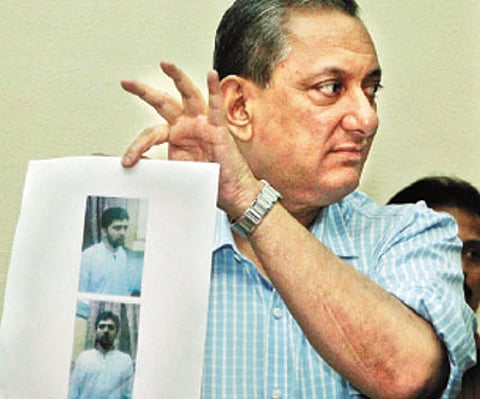

When Mumbai police arrested Naquee Ahmed in connection with the 13/7 blasts, a quiet cheer went up in Maharashtra Anti-Terrorist Squad (ATS) headquarters. The arrest is part of the city’s ongoing legacy of violent death: in the last two decades 535 people have died and 2,693 have been injured in terror attacks, primarily bomb blasts, in Mumbai. The 26/11 carnage of 2008 alone claimed 166 lives and left 300 people injured. According to former Union Home Secretary Ram Pradhan, appointed to head the two-member panel set up by Maharashtra to probe the 26/11 attacks, Mumbai will always be a target. Why does Mumbai continue to be wounded?
The answers may lie in Mumbai’s economic power. The commercial capital of the third biggest economy in the world is an unique place. Its population of 12.5 million people crammed in 437.37 sq km with a density of 20,482 persons in each is not just a tempting hunting ground for terrorists, but also a safe haven where sanctuary, political patronage, arms smuggling and hawala are part of the subterranean portrait of terror. A floating population of over two million also makes it difficult for the police to trace the movements of terrorists.
“Mumbai would be a target of terrorist attacks even if it had less population. Being the nation’s commercial capital, terrorist elements in Pakistan would want the foreign direct investment coming into India to be discouraged and thereby affecting our economy. By targeting Mumbai, terrorists are able to send a message to the world that India is no longer safe a place for investment and tourism,” says former director general of police D Sivanandan.
Every day 7.5 million people, a number equivalent to the population of international cities such as Beijing (7.4 million) and Bangkok (7.5 million), travel on the Mumbai train network. Incidentally, Nadeem Akhtar Shaikh, one of the three accused arrested by the ATS in the 13/7 case, brought the explosives to Mumbai by train, assembling his bombs in an apartment rented at Byculla.
That it is easier to blend in the Mumbai cosmopolitan crowd and go undetected can be judged from the fact that the 13/7 bomb planters had hired a place in Byculla that was just 15 minutes from the ATS head office. It would be convenient to blame the police for its ignorance of what happens in the neighbourhood. However, it is easier said than done, particularly in Mumbai, where there is only one policeman for every 311 persons.
The 1992-93 communal riots in Mumbai increased the ghettoisation of a pluralistic city, and the image of the largely understaffed and under-equipped police being divided on communal, linguistic and caste lines further eroded its credibility. “We do not go to the roots of the problem, the police by and large are not impartial and the sentiments of injustice or misunderstandings created due to this lead to the formation of sleeper cells,” says former IPS officer Sudhakar Suradkar, adding that “in case (the police) did not want the sleeper cells to be created, then their role needed to be fair and firm”. He rues that honest officials are sidelined and adds that political patronage and support to officials by politicians and rival political lobbies with vested interests exacerbated things.
Experts say, however, that the Mumbai Police could be faulted for not having turned the city’s large population into an advantage with community policing. None of the residents in the Habib building of Byculla suspected terrorists were living among them. “People in Mumbai spend their lifetimes without knowing who their neighbours are. It is the utter lack of security consciousness that provides anonymity to anti-social and anti-national elements,” says Sivanandan.
The nexus between politics and black money is well known, and terrorism continues to be a close cousin with political patronage. The 13/7 attacks were carried out by the Indian Mujahideen after a long pause, but Naquee’s arrest is being politicised cynically. In another version of Batla House where a brave Delhi police officer Mohan Chand Sharma lost his life — an encounter whose veracity was later questioned by political leaders — both the National Minorities Commissions and CPI(M)-affiliated Sahmat demanded a probe into Naquee’s arrest. The ATS feared their pitch may be queered in court by bringing the case public. The arrest also led Maharashtra Navnirman Sena leader Raj Thackeray to say that he wasn’t merely raising an immigrant bogey. “People make fuss over my statements but nobody pays any heed. Yesterday’s arrest in 13/7 bomb blast case revealing Bihar connection proves my point,” he said.
In the end, it is the Mumbai citizen who suffers. “The police should develop confidence in the citizens to report suspicious people and activities,” says a retired bureaucrat who held a key post during the 26/11 terror attacks, pointing out that in case people who saw the Pakistani terrorists land at Macchimar Nagar in South Mumbai had reported their suspicions to the police, the attacks could have been averted. Maharashtra Chief Secretary Johny Joseph also feels that post- 26/11 “security consciousness must be built into the people.”
Naquee, who hails from Bihar, owns a leather unit in Mumbai. He helped 13/7 mastermind Ahmed Siddi Bappa aka Yasin Bhatkal to rent the Byculla house where the two suspected bombers — Waqas and Tabrez — stayed. Terrorists take advantage of the parallel economy of black money that thrives through hawala, which offers illegal but safe international money transfers. Investigations in the 13/7 case reveals that money came in from Dubai. In July 2011, the Maharashtra sales tax department busted a Rs 6,500-crore hawala racket that had gone undetected since 2007; experts say this is just the tip of the iceberg.
The police are also exercising caution while dealing with suspects as in the past, custodial deaths have derailed the promising careers of many police officers. In the alleged custodial death of 2002 Ghatkopar bomb blast suspect Khwaja Yunus, policemen from two teams face suspension and prosecution. “Mumbai Police, which has a headcount of 48,000, should work as one team to tackle terror. Gathering of terrorist intelligence should not be just relegated to specialised units,” says Sivanandan. Apart from this, the co-ordination between Mumbai ATS and counter-terrorism units of other states gets bogged down in turf wars. When Naquee was arrested, the Delhi Police objected, saying he was just a conduit to Bhatkal.
The pressure on Rakesh Maria and his ATS team to bring closure to the attacks is immense, but in the long run this may also lead to hasty decisions.
- with Dhaval Kulkarni