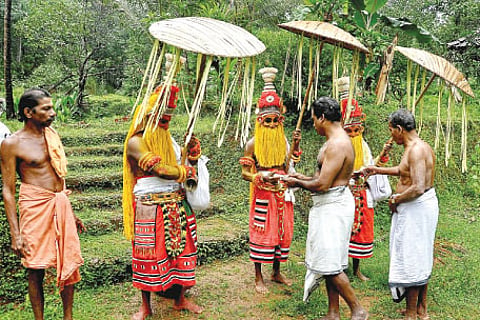

On the day before Onam, Lalu will line up, along with dozens of other strangely yet colourfully dressed men at the Nettur Shiva temple in Kozhikode, Kerala. He will offer a silent prayer in front of Lord Shiva, before embarking on a predetermined route with an empty sack in one hand and a bell in the other. Meet Onapottan, who for the next couple of days will be a sacred visitor and a reminder of a time long past for the people along his path.
Rural Malabar is filled with numerous unique folklore characters that are different from others found across the state. The Onapottan is Malabar’s version of a more recognisable character, Lord Mahabali who is instantly recognised across the state with his jovial demeanor, rotund belly, and curly moustache. But when he arrives in Malabar, he takes a different, more poignant appearance. For, while Lord Mahabali stops along the way and inquires about the welfare of his subjects, the Onapottan here is condemned to spend his sojourn in silence.
“The story of Onapottan is basically the story of Lord Mahabali, but with a twist,” says Lalu, who has been dressing up as the character since he was a child. He stays in Kakkattil, a rural hamlet in Kozhikode. “Here people believe that when Lord Vishnu granted Mahabali permission to visit his subjects, he put forward a condition that the king will not talk to any of his subjects during the visit. ‘Pottan’ in the local vernacular means ‘one who cannot speak’. We are also forbidden to speak when we are in the character of Onapottan as legend has it that if we do, we will lose the ability to speak in real life as well.”
The Onapottan can rightly be termed the more marketable Mahabali’s pauper cousin. With his shaggy beard made out of banana fibre and his worn-out sack, he looks more like a beggar rather than a king. Solitude is his only entourage during his journey and when he reaches a house, he stands in front and rings the bell in his hand incessantly until someone comes out and fills his sack with grain.
While the people run into the Onapottan on Onam and the day before, work starts much earlier for those who don the costume and their families. Most families have more than one person dressing up as the character, while others assist in making the costume. In Lalu’s case, both he and his grandfather Kelappan become the character while his uncle Rajesh makes the costumes. The grandfather and his grandson take sacred vows, ten days before Onam on the occasion of Atham, while Rajesh also starts work on the props on the same day.
The costume is carefully designed with each minor part having its own significance. “It is made up of numerous different parts, with different materials,” says Rajesh. “The beard is made of banana fibre, while the bangles and side-arm decorations are made of wood. All these props take days to make.”
And while the art form has remained unaffected by the commercialisation that has affected most Onam rituals, it seems a matter of time before the ritual, in its purest form, becomes extinct. “Lately, youth clubs in the area have been arranging Onapottan processions,” says Kelappan, who has been donning the costume for the past 50 years, going through the same sacred rituals every year. “They wear the costume one fine day, walk around with drums and trumpets and go from shop to shop collecting money. It might be an easy way to make money but they should realise that they are violating the sanctity of something that has been done in a particular way for centuries.”
