
Circus of old, as was traditionally staged across India, has moved past its sell by date. Realising the pitfall of mindlessly treading the old path, at least a handful of circus owners are getting out of their skin to merge various art forms like theatre with circus to try and arrive at a marketable product.
The Indian circus has been caught in the spotlight for the wrong reasons for a while now. First it was an outcry against cruelty against animals, leading to a ban on showcasing bears, monkeys, tigers, panthers and lions. Thereafter, the issue of cruelty against children came to the fore, resulting in a ban on child artists. The die was well and truly cast—the circus owners could either improvise or perish. We track two circus companies, based in Kerala and Maharashtra, that decided to take up the challenge.
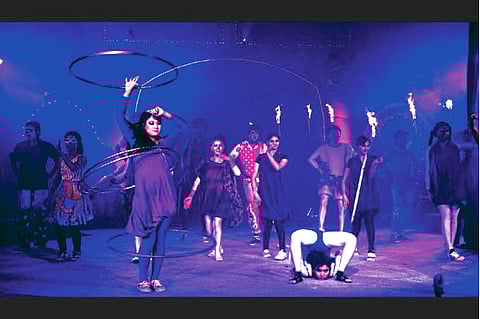
The next season will see Kannur-based Grand Circus introduce a new module, by blending acrobatics with theatre. They are working closely with some of the top names in theatre and the film industry. Towards this, Grand Circus has drawn its inspiration from the play, ‘Clowns and Clouds’ which was staged in collaboration with the National School of Drama (NSD).
Directed by NSD Assistant Professor Abhilash Pillai, it premiered in Kozhikode last year; later, it was staged in New Delhi in January. Circus artists and NSD students played stellar roles in the play set inside a circus tent. The Grand Circus is now planning a similar version with its own artists.
“The positive reception to ‘Clowns and Clouds’ was an eye opener and inspired us to start a new unit dedicated for staging regular shows of the new format,” says Sherith Othayoth, son of Chandran M, the owner of Grand Circus. “Almost all those who took part in the play are excited to be part of this venture. They will start working with our artists from October.” Othayoth and brother Shenil, both of whom were working in the software industry before deciding to come to the aid of their father’s business, are spearheading the improvisations.
The new version will be different from ‘Clowns and Clouds’, which was a contemporary art form with high artistic values. “We are planning a show with a commercial angle by incorporating theatre elements,” says Othayoth. Along with Abhilash Pillai, music director Paris V Chandran, lighting designer Sreekanth, choreographers Madhu Gopinath and Vakkam Sajeev of dance troupe ‘Samudhra’ and theatre person -turned-makeup artist N G Roshan are expected to join the project. “A major task will be to polish the acting and dancing skills of our artists,” says Othayoth.
Director Abhilash Pillai says his ‘Clowns and Clouds’ was an academic exercise as a teacher, but that inspired him to do more collaborative projects with circus, as a theatre person.
“Circus is essentially a contemporary urban art form,” he says. “But for some reason or the other, the growth of the Indian circus has become stagnant. It is stuck in the aesthetic vocabulary of the 1980s. Sadly, the majority of the circus owners are reluctant to take up fresh challenges. The Indian circus has to try out new things.”
Abhilash is modest about the commercial success of the new form: “It will take some time before we can come up with a product with mass appeal.”
TAKING CIRCUS TO THE THEATRE
“The circus needs to reinvent itself,” says theatre person and co-owner of Mumbai-based Junoon Theatre, Sanjana Kapoor. “There should be proper training facilities, accessible grounds, and medical insurance. There is a great deal to be done. Sadly, the Centre is not taking the lead in this, as did the French government when it set up colleges of circus arts. This gave an enormous fillip to the circus in France. It encouraged renowned theatre directors, dance choreographers and designers to work closely with circus performers. This enabled them to create a ‘New Circus’—a whole new genre of performance that is superb and performed not only in tents but also in regular theatres across the world,” she says.
Sanjana has already joined forces with Sujith Dileep, the owner of the Pune-based Rambo Circus, by getting circus staged in a conventional theatre. In June, Rambo Circus staged a show at Prithvi Theatre in Mumbai in collaboration with Junoon Theatre. It was a show comprising acts like the German wheel, pyramids, high-wheel cycle, fire acts and juggling.
The idea was to take the circus to a new audience. “At Rambo Circus we have air-conditioned and water-proof Italian tents. Despite this, the middle and upper middle classes, perhaps unaware of the new ambience, had chosen to stay away from circus in the past few years. But at the Prithvi Theatre show, some of the audience arrived in Mercedes Benzes. Evidently, we have managed to attract a new class. Now, I am planning a travelling-circus which performs in theatres,” says Dileep.
Interestingly, Rambo Circus had dropped its plans to introduce a contemporary style. Dileep says that his researchers found that the classic circus works well with the Indian audience. “We did a contemporary show with American and Indian artists in collaboration with MTV at our circus tent some time ago,” says Dileep. “The audience got bored mid-way. Children are our target audience and they will start yawning if we present a new form.”
Dileep believes that the circus has to be liberated from the old system of training and performance. “The acts have to look magical by incorporating state-of-the-art sound and lighting systems,” he says.