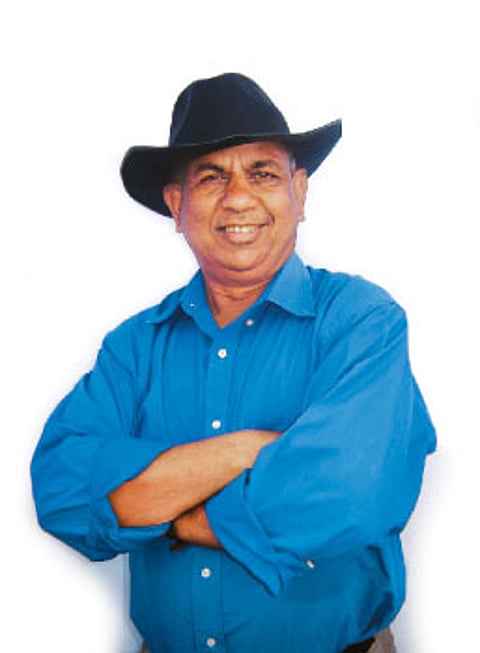

He digs history. Dropping out of school as a teen has not stopped Om Prakash Sharma from pursuing his love for artefacts and antiques. “Art is the supreme wealth of mankind, more valuable than any metal,” says 56-year-old Sharma aka Kukki, who is based in Rajasthan.
Sharma has discovered several rock paintings of the Mesolithic, Neolithic and Chalcolithic ages and artefacts such as black/red ware pottery, earthenware, terracotta pieces and shell bangles from the Lodhi, Mauryan and post-Gupta era in Bundi, Bhilwara and Kota districts of Rajasthan.
A history buff, Sharma calls himself a self-styled archaeologist. His quest for antiques dates back to 1978, but it was only in 1995 that he discovered several coins and rock paintings.
“I started hunting for old coins and metal toys inspired by a neighbour,” he says. He claims to have unearthed more than 75 sites of rock paintings around Bhilwara and Chittor districts in the last two decades. “After I put Bundi on the tourist map, a lot of scholars, students and foreigners have started visiting the region. I am famous now,” beams Sharma, a grocer by profession.
Sharma also uncovered a prehistoric rock painting that is 35km-long in Garadha. It depicts human and animal figures. “One such painting starts from Banki village and ends at Mandal dam (in Bhilwara) making it probably the world’s longest rock painting,” he says. According to him, rock paintings are usually found in the lower shelters on river banks and these discoveries indicate that the surface was in use for drawing and developing paintings from time to time. He also unearthed about 20 earthen dice in a region 34km from Bundi. The dice belong to the Kushan period of 1st to 3rd century AD.
Sharma says his work gives him peace even though it does not fetch him any money. “The happiness I derive from these discoveries strengthens me against jibes from my family who disapprove of it as this work is not financially rewarding,” he says. He has also made many more prominent discoveries such as that of Mauryan punch mark copper coins dating back to 185 BC, pieces of 25,000 year-old ostrich egg shells and the temple remains from the Gupta period.
“The whole region is rich in ancient artefacts and if the sand mounds are exhumed properly, hints of unbroken human habitat of at least 4,000 years can be found here,” Sharma says. At present, he is searching for ancient coins in Kumharia, Haryana.
Sharma says he submits all his finds to government museums and is conscious of the ethics of his work. “I walk several miles on mountainous terrains to discover the sites. Things do not happen just by digging,” he says. “I am a patriot and I respect what I do. I donate most of my discoveries to government museums and retain a few for exhibitions.” Sharma says he would never trade the heritage of India for personal gain.
Though his zeal and sincerity make up for the lack of a formal education, Sharma says at times he acutely feels the shortcomings of not having completed school. “There have been many instances when due to my inadequate knowledge of English, I found it difficult to guide archaeology students doing research. I realise that at times I am unable to express what I feel,” he says.
Sharma says he has read all available literature on archaeology to compare his work with that undertaken in other parts of the world. He feels a bit shortchanged. “While researchers aboard gain laurels instantly, I am yet to be acknowledged,” he says.
Though he has been recognised for his contributions by the government of Rajasthan and the Archaeological Survey of India, he hopes to get some financial assistance from the government so that he can continue his work. “I want to devote my lifetime to archaeology. If they provide me with facilities and give me due support, I can serve my nation better,” he signs off.